Skip to content

Tag: crime fiction

Noir in the Age of #MeToo

With the release of an annotated edition of The Big Sleep this month, author Megan Abbott reflects on noir and the work of Raymond Chandler:

What fascinates and compels me most about Chandler in this #MeToo moment are the ways his novels speak to our current climate. Because if you want to understand toxic white masculinity, you could learn a lot by looking at noir.

Loosely defined, noir describes the flood of dark, fatalistic books and films that emerged before, during, and especially after World War II. As scholars like Janey Place have pointed out, this was an era when many white American men felt embattled. Their livelihoods had been taken away—first by the Depression, then by the war, and then by the women who replaced them while they were off fighting. Into this climate noir flowered: Tales of white, straight men—the detective, the cop, the sap—who feel toppled from their rightful seat of power and who feel deeply threatened by women, so threatened that they render them all-powerful and blame them for all the bad things these straight white men do. Kill a guy, rob a bank—the femme fatale made me do it. These novels simmer with resentment over perceived encroachment and a desire to contain female power.

In an earlier essay for the LA Times, Abbott looks at why women are interested in true crime stories:

[In] the last few years, and especially in recent months as the Harvey Weinstein and associated scandals have dominated headlines, I’ve come to think of true crime books as performing much the same function as crime novels (also dominated by female readers): serving as the place women can go to read about the dark, messy stuff of their lives that they’re not supposed to talk about — domestic abuse, serial predation, sexual assault, troubled family lives, conflicted feelings about motherhood, the weight of trauma, partner violence and the myriad ways the justice system can fail, and silence, women.

While these weighty issues aren’t generally resolved in true crime… these books provide a common site to work through crises, to exorcise demons. I’ve come to believe that what draws women to true crime tales is an instinctual understanding that this is the world they live in.

And at Vulture Abbot talks to Ruth Franklin about her new novel, Give Me Your Hand:

The seductive female criminal, a.k.a. femme fatale, has always been a noir staple: Mary Astor in ‘The Maltese Falcon’, Ava Gardner in ‘The Killers’But Abbott argues that these characters aren’t psychologically authentic. They’re “a projection of male anxiety,” she says, vampy caricatures whose primary purpose is to use their irresistible charms to lure the detective-hero into a setup. As Abbott sees it, classic noir “always comes back to the idea of femininity as a kind of dark continent.” Male writers “really don’t want to look in there,” she says. They want to believe female violence “is always an aberration … What if those stories had been told from the femme fatale’s point of view? Think how different they would look.”

On a semi-related note, film critic David Thomson recently wrote a long piece for the London Review of Books on Alfred Hitchcock’s film noir Vertigo in light of the revelations about Harvey Weinstein. It’s interesting as a dissection of a classic movie, but it is not, ultimately, the take I wanted. Thomson’s claim that a medium that has historically been dominated by the male gaze is somehow essentially so, is surely something that only a male critic would say. Women need to be given the space to address these issues, and, frankly it is a female critic’s reassessment of Hitchcock that I want to read. 

Both the Abbott and Thompson pieces on noir reminded of Claire Dederer’s 2017 essay, ‘What Do We Do with the Art of Monstrous Men?‘, on Woody Allen and whether genius and monstrosity go hand in hand. It’s worth reading if you haven’t already. In the essay, Dederer talks briefly about Roman Polanski. I would love to read a contemporary reassessment of Chinatown. 1        

Comments closed
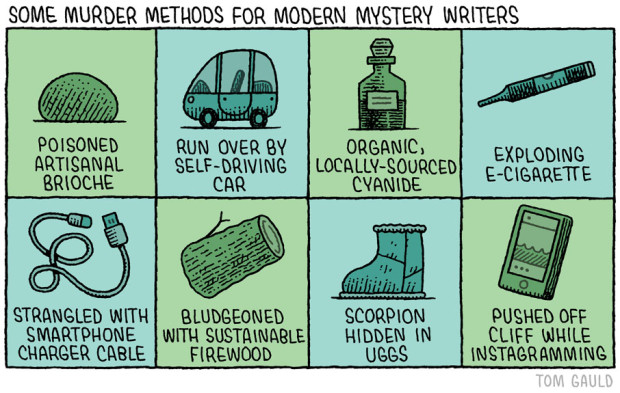
Some Murder Methods for Modern Mystery Writers

modern murder methods Tom Gauld

Tom Gauld for The Guardian.

Comments closed

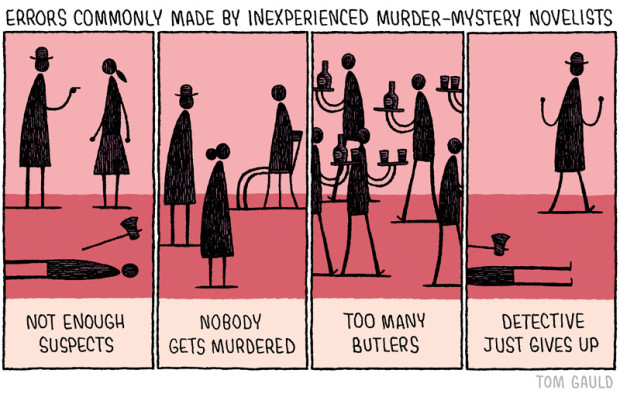
Errors Commonly Made by Inexperienced Murder-Mystery Novelists

errors-commonly-made

Tom Gauld.

Comments closed

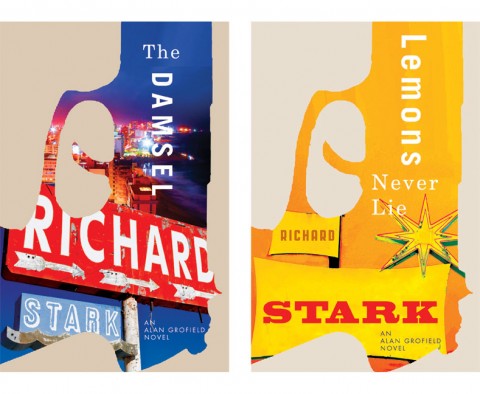
Stark’s Grofield Novels Designed by David Drummond

David Drummond designed the covers for the University of Chicago Press recent reissues of Richard Stark’s ‘Parker’ novels. Now David has designed great new covers for the reissues of Stark’s ‘Alan Grofield’ novels as well – The Dame, The Damsel, Blackbird and Lemons Never Lie.

I actually really like these earlier, slightly looser, alternatives as well:

David has written more about the design process on his blog, and you can read my interview with him here.

Comments closed

Something for the Weekend

Not My Type — Paul Shaw really doesn’t like Just My Type by Simon Garfield:

This is the second time I have tried to write a review of Just My Type. It is a frustrating book—warm and friendly on the surface but obnoxious underneath. The first time, I methodically tore it to pieces in my blue-pencil style, pointing out its deficiencies in niggling detail. When I was done, I felt satisfied but also uncomfortable. Did Simon Garfield really deserve such a bashing? After all, the book is full of fascinating stories and odd trivia about type, and the author has a charming, breezy style that makes each bit of typographic arcana easy to swallow. Is it really that bad? Yes, it is.

Ouch.

“I just call them books” — Robert Birnbaum interviews author John Banville for The Morning News:

I don’t like this ghettoization of books. When I started publishing fiction it is was good, not so good, bad, you know. Now there is a ghetto for crime fiction. I would like to have books listed alphabetically—no distinction.

And finally…

Control+A / Control+ C / Control+V  — A provocative excerpt from Uncreative Writing: Managing Language in the Digital Age by Kenneth Goldsmith in the Chronicle of Higher Education:

There’s been an explosion of writers employing strategies of copying and appropriation over the past few years, with the computer encouraging writers to mimic its workings. When cutting and pasting are integral to the writing process, it would be mad to imagine that writers wouldn’t exploit these functions in extreme ways that weren’t intended by their creators… The previous forms of borrowing in literature, collage, and pastiche—taking a word from here, a sentence from there—were developed based on the amount of labor involved. Having to manually retype or hand-copy an entire book on a typewriter is one thing; cutting and pasting an entire book with three keystrokes—select all / copy / paste—is another.

Comments closed

Midweek Miscellany


Nick Hornby on book cover design at We Made This:

[I]ncreasingly the big retailers, Amazon and the supermarkets, have a say in how a book looks before publication, if the book in question has serious commercial prospects. I don’t really know what to say about that, apart from observing that the people who sell books in supermarkets have different tastes from my own. I am at liberty to object to the covers on my novels, if I really hate them, but my publishers would then, I think, be entitled to ask me to take a lower advance, if I care about aesthetics so much. The days of the iconic jacket illustration, the image that forever becomes associated with a much-loved novel, are nearly gone. The stakes are too high now.

(pictured above, the cover for the Penguin Ink edition of High Fidelity by a tattooist Russ Abbott)

George Pelecanos chooses a music playlist for his new book, The Cut, at Largehearted Boy.

Brian Doherty reviews three books on comics history for the LA Review of Books.

And finally…

Longing for the Little Bookstore — Ann Patchett, author of State of Wonder, on bugs, book tours and bookstores, for the New York Times:

With the demise of the Borders chain and the shaky footing of Barnes and Noble, one might be tempted to write off the whole business. But as one who spent her summer on a book tour, I would like to offer this firsthand report from the front lines: Americans are still reading books. Night after night after night I showed up in a different bookstore and people were there with their hardbacks. Sure, I signed a couple of iPad covers, Kindle covers. I’ve got no problem with that. But just because some people like their e-readers doesn’t mean we should sweep all the remaining paperbacks in a pile and strike a match. Maybe bookstores are no longer 30,000 square feet, but they are selling books.

1 Comment

Midweek Miscellany

Superhybridity — Tom Payne reviews Retromania by Simon Reynolds for The New York Times:

It’s not so much the selling-­out that saddens Reynolds. Rather, it’s our ready acceptance that the past is our only future: that after postmodernism, with its weary, overinformed view that there is nothing new to say, comes something called “superhybridity.” Superhybridity, a concept borrowed from an art magazine, exists because the Internet can bring whatever we want into our hard drives, so that we can sample it or mash it up: no culture, from any time or place, can be remote from us.

Anger — In light of the recent riots in Britain, Chris Arnot looks at the legacy of Alan Sillitoe (Saturday Night and Sunday Morning) with the author’s son David:

Something about the sudden switch from menace to charm, coupled with that jack-the-lad swagger, briefly brings to mind Arthur Seaton, the antihero of Saturday Night and Sunday Morning… Arthur had already shrugged off the collectivist values of the postwar years. He was “trying to screw the world … because it’s trying to screw me.”

“Currently my head is empty. I am on holiday.” — Wim Crouwel at Designers & Books.

The Weird Outsider — A long profile of Jared Lanier, author of You Are Not A Gadget, in the New Yorker:

Like an innovative painter who alternately courts and scorns the establishment, Lanier often seems torn between embracing and repudiating his newly influential status. As we drove, he mentioned, with some pride, that he had been “banned” from the TED conferences last year, after publishing an essay about the narcissistic nature of the event in a London magazine. (A spokesperson for TED said that Lanier is welcome at the conferences.) He purported to be similarly unimpressed by Davos, the economic conference, which he has attended “a billion times.” “At one point, I was in an elevator with Newt Gingrich and Hamid Karzai,” he said. “There are really only so many times you want to be in that situation.”

And finally…

Writer Chuck Klosterman interviews Bill James, inventor of sabermetrics — the “ideological engine” behind MoneyballMichael Lewis’ book on baseball — and author of a new book Popular Crime: Reflections on the Celebration of Violence, for Grantland:

This line is fascinating if you’re interested in crime fiction:

The whole idea of Sherlock Holmes is dangerous because it encourages people to think that — if they’re intelligent enough — they could put all the pieces together in absolute terms. But the human mind is not sophisticated enough to do that. People are not that smart. It’s not that Sherlock Holmes would need to be twice as smart as the average person; he’d have to be a billion times as smart as the average person.

But this is just great:

There were so many terrible things done by kings and emperors and everyday normal people that are just incomprehensible today. The historian Suetonius writes about how Nero — beyond the many thousands of people he killed in his official duties— liked to sneak out of the palace at night and murder people in the streets, purely for entertainment. Now, whatever you may think of our recent presidents, it’s pretty safe to say they didn’t do that.

Comments closed

George Pelecanos

Author George Pelecanos talks to NPR’s Morning Edition about race, class and setting all his novels in Washington, DC:

NPR MORNING EDITION: Taking On Crime In A Racially Divided D.C.

George Pelecanos’ new novel The Cut is released later this month.

(via Largehearted Boy)

Comments closed

Richard Price Paperbacks | Henry Sene Yee

Columbine and A Wall in Palestine: cover designs by Henry Sene Yee

Henry Sene Yee is a designer and art director at Picador USA. The very of his best work (and all of it is good) — his cover designs for Columbine by Dave Cullen and A Wall in Palestine by René Backmann to pick two recent examples — combine judiciously selected and smartly cropped photographs with bold typographic choices.

Given the poignancy of the images he chooses and the respect he gives to them within his compositions — the room he gives them to breath —  it isn’t surprising that Henry is a photographer himself, regularly capturing scenes of daily life in his beloved New York through a lens.

Photo by Henry Sene Yee

The author Richard Price, who has also written for the HBO series The Wire, was born in and raised in the Bronx. Several of his novels, including Clockers and Freedomland (both adapted to movies), are set in the in fictional town of Dempsy, New Jersey.

Photo by Henry Sene Yee

Over the last couple of years Henry, who also happened to grow up in New Jersey, has designed covers for Picador’s recent reissues of Price’s novels.

Bringing his understanding of photography and type to the designs Henry has, like Price himself, avoided the expected crime fiction clichés.

As fan of Price’s work as well as Henry’s, I thought I would take to the opportunity to ask the designer how he approached the covers.

Here is his reply:

Lush Life: cover design by Aaron Artessa

It started when Picador published the paperback edition of Richard Price’s bestseller Lush Life. Because of its success, the FSG cover was reproduced in ads and displayed prominently in bookstores. Repackaging the cover for paperback would not take advantage of the public familiarity with it so it was decided to keep the original jacket design [by Aaron Artessa].

Clockers final cover by Henry Sene Yee

Clockers: unused designs by Henry Sene Yee

Clockers, probably Price’s most well known backlist was also acquired by us and was reprinted to coincide. It was designed as a stand alone. I couldn’t see how I would or need to relate it to Lush Life.

Bloodbrothers final cover by Henry Sene Yee

It was followed by his next backlist title Bloodbrothers, which was also designed as a stand alone. That book’s themes reminded me of photographer Bruce Davidson’s beautiful 1970s NYC Subway photos. I found this great Davidson photograph from his gang series and kept the colors simple.

The Breaks final cover by Henry Sene Yee

We later acquired The Breaks and Ladies’ Man and I had no intention to follow any previous Price’s look since there was none. Photo research found some great images similar in look to the Davidsons. My two favorite photos happen to both be horizontal and the initial layouts looked similar to Bloodbrothers. I tried to distinguish them by using different colors in the background, type. But in the end, it was just distracting from the great photos. So I decided to have them match Bloodbrothers, keeping the type and same palette of black, warm gray duotones, cream and warm red.

Ladies man final cover by Henry Sene Yee

The Breaks and Ladies Man: unused designs by Henry Sene Yee

Thanks Henry!

Disclosure: As of Fall 2011, book published by Picador will be distributed to independent bookstores and libraries in Canada by my employer Raincoast Books as part of a new distribution arrangement with Macmillan US. For the record, Henry and I discussed featuring his work on The Casual Optimist several times well before details of this deal was known to either of us.

1 Comment

Les Diaboliques | A. O. Scott

New York Times film critic A.O. Scott turns his attention to the 1955 French thriller Les Diaboliques directed by Henri-Georges Clouzot:

Les Diaboliques was based on the novel Celle qui n’était plus (She Who Was No More) by Pierre Boileau and Thomas Narcejac and before Clouzot bought the rights to the screenplay, Alfred Hitchcock was apparently about to do so. Coincidently, Robert Bloch, author of Pyscho, was a fan of Clouzot’s movie.

Comments closed

Henning Mankell | BBC World Book Club

Author Henning Mankell talks to Harriett Gilbert about Faceless Killers, the first novel featuring Inspector Kurt Wallander, for the BBC World Book Club:

BBC WORLD BOOK CLUB: Henning Mankell

2 Comments

Jo Nesbø | BBC World Book Club

With A.A. Knopf FINALLY publishing his novel The Snowman in the US this May, Norwegian author Jo Nesbø discusses his earlier Harry Hole novel The Redbreast with the BBC World Service Book Club:

BBC WORLD BOOK CLUB: JO NESBØ

1 Comment