Embracing…messiness and understanding its contribution to the creative process is something that writers and creative types, artists, whatever have got to cultivate, have to learn to be comfortable with. Because it goes against a lot of our kind of instincts and training as kind of educated people.
A neat animated adaptation of a talk given at the RSA (Royal Society for the encouragement of Arts, Manufactures and Commerce) by Sir Ken Robinson (mentioned previously here):
In Influencers, a short documentary Paul Rojanathara and Davis Johnson, New York creatives discuss pop culture trends and what makes a person creatively influential:
A video on the current state of education and REDU (Rethink / Reform / Rebuild Education), a campaign designed to expand and encourage conversation around education reform:
I thought I had posted about creativity and education expert Sir Ken Robinson before, but apparently I haven’t and so thank you to The Donut Project for reminding me to watch his TED talks again and mention them here…
In 2006 Robinson gave an inspiring presentation about creating an education system that nurtures creativity, and he returned to TED in 2010 to make the case for a shift away from standardized schools to fostering creativity and the natural talents of kids.
After posting about Newsweek‘s report on education and declining creativity in America yesterday, this amazing animated infographic created by Buck for the documentary Waiting for “Superman”seems awfully relevant:
Made by David Oscar-winning filmmaker David Guggenheim (An Inconvenient Truth), Waiting for “Superman” is a documentary about the American public education system and how it is failing kids. You can watch the trailer here.
Newsweek reports on research that shows, for the first time ever, American creativity is declining:
With intelligence, there is a phenomenon called the Flynn effect—each generation, scores go up about 10 points. Enriched environments are making kids smarter. With creativity, a reverse trend has just been identified and is being reported for the first time here: American creativity scores are falling…
The potential consequences are sweeping. The necessity of human ingenuity is undisputed. A recent IBM poll of 1,500 CEOs identified creativity as the No. 1 “leadership competency” of the future. Yet it’s not just about sustaining our nation’s economic growth. All around us are matters of national and international importance that are crying out for creative solutions, from saving the Gulf of Mexico to bringing peace to Afghanistan to delivering health care. Such solutions emerge from a healthy marketplace of ideas, sustained by a populace constantly contributing original ideas and receptive to the ideas of others.
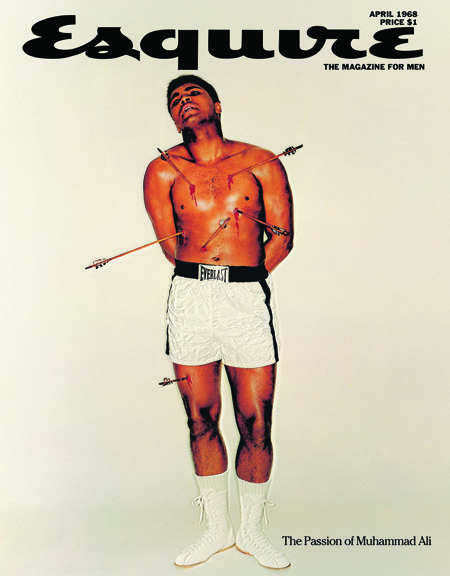
Like Dieter Rams, George Lois seems to be a recurrent theme here and I was wondering why that was. Sure, he has a new book out (published by Assouline), but why is he still relevant? Thinking about this, I kept coming back to his April 1968 Muhammad Ali cover for Esquire.
In 1964 Muhammad Ali, the heavyweight champion of the world, had controversially joined The Nation of Islam and changed his name from Cassius Clay. Three years later he refused to be drafted into the U.S. army because of his religious beliefs and opposition to the Vietnam War. He was stripped of his world title and had his professional boxing license suspended.
At a time of racial tension in the US (there were race riots and civil rights protests across the country in 1967 as well as protests against the Vietnam war) Ali was a successful, outspoken, controversial and self-confident black man refusing to fight for his country. He was reviled and, one suspects, feared by white conservative America.
By 1968, Ali was on bail awaiting his appeal to the Supreme Court. He was still unable to fight and the magazine was planning a story on his exile from the ring.
Putting the boxer on the cover was certainly controversial. But Lois did not make the fighter ‘respectable’ (one doubts the thought even entered his head). Instead, in a photograph taken by Carl Fischer, he presented Ali bare-chested and pierced with arrows.
It is a striking, bloody, and shocking image — especially given the context.
Yet it is also witty, irreverent and surprising: a complex “big idea” rendered with beautiful simplicity.
Lois posed Ali as Saint Sebastian, a 3rd Century Christian soldier and martyr who was bound to a post and shot full of arrows for his beliefs (the arrows, incidentally, didn’t kill him — a subsequent beating took care of that).
Like so many of Lois’ other covers for Esquire — this is unquestionably an attack on the establishment. But ‘Ali as St. Sebastian’ is also just about the most elegant and incisive “fuck you” imaginable. It is not the shocking irreverence that makes it resonate — it’s the lacerating wit.
From race to sex to Vietnam — this stuff mattered to Lois. And that never, ever gets old.
It’s been a slightly shite week in the book trade this week.
Amidst the plethora of end of year/decade “Best of…” lists and gift guides, it was announced that Kirkus and Editor & Publisher Magazine are going to close (are we surprised? No); B&N’s Nook e-reader turned out to be not be quite as good as it was cracked up to be (are we surprised? No); and Simon & Schuster, Hachette, and HarperCollins upset the usual suspects (for all the usual reasons — only Moby Lives seemed to get that it might be about something else) by announcing their decision to hold back the release of a few e-book editions (are we surprised? No)… Is any of this particularly interesting? No. (Although — for the record — I am grateful to the WSJ‘s Jeffrey A. Trachtenberg for reporting on the e-book developments, and to indefatigable Largehearted Boy for compiling a comprehensive list of Best of… lists)…
So needless to say, there isn’t much about the book industy in today’s links. Ah well…
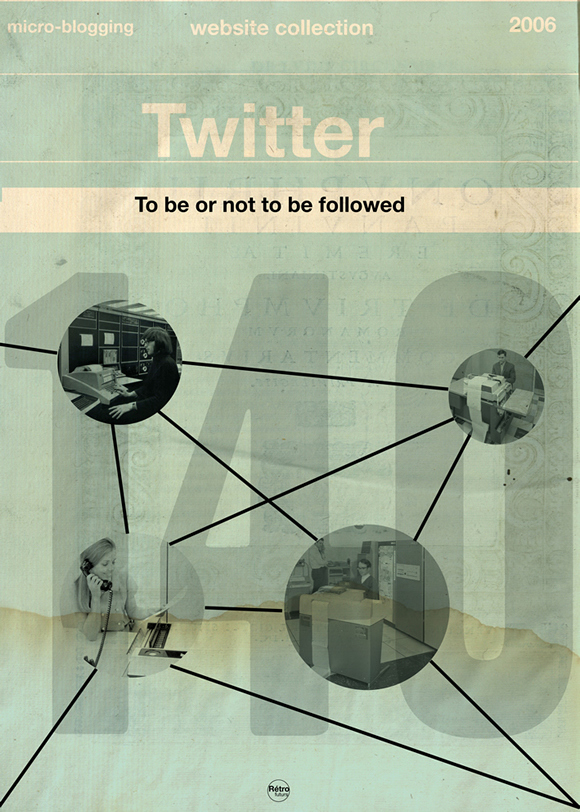
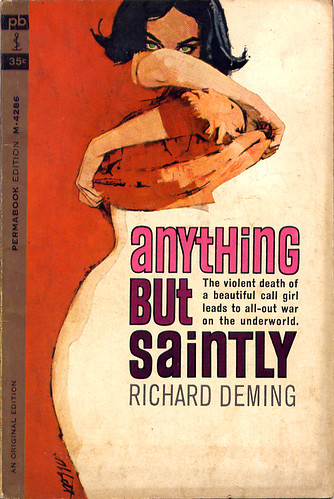
Another addition to the weirdly brilliant (or brilliantly weird?) vintage book/pop culture mash-up phenomenon: Web Services Book Covers by French illustrator Stéphane Massa-Bidal AKA Hulk4598, or Rétrofuturs. They’re sort of like Olly Moss meets Cristiana Couceiro. (First seen at Design You Trust and then just about everywhere else this morning).
The Sixties — Another fantastic new cover by Henry Sene Yee for Picador’s BIG IDEAS // small books series.
Type for the Tube — an interesting history of Edward Johnston’s typeface for the London Underground from its design to current usage.
A Gutenberg-style revolution is not… expected in the next few months. But if you are a lover of well-stocked bookshops, then you should enjoy them while you can.
Penguin Automaton made by artist-maker Wanda Sowry to celebrate Penguin’s 70th anniversary and available from Art Meets Matter . Apparently winding the handle “causes the Penguin to drink from a mug, its flippers to waggle and a piece of 70th Birthday cake to rise magically from the table” (via the lovely tweeps at New Directions ).
Originally coined by the designer Matt Jones and built upon by the strategist Russell Davies, among others, unproduct is basically maximum idea, minimum stuff… More than anything, unproduct is a new way of thinking about things. A new model. So is making something and giving it away. So are joint ventures. We’ve got people building stuff quickly, trying out new ideas, often for free. We have clients and agencies taking risks and more importantly sharing those risks. We’re creating maximum ideas and minimum stuff.
When people start talking to me about e-books, I have to confess there’s a small part of my brain that begins to shut down because I just don’t find them intrinsically interesting (inevitable and utilitarian yes, fun and interesting, no). But I love the idea of applying unproduct-type principles to publishing.
Sadly I don’t own a copy of Things Are Friends Have Written on the Internet 2008, but I gather that on the last page Russell Davies and Ben Terrett say: “2009 feels like a year for printing and making real stuff in the real world. Its going to be exciting”.