Chip Kidd, book designer and associate art director at A.A. Knopf, profiled at Stodgy is Sexy:
Comments closed
Published March 10, 2011
Books, Design and Culture
Chip Kidd, book designer and associate art director at A.A. Knopf, profiled at Stodgy is Sexy:
Comments closedCBS News looks at the past, present, and future of book covers, and talk to Knopf’s Associate Art Director Peter Mendelsund and some guy called Chip Kidd:
Comments closed

Picador Paperback have posted their fall catalogue to Facebook. Apparently they also did this with their spring list too . Needless to say, I think this is a great idea. Is any one else doing it? (via Arthur’s Design)
Control — An interview with Alan Rapp, former senior editor of art, design, and photography at Chronicle Books and the new Associate Director of Hey, Hot Shot!:
for all the possible flaws in the trade publishing model, one thing I always liked about it is the collaborative process. It defies the auteur model; the author is almost never the sole creator. I suppose that this could sound like the ex-editor making a case for the value of his role in an industry that is really undergoing massive and fundamental changes, but I stand by the principle: all content benefits from editing. The author, whether a verbal or visual one, is almost always too involved with the material to see how it can be best adapted to another form. And the design and production processes are also critical to making the best book possible; one thing [that] I think is in danger of getting lost in self-publishing is the production potential. The physical aspects of books make important, and often subliminal, effects on the reader, but we are getting a much more homogenized offering through the current self-publishing models.
Final Crisis — A short Q & A with Chip Kidd about designing comic book covers at the NY TImes‘ ‘The Moment’ blog.
And finally, thinking of comics, Will Kane (The World of Kane) recently posted some mind-blowing pop-art pages from French comic “La Vie Privée de Dyane” drawn by Michel Quarez, published in 1968 (pictured below). Also check out Will’s post on Quarez’s 1967 Mod Love.


Isotype — Gerd Arntz’s amazing pictograms and visual signs for the visual language Isotype at the beautifully designed The Gerd Arntz Web Archive (pictured above).

Jacket(s) — Much as I admire Chip Kidd’s book covers, most of them are just too familiar to re-post here. But I hadn’t seen this ingeniously layered design for Kenzo Kitakata’s Ashes before even though it was published by Vertical in 2003 (pictured above). Seeing it all laid out, it’s really hard to begrudge Mr. Kidd’s reputation for awesomeness.
We like to be part of something — Nick Harkaway on connections:
A paper book has a history. Somewhere, at some time, an author wrote it all down, printed it out, gave it to an editor, who also worked over it. The book was typeset – yes, on a computer, these days, but still — and finally pressed and packaged and distributed. There is a chain of physical events which leads from me to you. With old editions, it’s even more direct. With signed ones, it’s a handshake. We like to connect. And digital books feel as if they’re trapped behind glass. The book is in the machine, and we can’t open the cover and touch the pages.
Black, white and read all over — Creative Review looks at Faber & Faber‘s new editions of 20th Century poetry. The books feature specially commissioned woodcut and linocut cover illustrations. The new editions are part of the Faber’s 80th anniversary celebrations. You can see more of the cover images at designer Miriam Rosenbloom’s design:related page.
The Disappointment Brokers — I going to go out on a limb and say this is another must-read for book-industry types from Poets & Writers — Literary agents Anna Stein, Jim Rutman, Maria Massie, and Peter Steinberg have a fascinating conversation about their profession and the state of the industry:
here’s the silver lining: [The industry’s] unhealthy enough that it’s an exciting time. It’s broken enough that publishers and agents and everyone has to change. Everyone has to rethink what they’re doing. So we have a group responsibility, and an opportunity, in a way that the industry has probably never seen before.
The Legacy of Modernism — Spiegel Online celebrates 90 years of Bauhaus (via @PD_Smith).
Comments closed
Rare (and not so rare) — Joel Kral‘s fabulous collection of book covers on Flickr (via Monoscope):
These are some of the rare (and not so rare) books that I have collected over the past 13 years. They range from graphic design, architecture, art, typography, illustration, skateboarding, graffiti, etc.
Literary Fibs — “Miserable writerist” Charlie Brooker responds to the claim that 65% of us lie about the novels we’ve read in a bid to impress people:
The… irony is that while people lie about having read highbrow novels in order to impress each other, a massive percentage of highbrow novels aren’t worth reading anyway because the authors are too busy trying to impress the reader (who, we now know, probably hasn’t bothered turning up)
Shelved Books — “A blog dedicated to the cover that never happened” by designer Kimberly Glyder.
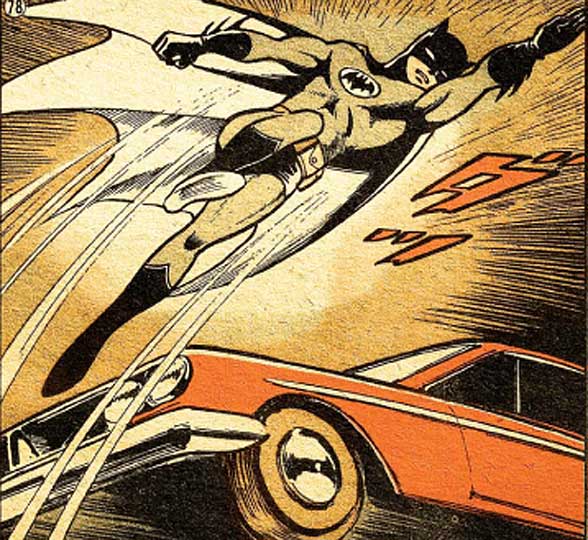
Day to Day Batman — Chip Kidd, the self-described “Indiana Jones of Forgotten Japanese Batman Comics”, talks about Bat-Manga! on NPR (pictured above).
Isn’t that enough? — Jeff Gordiner, Editor-at-Large at Details magazine and author of X Saves the World, interviewed at The Raleigh Quarterly (via@RonHogan):
Other than Philip Roth, though, almost everybody’s writing too much. Blogs, chat rooms, Twitter, Facebook status updates —there’s a wordy data glut going on, and it’s made me more reverent than ever of strategic silence. I’m fond of the J.D. Salinger approach — just evaporating from public view. Is it wrong that Salinger hasn’t left us with 30 or 40 books?
Snooty British traditions and New York brashness — the National Post talks to Nicole Winstanley about Penguin Canada’s new imprint Hamish Hamilton Canada. This is the 4th installment of the Post‘s ‘The Ecology of Books’ series. Part one is about literary agents, part two looks at literary journals, part three is a fascinating profile of McClelland & Stewart’s Ellen Seligman.

The Periodic Table of Typefaces — (pictured above)
And finally, Alan Taylor has launched ‘meta-blog’ Big Picture Notes to accompany the Boston Globe‘s brilliant photo blog The Big Picture. Great stuff.
Comments closedApologies for the rant about the Globe and Mail this morning (note to self: don’t blog without coffee). Hopefully a highly-caffeinated design-heavy post for the weekend will make up for it…

First off, Jenny Griggs’ gorgeous typographic designs for Peter Carey’s backlist (pictured above) described by the great man himself as “A triumph!!!!!! Fucking fantastic!!” (Jenny talks about her more recent papercut designs at FaceOut Books)

M.S. Corley re-images the Lemony Snicket (pictured above) and Harry Potter series as Penguin Classics (via the BDR)

Metacovers — Joseph at the BDR looks at books on book covers (see above!).

The Way Through Doors — written by Jesse Ball; stunning minimal cover design by Helen Yentus for Vintage. Not quite a ‘metacover’ but I still love it (pictured above — seen at the Book Cover Archive of course)

Holey Font! – “How much of a letter can be removed while maintaining readability?” EcoFont has tiny holes and uses up to 20% less ink. Based on Verdana, and developed by SPRANQ in the Netherlands, it’s free to download, and free to use. And it seems to work.
And lastly, The Book Depository Live — Watch what books people buy from The Book Depository around the world in real time. Very cool. (via @paperbackjack)
1 CommentThe 10 Commandments of Book Giving by Michael Dirda, Pulitzer Prize-winning critic and Senior Editor of the Washington Post‘s Book World (via Right-Reading):
Over the years I’ve gone through all kinds of Christmas presents, and nearly all of them quickly broke or have been long forgotten. Not so the gift books, whether Edgar Rice Burroughs’s Tarzan and the Golden Lion, a paperback copy of Ovid’s Metamorphoses or the Pléiade edition of Stendhal’s Oeuvres Intimes. Given to me by relatives, teachers and friends, they helped to make the season bright — and they also helped to make me who I am.
“Book apps for the iPhone keep getting better” according to Maud Newton (via DesignNotes)
Lying Liars: “Nearly half of all men and one-third of women have lied about what they have read to try to impress friends or potential partners”, the BBC reports.
Nintendo launches ‘great books’ package:
The creator of Donkey Kong and Super Mario is hoping that Austen and Dickens will prove as great a pull to computer game fanatics. It has worked with HarperCollins to select 100 titles – from 20,000 Leagues Under the Sea to Gulliver’s Travels, Pride and Prejudice, A Tale of Two Cities and Treasure Island – which will be available in a single software package for the Nintendo DS
Mwa ha ha! Chip Kidd discusses Bat-Manga! (via Books Covered)
The Age of Mass Intelligence — Are we actually smarter than we think we are? John Parker thinks so (via kottke):
One of the commonest complaints by cultural doomsayers is that nobody reads good books any more. Yet in the past two years, the Oprah Book Club in America recommended Tolstoy’s “Anna Karenina” and three novels by William Faulkner–good by any standard, and they all made the bestseller lists. This year, Waterstone’s, which owns over 300 bookshops in Britain, asked two celebrated novelists, Sebastian Faulks and Philip Pullman, each to choose 40 titles and write a few words of recommendation. The chain then piled copies of the books on tables next to the entrances of its main shops and waited to see what would happen. Faulks and Pullman hardly dumbed down their choices: they included Fernando Pessoa’s “Book of Disquiet”, Rudyard Kipling’s “Kim”, and Raymond Queneau’s “Exercises in Style”. The sales increases for these books over the same period the year before were, respectively, 1,350%, 1,420% and 1,800%–clear evidence of latent demand. If you offer it, they will come.
In this brief interview at inFrame.tv, award-winning Australian artist and author Shaun Tan discusses his work and the adaptation of his book The Lost Thing into an animated movie (via drawn):
And on a similar note, stills of the 25 minute animated adaptation of Oliver Jeffers’ book Lost and Found (to be broadcast on Channel 4 in the UK on Christmas Eve) can be seen on the STUDIOaka website. Looks lovely.

And this is probably my last regular post for the next couple of weeks. In the extremely unlikely instance you get withdrawal symptoms, you can always check out the links in the sidebar and/or send me an email!
See you in the New Year!
1 CommentAfter a week of feeling gloomy about publishing, here are a few links to some less apocalyptic book-related stories that I’ve been reading:

“Your…fucking…book” : Author Michael Lewis, who just happened to chronicle Wall Street’s excess in the 80’s in his book Liar’s Poker, tries to figure out what the hell just happened for Portfolio magazine (via kottke):
“This was what they had been waiting for: total collapse… Lehman Brothers had vanished, Merrill had surrendered, and Goldman Sachs and Morgan Stanley were just a week away from ceasing to be investment banks. The investment banks were not just fucked; they were extinct.”
Did someone just say ‘Schadenfreude’? Well, I guess it is reassuring that there’s an industry more fucked than publishing… Anyway, Lewis is apparently writing a book about the whole financial crisis…
Contempt for the beautiful losers: Slate‘s Ron Rosenbaum goes to town on BuzzMachine’s Jeff Jarvis (author of the forthcoming book What Would Google Do?) taking in journalism, new media, publishing, the Frankfurt Book Fair, and “New Age boilerplate mysticism” of Paulo Coelho on the way:
“If Jarvis values books (and I can’t help think that despite all the digital bluster, he’s an intelligent guy who likes reading), do we just listen to the market and focus-group what we should print and give away, which is likely to result in all Coelho, all the time, with maybe a little bit of Jarvis thrown in?”
Inevitably you can already read Jarvis’ response on his blog. Despite all the overblown cattiness, it’s actually an interesting argument. (via fimoculous)
More Information Than You Require: Former literary agent turned author John Hodgman, best known for playing PC in those increasingly misfiring Apple commercials, interviewed by The Book Bench blog:
“I believe that by releasing ‘passing interest/low keepsake-value literature’ from the burden of physicality, you are actually releasing the words from their worst liability: the price and inconvenience of actual bookness.”
“Lord Death Man”: PowellsBooks.Blog previews Chip Kidd’s latest pet project Bat-Manga! (pictured).
Comments closed