Skip to content

Tag: china mieville

Midweek Miscellany

The Creative Review previews an exhibition of the graphic design of the Eames opening at the PM Gallery in London next month.

Gravity — A profile of playwright Tom Stoppard, at Intelligent Life:

He gets the old books he needs from the London Library, the open-stack treasure-house in St James’s Square. It was founded by Thomas Carlyle and others in 1841, and Stoppard has been its energetic president since 2005. “I get a big kick out of the very existence of the London Library. I’d say it was an ornament to society, only it is more than an ornament. The centre of gravity of our morality is our literary culture.”

Special — China Miéville’s keynote speech at the 2012 Edinburgh World Writers’ conference on the future of the novel:

The blurring of boundaries between writers, books, and readers, self-publishing, the fanfication of fiction, doesn’t mean some people won’t be better than others at the whole writing thing, or unable to pay their rent that way – it should, though, undermine that patina of specialness. Most of us aren’t that special, and the underlining of that is a good thing, the start of a great future. In which we can maybe focus more on the books. Which might even rarely be special.

And finally…

Girls — Writing at CNN’s Geek Out! blog, Danica Davidson looks at manga’s popularity with women:

“I honestly believe women are just as interested in the comic format as men no matter the country of origin,” said Robin Brenner… author of Understanding Manga and Anime.

“Women are just are more likely to pick up titles that acknowledge or seek them as an audience,” she said.  Japan has been pursuing women and girls as an audience in earnest since the 1970s, whereas we here in the States left that audience behind in the 1970s”

Comments closed

Midweek Miscellany

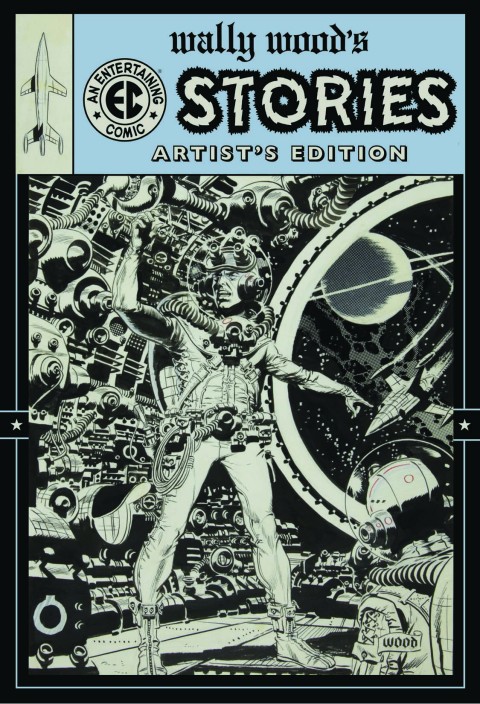
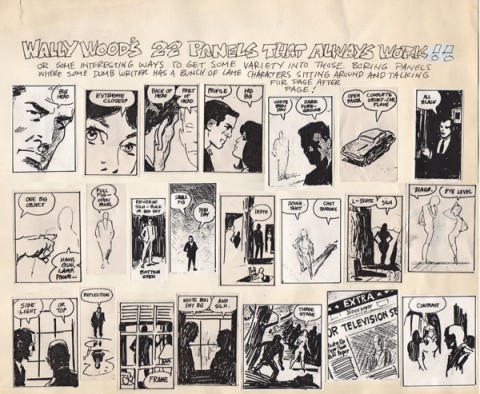
J. David Spurlock on the great Wally Wood at Imprint:

In nearly all of his work – no matter how overworked he was – even when he did risque material, there was always a charm, and he imbued the work with a purity of love for the medium.

And he was a master of every genre. That is one of the things that make him unique. Whether horror for EC, humor for Mad or Plop, war comics for DC or Gold Key, science fiction magazine illustrations, his Wizard King trilogy of fantasy graphic novels, superheroes for Marvel, cheesecake, romance, or westerns, whatever genre one picks, Wood’s contribution is among the finest ever.

Meditations — Dana Stevens on reading Zona, Geoff Dyer’s book about Andrei Tarkovsky’s 1979 film Stalker, while watching the movie:

[If] Zona goes off in a few too many directions, most of them are fascinating enough that we’re happy to zigzag along in the author’s wake. In addition to being a real-time explication of a single movie, Zona is a meditation on movies and time: the way movies change us, and change for us, as we return to them through our lives. Dyer reminisces about seeing Stalker in different decades, in different cities, with different girlfriends, as a young and then a middle-aged man… As he makes his way through Stalker scene by scene, Dyer’s account of what’s happening on screen is constantly being interrupted and informed by associations with the past as well as the present.

See also: Zona reviewed in the New York Times.

Also in the New York Times, author China Miéville on “Apocalyptic London“:

It used to be startling to see a fox in London — impossible not to feel that the city had slipped into a fable. Now you spot them on any late-night jog. In 2011, one of these agents of animal chaos infiltrated the Shard — at 32 London Bridge, the city’s unfinished tallest building — and climbed a thousand feet above the streets to live on builders’ scraps.

At dusk and dawn, green bolts shoot low, as flocks of feral parakeets set about bird business. Walking at dawn in the mud of Wormwood Scrubs, a rough, wild common next to the prison of the same name, we approach a screaming copse. Incredible flocks of these nonnatives preen and screechingly bicker, overlooking the glow of waking London.

And finally… A lovely piece the in The Daily Telegraph on Word on the Water, a Dutch barge selling second-hand books in London:

“We live in times where young people have Debussy moustaches, and listen to Sixties and Seventies music. They are interested in the past. I don’t remember there being a youth cult before where the past was so fascinating. There’s a hunger for authenticity … Younger people are becoming interested in things that machines can’t do: talent.”

1 Comment

Midweek Miscellany

Juggling — The multi-tasking Charlotte Strick,  art editor of The Paris Review, art director at Faber & Faber and Farrar, Straus & Giroux, and book designer,  interviewed at From The Desk Of…

Genre — China Miéville, on his new book Embassytown and genre fiction in The Guardian:

“I love genres; I think they are fascinating. My issue with litfic is not that it is a genre but that (a) it doesn’t think it is and (b) it thinks it’s ipso facto better than all the ones that are genres. Literary fiction of that ilk – insular, socially and psychologically hermetic, neurotically backslapping and self-congratulatory about a certain milieu, disaggregated from any estrangement or rubbing of aesthetics against the grain – is in poor shape.”

Invasion by the Virtual — Iain Sinclair discusses London and five novels that capture the spirit and history of city:

When the railways were first put in, there was devastation, because there were so many competing companies who just ripped up houses right, left, and centre. In the name of catching the spirit of the age and indulging in this technological process (and the idea of progress through science), London was savagely remade. It took a long time to absorb, recover and discover itself through that. At the moment, we’re in this sort of management age — an age of the virtual — in which you can change reality by looking at digitised, computer-generated images and projecting a fantastic city of the future, like a science fiction. People have come to believe that this is reality, even though they are contradicted by observation, which shows you devastated fields, radioactive materials buried in the ground that have been ripped up fast, and absolute destruction… So it is a devastating moment for the city, which I don’t think has ever been under such a prolonged form of invasion by the virtual.

Franzen’s Ugly Americans — Tim Parks on reading Jonathan Franzen’s Freedom in Europe (and, incidentally, the work Swiss novelist Peter Stamm, author of Seven Years, which sounds great) (via Bookslut):

Freedom’s failings are interesting in so far as they deepen the mystery of the book’s international success. It’s one thing for the Americans to hype and canonize one of their favorite authors, but why do the Europeans buy into it? Ever anxious that they need to understand America, fascinated by its glamor and power, Europeans are perhaps attracted to those American novels that explain everything: Roth’s American Pastoral, DeLillo’s Underworld. More than a novel by an American they want The Great American Novel. But of course Europeans also resent American world hegemony and feel (still and no doubt wrongly) superior culturally.

And finally…

20 Books Every Graphic Designer Should Read and an interview with Rick Poynor, founding editor of Eye and a co-founder of Design Observer, who compiled the list, at Designers and Books:

Books always point to other books. A bookshop, like a library, is a fantastic, spatially organized, easily navigable source of vast quantities of interconnected information about what exists for you to discover and know. If someone devised an online virtual space that allowed you to do this kind of rapid, effortless, multifocal, visual, and spatial browsing—perhaps someone has, though it certainly isn’t Amazon or the iPad App Store—we’d applaud them for a brilliant new concept. But these marvelous spaces already exist, at least for the time being, right there in your local shopping street.

art editor of The Paris Review and an award-winning designer known for creating the jackets for books by Roberto Bolaño, Lydia Davis, and Jonathan Franzen, among many others. She is also art director of Faber & Faber, Inc. and of the paperback line at Farrar, Straus and Giroux.art editor of The Paris Review, art director of Faber & Faber and at Farrar, Straus & Giroux,
Comments closed

Midweek Miscellany

The Death Ray by Daniel Clowes

The new cover for Daniel Clowes’ The Death Ray available this fall from Drawn + Quarterly. (The usual disclosure: D+Q is distributed in Canada by my employer Raincoast Books).

The Enemy of Creativity — Jim Holt reviews Nicholas Carr’s The Shallows for London Review of Books:

It’s not that the web is making us less intelligent; if anything, the evidence suggests it sharpens more cognitive skills than it dulls. It’s not that the web is making us less happy, although there are certainly those who, like Carr, feel enslaved by its rhythms and cheated by the quality of its pleasures. It’s that the web may be an enemy of creativity. Which is why Woody Allen might be wise in avoiding it altogether.

A Machine To Think With — Paul Duguid reviews Merchants of Culture by John B. Thompson, Publishing as a Vocation by Irving Louis Horowitz and The Phantoms on the Bookshelves by Jacques Bonnet  for the TLS:

I. A. Richards called the book “a machine to think with”, yet it is curiously resistant to technological standardization. That point escapes many digitizing technologists, who are not perhaps the anti-book boors as sometimes portrayed… Rather they may be the last romantics, idealizing the book as a simple carrier of information and so one that submits unproblematically to their computer algorithms.

Unsolving the City — BLDGBLOG talks to author China Miéville about architecture and his recent novels The City and The City and Kraken. Fantastic stuff:

My intent with The City and The City was… to derive something hyperbolic and fictional through an exaggeration of the logic of borders, rather than to invent my own magical logic of how borders could be. It was an extrapolation of really quite everyday, quite quotidian, juridical and social aspects of nation-state borders… But I’m always slightly nervous when people make analogies to things like Palestine because I think there can be a danger of a kind of sympathetic magic: you see two things that are about divided cities and so you think that they must therefore be similar in some way.

The new covers for Miéville’s forthcoming book Embassytown, and his entire back catalogue with Pan Macmillan UK, were designed by Crush Creative.

And finally…

Handsome Boy Modeling School — A profile Lorin Stein, editor of The Paris Review, in The New York Times’ Fashion and Style section:

Mr. Stein, an unabashed bon vivant who favors bespoke shirts and tailor-made suits by Kirk Miller, appears indifferent to accusations of pretension or dandyism… He has already cemented his status as a somewhat unlikely sex symbol (though among New York’s literary crowd, being pale, thin and occasionally bespectacled doesn’t count against you) with a practiced charm and habit of leaning in close and locking eyes intensely in conversation.

There is hope for us all yet… I just wish I could afford the bespoke shirts and tailor-made suits…

Comments closed

Monday Miscellany

These are mostly links I was going to post on Friday, but with a long post on Mendelsund and a last minute WordPress fail (to add to all the usual pressures of part-time blogging) I thought I might as well hold them over until today. Think of it less as a bad end to last week, and a great start to this one (or something like that)…

Designer Eric Skillman on Adrian Tomine’s illustrations for the Criterion boxed set of Yasujiro Ozu’s The Only Son/There Was a Father.

And on the subject of Adrian Tomine, David L. Ulin reviews his new book Scenes From an Impending Marriage for The LA Times:

Tomine has always been a master of the small gesture, as anyone familiar with his work knows. Such encounters motivate the deceptively informal stories in his series “Optic Nerve,” as well as his graphic novel “Shortcomings,” which explores the limits of identity and intimacy. With “Scenes from an Impending Marriage,” though, he seems almost willfully understated, tracing, in a series of offhand comics, the peculiar rigors of the wedding dance, from guest lists to seating charts to invitations and beyond.

(For the record: several of Adrian’s books, including the new one, are distributed in Canada by my employer, Raincoast Books).

The Impulse to Write — Patti Smith talks about her writing and music in The Guardian:

“More than anything that’s been the thread through my life – the desire to write, the impulse to write. I mean, it’s taken me other places, but it was the impulse to write that led me to singing. I’m not a musician. I never thought of performing in a rock’n’roll band. I was just drawn in. It was like being called to duty – I was called to duty, and I did my duty as best as I could.”

And finally…

London Intrusion — China Miéville, author most recently of The City and The City and Kraken, is posting a webcomic on Tumblr (via Robot 6).

(And speaking of Tumblr… Posts from here and The Accidental Optimist are now also available on Tumblr if that’s your thing.)

Comments closed

Favourite New Books of 2010

Ducking in just under the wire, here is my list of favourite of new books of the year. It’s not meant to represent the “best” of 2010. Rather, it’s a completely unscientific, very subjective list of books (arranged in alphabetical order) that I enjoyed. As I mentioned in my previous post, I found compiling the list a bit of a challenge and yet, for all that, there’s an air of withering predictability about the selections. There are no surprises. But even if this wasn’t a particular stellar year for reading, there were still lots of books I was excited about and that can only be a good thing.

I should also mention, for the sake of disclosure and all that, the top 10 includes one book distributed by Raincoast Books in Canada, and the list of honourable mentions refers to a couple of other titles I have helped promote in some minor capacity. They’re included here because I actually like them, not for any nefarious marketing reasons, but I guess you’ll just have to take my word for that. In any case, all these titles are identified with an asterisk…

And with that out of the way, on to the list!

Born Modern: The Life and Work of Alvin Lustig*
Elaine Cohen Lustig & Steven Heller

Chronicle Books
ISBN 9780811861274
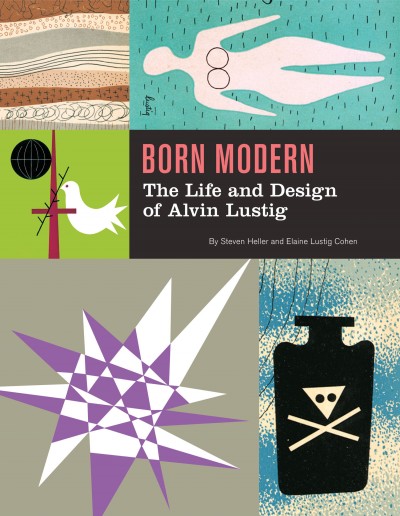
I am a little embarrassed to start this list with a title distributed by Raincoast, but it comes first alphabetically and, I can honestly say tat Born Modern was the book I was most looking forward to this year. And I was not the only person excited about the book. When I tweeted about it from the Raincoast sales conference, the response was immediate. Almost every North American book designer I’ve ever spoken to cites Lustig — who designed covers for New Directions Press in the 1950’s — as an influence. The book designer’s book designer, then… A must-have.

C
Tom McCarthy
Knopf
ISBN 9
780307593337

Tom McCarthy’s C was, as mentioned previously, one of the defining books of the year for me, standing — perhaps unfairly — opposite the ubiquitous Freedom. If I am honest though, I liked it less than McCarthy’s previous novel, the starkly compact Remainder (one of my favourite books of the last 10 years). At times, the sprawling, crawling C felt like it was held together with the sticky-tape of McCarthy’s singular intellect (a thought reaffirmed by seeing him in conversation with Douglas Coupland in Toronto). But somehow, in the end,  it still works in some sort of baffling, gorgeous way.

The book was also perfect excuse to finally talk to Knopf cover designer Peter Mendelsund for the blog. The Q & A with Peter and Tom about C is here.


The City and the City
China Miéville
Del Rey
ISBN 9780345497529

I am cheating a little by including The City and the City because it was first published in 2009. It was, however, published in paperback in 2010, and as that’s how a lot of us still buy our fiction, I’m bending the rules to include it.

The novel itself is essentially a detective story, but what lifts out of the ordinary is the imaginary space in which it takes place. Architecture, geography and maps are clearly important to Miéville, but where, for example, Perdido Street Station creates a fantastically baroque city of ghettos and towering alien architecture, The City and the City is only slightly off-kilter — familiar but unsettling — and the book is even better for it.

Joy Division
Kevin Cummins
Rizzoli

ISBN 9780847834815

This was my Christmas present (thank you Mrs C.O.!) and it is — pretty obviously I would think — for fans only. Still, I’m guessing there’s quite a few out there. In any case, the book is a collection of beautiful black and white photographs of Joy Division and the late Ian Curtis by Manchester-born photographer Kevin Cummins. It includes Cummins’ iconic pictures for the NME of the band standing on a snowy bridge in Hulme, Manchester, as well as photographs of live performances and the band back stage. The book was stylishly designed — with more than a whiff of Peter Saville — by London design agency Farrow.

Just Kids
Patti Smith
Ecco
ISBN 9
780060936228

Other than owing a copy of Horses,  I can’t say that I’m particularly familiar with the work of Patti Smith, or Robert Mapplethorpe for that matter (other than the sort of stuff must people know about his art, and that he was connected to Sam Wagstaff, no relation). But, it doesn’t really matter. Smith’s memoir about her relationship with Mapplethorpe is a touching and self-deprecating look at their early years together in New York and their adventures in the art/music scene of the late 1960’s and early 1970’s.

Memories of the Future
Sigizmund Krzhizhanovsky, translated by Joanne Turnbull
NYRB
ISBN 9781590173190

I am definitely cheating by including this in the list as it was published in 2009. That said, it was published late in 2009, I missed it, and it’s too good not to be in this year’s top 10.

The book itself  is a collection of seven short stories written between 1922 and Krzhizhanovsky’s death in 1950,  all of which were suppressed by Soviet censors. The stories are reminiscent of Gogol’s short fiction and Bulgakov’s novellas, and suffice to say, they’re all bonkers. But in a good way. I loved the story Quadraturin about the man who gets lost in his black, ever-expanding apartment, and the strange time travel title story which concludes the book.

Penguin 75: Designers, Authors, Commentary (the Good, the Bad…)
Paul Buckley

Penguin
ISBN 9780143117629

Seeing as I spend so much time talking about cover design, I would be remiss if I didn’t include Penguin 75 in my top 10. Released to celebrate Penguin’s 75th anniversary, it’s a surprisingly diverse and candid look at the recent cover designs from Penguin’s US outpost in New York.  I talked about Penguin 75 with art director Paul Buckley and book designer Christopher Brand here.

Parker: The Outfit
Darwyn Cooke

IDW
ISBN 9781600107627

The previous book in Darwyn Cooke’s Richard Stark adaptations, The Hunter, was on last year’s list, so perhaps it is hardly surprising that the sequel, which I think is better,  is in this year’s top 10 as well. In new book, the formidable Parker — now with a new face — turns the tables on ‘the Outfit’, who quickly wish that they’d let sleeping dogs lie. Cooke seems in more confident form with this adaptation and the result is a stylish and fast-paced noir that looks incredibly cool. My pithier Advent Book Blog pitch for The Outfit is here.

The Shallows
Nicholas Carr
W.W. Norton & Co.
ISBN 9780393072228

I had a frisson of recognition reading Carr’s description of internet affected attention spans and I doubt I was the only one who thought “oh god, that’s happening to me” while reading The Shallows. The book is too long — a shorter book would’ve been even more effective — but it is still compelling. Carr doesn’t say technology is wrong, but reminds us that for all its benefits, we should be mindful of the consequences and what we might be losing.

Werewolves of Montpelier
Jason
Fantagraphics

ISBN
9781606993590

I wrote about my love for Jason’s comics when Werewolves of Montpellier was about to be released earlier this year, and the book itself didn’t disappoint. Ostensibly the book is about a thief called Sven who disguises himself as werewolf to rob people’s apartments and incurs the wrath of the town’s actual werewolves. It is, however, as much about friendship, identity, loneliness, and, ultimately, Sven’s unrequited love for his neighbour Audrey. In a lovely one-page scene, Audrey stands behind Sven, hugging his shoulders.  “Do women come from another planet?” she asks. “Yes, women come from another planet,” Sven replies. The whole book is achingly brief, but Werewolves of Montpellier is possibly my favourite Jason book to date.

Honourable Mentions

American Trademarks edited by Eric Baker and Tyler Blick*
Footnotes In Gaza by Joe Sacco (December 2009)
I.O.U.: Why Everyone Owes Everyone and No One Can Pay by John Lanchester (published in the UK as Whoops!)
KENK by Richard Poplak and Nick Marinkovich*
Large Scale: Fabricating Sculpture in the 1960’s and 1970’s by Jonathan Lippincott*
The Lost Rolling Stones Photographs: The Bob Bonis Archive, 1964-1966 by Larry Marrion
The Rocketeer: The Complete Collection by Dave Stevens (December 2009)
Shirley Craven and Hull Traders: Revolutionary Fabrics and Furniture 1957-1980 by Lesley Jackson (October 2009)

So there you go. If  this hasn’t met your requirements, Largehearted Boy is aggregating every online “best of 2010” book list he can find, and Fimoculous is aggregating all of the lists related to 2010 in categories ranging from ‘Advertising’ through to ‘Words’. That should keep you busy…

Happy New Year!

aggregates all of the lists related to 2010aggregated all of the lists related to 2010)
Comments closed

The Books That Made Me: China Miéville

China Miéville, author of one of my favourite novels this past year The City and the City, talks to Claire Armitstead about the six books that inspired him for a new Guardian Books podcast series ‘The Books That Made Me’. The books range from Beatrix Potter’s Tale of Jeremy Fisher to Max Ernst’s surrealist Une Semaine de Bonté:

The Books That Made Me: China Mieville

Miéville latest novel is Kraken.

4 Comments