The New Yorker visits the Community Bookstore in Brooklyn as owner John Scioli begins to clean out his “cavern of books” in preparation of the store’s closing in May:
Comments closed
Published March 22, 2016
Books, Design and Culture
The New Yorker visits the Community Bookstore in Brooklyn as owner John Scioli begins to clean out his “cavern of books” in preparation of the store’s closing in May:
Comments closedDon’t miss Dwight Garner’s New York Times review of Martial Bliss.: The Story of the Military Bookman, Margaretta Barton Colt’s account of running an antiquarian bookstore in Manhattan that sold only military titles. If you ever worked in an independent bookstore, you’ll probably relate…
Comments closedHistorians and journalists were devoted to the store, and leaned on it for their research. No one is lonelier than the author of a forgotten book. Ms. Colt speaks for many writers who walked into the Military Bookman when she says of one, “He loved to come to a place where the denizens knew what he had done”…
…Ms. Colt, who had previously worked in publishing, didn’t suffer fools — or ghouls. Here she is on one customer: “Lean and mean, with a crew cut, he was a real right-winger, collecting Holocaust memorabilia while being a Holocaust denier: a misanthrope with a sour sense of humor and guns in a secret closet.”
The store kept sometimes mischievous notes on its customers. These had observations like “tire-kicker, quote-dropper, reservation-dropper (particularly heinous), unredeemed check-bouncer (even worse). Also: cheapskate, picky, SS tendencies, questionable dealings, edition or d/j freak, and other sins and misdemeanors.” (The “d/j” refers to dust jackets.)
If it sounds as if the patrons were a band of brothers, yes, they were mostly men. The store maintained a comfortable chair for wives and girlfriends. Ms. Colt, who loved her work, writes terrifically about trying to maintain her sang-froid in this testicular environment.
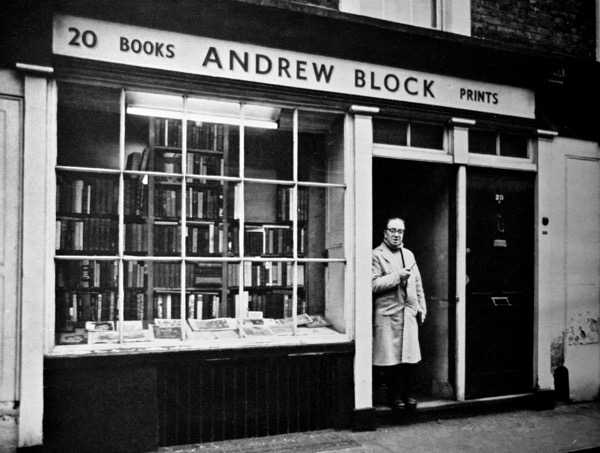
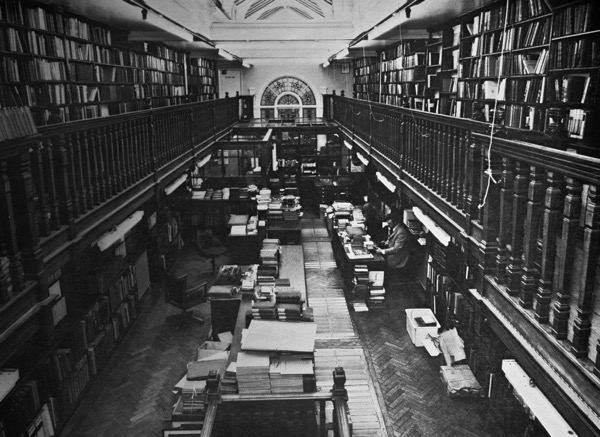
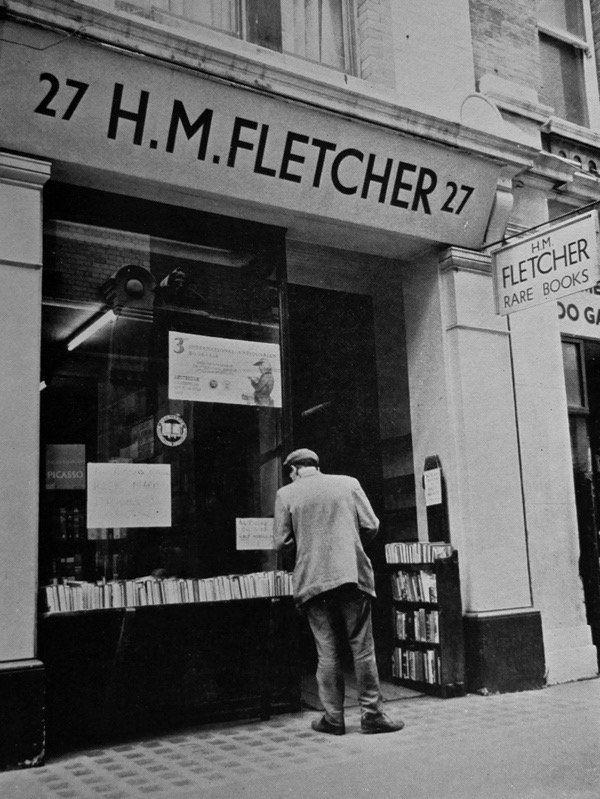
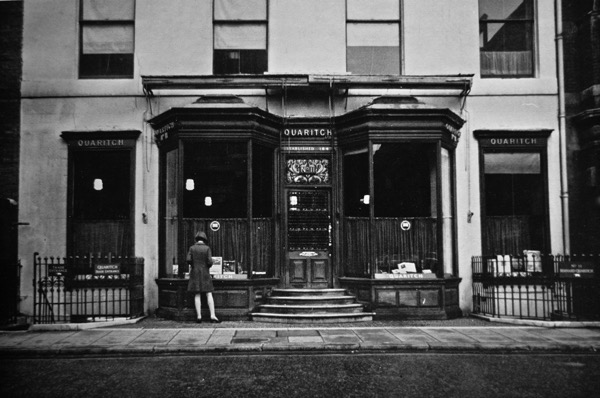
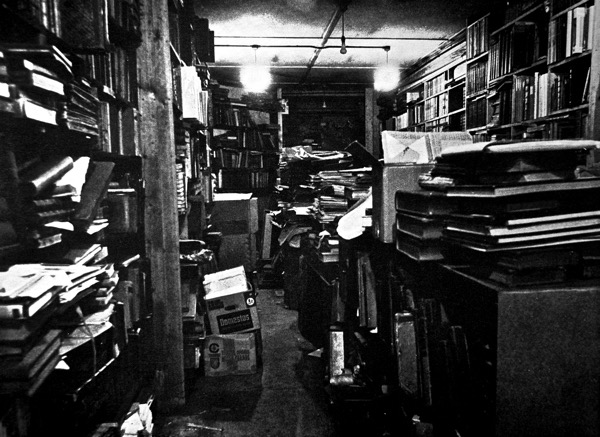
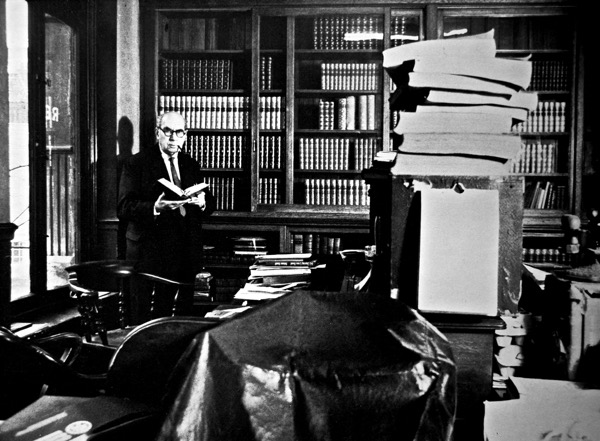
At the lovely Spitalfields Life blog, the Gentle Author reminisces about buying and selling used books in London, and shares some wondeful black and white photographs of the city’s secondhand bookshops taken in 1971 by Richard Brown:
Frustrated by my pitiful lack of income, it was not long before I began carrying boxes of my textbooks to bookshops in the Charing Cross Rd and swapping them for a few banknotes that would give me a night at the theatre or some other treat. I recall the wrench of guilt when I first sold books off my shelves but I found I was more than compensated by the joy of the experiences that were granted to me in exchange.
Inevitably, I soon began acquiring more books that I discovered in these shops and, on occasion, making deals that gave me a little cash and a single volume from the shelves in return for a box of my own books. In this way, I obtained some early Hogarth Press titles and a first edition of To The Lighthouse with a sticker in the back revealing that it had been bought new at Shakespeare & Co in Paris. How I would like to have been there in 1927 to make that purchase myself.
Comments closed
To mark Independent Bookshop Week in the UK, author Helen Dunmore celebrates browsing the shelves:
Comments closedReaders go their own way, and this is what frustrates governments and tantalises publishers. You can drag the reader to the water with the most brilliant advertising and marketing campaigns, but you cannot make him or her drink deep of shallow words.
No one can define the quality in a book that makes it command passionate loyalty from readers, and while some bestsellers are predictable, others have leapfrogged every idea about what readers should love. This is where physical bookshops and libraries are so important to readers, in spite of the convenience and ease of making an online purchase. We need to be able to see all the books that we don’t know about yet. Bookshops encourage browsing, dawdling and discovery. They open byways that become high roads to new fields of understanding. They don’t nag; they suggest. To be a reader in search of a book is more than to be a shopper who already knows what he or she wants to buy. Bookshops and libraries are places where books and readers come out of the private world, and make their claim on the public space. They say, visibly, how important books are to us.
At The Dabbler, gentleman bookseller Steerforth recalls his run-ins with book thieves over the years:
After a while I became quite good at spotting the biblioklepts. Sometimes they gave themselves away through their body language, other times it was their appearance. One thief was dressed as a respectable businessman but his shoes were shabby and when I scrutinised him further I could see that he was wearing a charity shop suit. Our eyes met and he realised that he’d been rumbled. Later I mentioned this incident to someone in another bookshop and they said ‘Ah yes, the Businessman.’ He was well-known.
The most successful thieves were, of course, the ones we never saw. Someone used to steal entire shelves of books during Thursday lunchtimes – one week it was Nabokov, another Terry Pratchett – presumably in order to furnish another bookshop. Although we became obsessive about checking everyone who entered the shop, we never caught them.
We had regular thieves at both bookshops I worked in too. I don’t think any of them were quite as colourful as ‘the Businessman’ sadly.
Comments closedIn November’s Vanity Fair, Bruce Handy profiles George Whitman, the late owner of Shakespeare & Company — “the most famous independent bookstore in the world” — and his daughter Sylvia, the current owner of the shop:
Comments closedIt is not true, as the store’s workers have sometimes overheard passing tour guides proclaim, that James Joyce lies buried in the cellar. (If only. He was laid to rest at a conventional, non-bookselling cemetery in Zurich.) But the store’s roots do indeed reach back to the Shakespeare and Company that Sylvia Beach, an American expatriate, owned in Paris in the 1920s and 30s. As every English major knows, her bookshop and lending library became a hangout for Lost Generation writers such as Ernest Hemingway, F. Scott Fitzgerald, Ezra Pound, and Joyce, whose Ulysses was first published in its complete form by Beach because authorities in Britain and America deemed it obscene. She closed up shop during the Nazi occupation and never reopened. But her mantle was taken up by another American, George Whitman, who opened the present-day store in 1951, just as Beat Generation writers were finding their way to the Left Bank. (The so-called Beat Hotel, which would become a Parisian equivalent to New York’s Chelsea Hotel as a flophouse for writers, artists, and musicians, was only a few blocks away.) Writers who logged time at the current Shakespeare and Company, sometimes even sleeping there—Whitman was possibly keener on extending hospitality to authors, lauded or not, than on selling their books—include Allen Ginsberg, Henry Miller, Richard Wright, Langston Hughes, Lawrence Durrell, Anaïs Nin, James Jones, William Styron, Ray Bradbury, Julio Cortázar, James Baldwin, and Gregory Corso. Another early visitor, Lawrence Ferlinghetti, co-founded his City Lights Bookstore, in San Francisco, as a sister institution two years after Shakespeare’s opened. William S. Burroughs pored over Whitman’s collection of medical textbooks to research portions of Naked Lunch; he also gave what may have been the first public reading from his novel-in-progress at the store. (“Nobody was quite sure what to make of it, whether to laugh or be sick,” Whitman later said.)
Writing for the New York Times, Julie Bosman recently looked at how surging rents are forcing bookstores from Manhattan:
The closings have alarmed preservationists, publishers and authors, who said the fading away of bookstores amounted to a crisis that called for intervention from the newly minted mayor of New York City, Bill de Blasio, who has vowed to offer greater support to small businesses.
[Author Robert] Caro said in an interview that he is heartbroken by the loss of bookstores from Manhattan, calling it “a profoundly significant and depressing indication of where our culture is.”
“How can Manhattan be a cultural or literary center of the world when the number of bookstores has become so insignificant?” he asked. “You really say, has nobody in city government ever considered this and what can be done about it?”
There has, of course, been a similar trend in Toronto with the Cookbook store, the Annex location of Book City, and the Bloor West Village Chapters all closing (or about to) in recent months.
On a happier note though, Bosman notes that some stores are thriving by locating to other, more affordable neighbourhoods in New York (and beyond):
just as many writers have fled to Brooklyn or Queens in search of more affordable housing, some bookstore owners have followed. Greenlight Bookstore in Fort Greene opened in 2009 to robust business and year-over-year increases in sales.
In December, Christine Onorati, the co-owner of Word bookstore in Greenpoint, Brooklyn, opened a second store in Jersey City. Ms. Onorati said she never looked seriously at Manhattan because the rents were so unaffordable…
…After spending years scouring Manhattan for a second location, Ms. McNally of McNally Jackson abandoned her search. At the urging of a former employee, she began looking in Brooklyn and settled on Williamsburg, where she found a “magnificent,” loftlike space with a 20-foot ceiling.
I hope this will be true of Toronto too even though it is much smaller than New York (New York has more than twice the population of Toronto). But here, despite some well-defined neighbourhoods, bookstores seem to have been slow to follow their customers (and their families) to more affordable areas of the city. My neighbourhood, where I’ve lived for 8 years, is filling up with young families and yet many store fronts remain stubbornly empty. And while I consider myself lucky to still have a bookstore, Book City’s Danforth location, only four subway stops away, it feel like a very different neighbourhood. I would love to be able to walk to a bookstore with my kids, or stop in to browse on my way home.
Perhaps the bookstores further afield, in communities like Burlington and Hamilton, are doing better? I hope so.
Still, I will leave the final word to Rebecca Mead, author of My Life in Middlemarch, who has written a sharp response to the New York Times article for The New Yorker:
Comments closedThose of us who cherish our local bookstores do so not simply because they are convenient—how great to be able to run out for milk and also pick up the new Karl Ove Knausgaard!—but also because we feel a duty to support them, because we believe in their mission. When books can be bought so cheaply online, or at one of the dwindling number of discount retailers, paying more to shop at a local bookstore feels virtuous, like buying locally sourced organic vegetables, or checking to see if a T-shirt is made in the U.S.A. It can be gratifying to the point of smugness to feel that one is being pluralistic, liberal, and humane; shopping at an independent bookstore may be one of the diminishing opportunities to experience that feeling in first-class New York City. Still, when I consider the vanished bookstores of Manhattan, I mourn not just their passing but the loss of a certain kind of book-buying innocence—a time when where one bought a book did not constitute a political statement, and reading it did not feel like participating in a requiem.