Skip to content

Tag: bookexpo

Paul Pope: In Your Space


In an interview for BookExpo, cartoonist and artist Paul Pope talks about his work, influences, and, yes, his studio space:


Pope’s new book Battling Boy is out in the fall from First Second (and, for the sake of disclosure, distributed in Canada by my employer Raincoast Books). He will be at BookExpo signing galleys on May 30th.

Comments closed

Something for the Weekend, June 5th, 2009

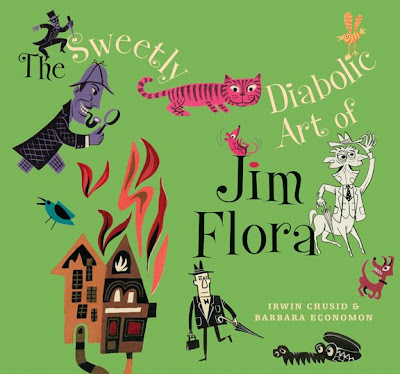
Sweetly Diabolic — A new Jim Flora compendium from Fantagraphics.

I really, truly, wasn’t going to link to any BEA autopsies — and there are plenty out there — but on the eve of BookCamp Toronto I thought Brian O’Leary’s post seem pertinent:

It would be more than nice, more than fun, more than illuminating, if we as an industry could use events like BEA as less an opportunity to predict the future and more a forum in which to examine the options. Okay, piracy is bad, but.. what if it helped sell books? Okay, we love long-form fiction and we think it should survive, but what if the people who read it now just stopped? Okay, a trade publisher provides value in choosing and curating content, but what if the world turned upside down and everyone were a writer, a publisher, a reader… Wouldn’t that be really cool?

Fingers crossed for tomorrow… Follow along on Twitter. The event account is @BookCampTO. The hash-tag is #bcto09.

Access of Evil — More on Google’s big e-book adventure at Business Week. The ‘news’ is that Google will be offering online access to e-books rather than downloads. Which, if I understand it correctly, is what Shortcovers does already. Not that anyone is giving them credit for it.

The ALPHABET chest of drawers by Kent and London, inspired by vintage printing blocks: “The perfect place to file everything from A-Z!” (via source of all good things swissmiss).

The George Orwell Archive at the BBC (via The Book Depository blog):

For two years, between 1941 and 1943, George Orwell – real name Eric Blair – was BBC staff member 9889, hired as a Talks Producer for the Eastern Service to write what was essentially propaganda for broadcast to India.

From recruitment to resignation, this collection of documents reveals the high regard in which Orwell was held by his colleagues and superiors and his own uncompromising integrity and honesty.

The Wickedest Man in the World — Jake Arnott, author of The Long Firm, on how the very real Aleister Crowley became the archetypal fictional 20th century villain. Sadly Arnott doesn’t mention that Oliver Haddo, W. Somerset Maugham’s literary Crowley, appears in the latest League of Extraordinary Gentlemen adventure.

The Future of Mainstream Media — a fascinating article about the success of National Public Radio (NPR) by Josh Catone for Mashable:

NPR’s amazing growth over the past 10 years prompted FastCompany magazine in March to call NPR the “most successful hybrid of old and new media,” and wonder if NPR could be the savior of the news industry. [T]hey owe that success to the culture of open access and audience participation that they’ve cultivated over the past decade.

And… OK I just can’t not link to Design Assembly‘s post about design-hero Wim Crouwel’s ISTD lecture.

Note: if you want me to link to your site, you just need to include a brilliant photograph of Wim Crouwel looking cool as f*ck and then use a genius soccer analogy:

“(For me) a grid is like a football pitch. You see a beautiful game of football, and then you see a not so beautiful one, but it all takes place on the same pitch”.

Yes. I am a cheap date.

4 Comments

Midweek Miscellany, February 4th, 2009

Slow Burner (above) — a rather awesome — if slightly racy — cover seen at the Bookkake Blog.

How to Publish in a Recession Part 3 — The always interesting Richard Nash, the editorial director of Soft Skull Press and the executive editor of Counterpoint, talks to Scott Esposito at Conversational Reading.

The Once and Future e-book: On Reading in the Digital Age — A fascinating article on the past, present, and future of e-books and e-book readers by John Siracusa at Ars Technica.  I think — like many —  he underestimates the challenges (such as rights issues and, on a really basic level, a lack of expertise and human resources) publishers face making their titles available as e-books, but this really is a must-read.

Book Expo Canada is officially dead. It is an ex-trade show– Surprising precisely no one. The Globe and Mail has publisher reactions and a postmortem interview with Tom Best, vice president, marketing, at H.B. Fenn. What troubles me is the belief that we need something to replace it…

There’s so much written about how publishers don’t know what they’re doing… But how do you know what to do?”The New York Observer talks to former PW editor Sara Nelson:

You’re making a bet on who’s gonna like something a year and a half from now. That’s without even getting into the economy or anything—just, ‘What’s the mood of a number of people going to be a year and a half from now?’ If you thought too much about that, you’d shoot yourself.”

“We are on the verge of an explosion in independent book publishing” — Hugh McGuire of Librivox and The Book Oven chats to Allentrepreneur.

The Google Paradox — Andrew Keen, author of The Cult of the Amateur, on two new books published (in the conventional way) about Google:

“the more Google does to kill the traditional publishing industry with the free online content from its search engine, the more books will get written about the central role of Google in our new digital economy… The irony of Elsewhere USA and What Would Google Do? is that both books rely on the five hundred year-old technology of Johannes Gutenberg’s moveable type to explain the wrenching digital transformation of the 21st century.”

Who is on twitter? — I think I fall into the cateogory of “people who are concerned about the collapse of the publishing industry.” (Thanks Sio!)

Comments closed

BEC DOA

Book Expo Canada is in trouble.

The Canadian publishing trade show has been dogged by industry apathy and persistent complaints about high costs, low attendance, and a lack of paying customers for years. But the immediate need to cut costs in the face of the economic downturn — or, at least, see some kind of measurable return on investment —  has been the final straw for dissatisfied publishers.

Random House, Canada’s largest trade publisher, unilaterally withdrew from the event in November, and last week HarperCollins and Penguin — closely followed by  Scholastic Canada and H.B. Fenn & Co.  — announced that they would not be attending BEC in 2009 either.

Scheduled for June 19th-22nd at the Metro Toronto Convention Centre, organizers Reed Exhibitions initially said that it was still their intention to hold the annual convention even though Simon & Schuster was the only one of the “Big Four” multinational publishers committed to the ailing event.

Now it seems Reed may be reconsidering that decision after Random House’s recent announcement that they would be launching a new Toronto “literary and cultural” festival with the Globe and Mail in May —  one month before BEC.

With a high-profile media sponsor, and including events with crowd-pleasing luminaries such as Naomi Klein, Margaret MacMillan, Richard Florida, Pulitzer Prize nominee Ha Jin, and New Yorker columnist Adam Gopnik, the two day “Open House Festival” is clearly aimed at doing precisely what BEC has seemed so incapable of – bringing in paying customers and driving book sales.

More troubling for Reed is that the new festival means their latest initiative, the Toronto Book Fair, planned for the first weekend in October, will almost certainly be stillborn.

Details of the fair were unveiled earlier this month by John McGeary, Reed’s general manager for Canada.

Hoping to win over critics of Book Expo, McGeary outlined an “inclusive celebration of reading and literacy” akin to Salon du Livre. But hampered by a venue (the Direct Energy Centre) on the fringes of public transit, and scheduled for one of the busiest months in the publishing calendar, Reed’s plans disappointed the vast majority of the invited audience of independent booksellers and industry-types.

McGeary, relying heavily on his PowerPoint slides, struggled to articulate a coherent vision for a fair that nobody seemed to want, and was unable to substantially differentiate it from Word on the Street, the popular not-for-profit book festival taking place in downtown Toronto one week before the Reed event.

“We consider ourselves extremely different” was about the best McGeary could manage. “Yes”, a wag in the audience said, “Word on the Street is free and in Queen’s Park!” Touché .

The poor timing and location, combined with a breath-taking dearth of both imagination and logistical detail, makes it unsurprising that Random House and Penguin have already announced they will not be attending the new fair. And more publishers are sure to follow suit.

Reed — who are now, according to PW, reviewing all their dealings with the book industry in Canada — will no doubt blame the combined failure of BEC and the Toronto Book Fair on the crumbling economy and the mixed messages sent by fickle, selfish and duplicitous book industry players.

But Reed cannot entirely escape responsibility for their situation. They have consistently put the cart before the horse, planning events before they have identified a real need or purpose. This ‘build it and they will come’ attitude may have worked in the past, or perhaps elsewhere. Unfortunately Reed’s abortive attempt to make BEC more inclusive two years ago, the now infamous the Booked!, and the shortcomings of the trade show itself have seriously damaged their credibility in Toronto.

And Reed is guilty of simply trying too hard. Their efforts to be inclusive are laudable, and yet in trying please everyone, they inevitably please no one.

The book community in Toronto consists of authors, publishers, distributors, bookstores, libraries, readers, publicists, journalists, bloggers and more. Their interests conflict at least as often as they overlap, and one only needs to look at the finger-pointing and handbag-swinging caused by the high Canadian dollar last year to see that relations between publishers and booksellers, and booksellers and their customers, (not to mention the industry and the media), are fragile at best. People get upset. And they get over it. Reed has never quite seemed to grasp that to organise an effective event they will need to risk offending some people.

It is simply not fair to expect Reed to organise an event like BookCamp, or even Word on the Street. It would be impossible. But Reed could – and probably should – have organised an event like the Open House Festival. It should’ve been possible to work, initially at least, with one or all of the Big Four and a single retailer to kickstart something bigger and more inclusive. Random House’s understandable impatience has slammed that door  in Reed’s face, and, to be honest, it is hard now to see where they have left to turn.

Comments closed