Skip to content

Tag: book reviews

It Can Happen Here

With shadows of authoritarianism rising around the world, Cass R. Sunstein reviews three books on life in Nazi Germany for the New York Review of Books.

The books, They Thought They Were Free by Milton Mayer, Defying Hitler by Sebastian Haffner, and Broken Lives by Konrad Jarausch, do not focus on the well-known historic figures, but explore how ordinary people navigated such a terrible time. The contemporary parallels are chilling:

With evident fatigue, the baker reported, “One had no time to think. There was so much going on.” His account was similar to that of one of Mayer’s colleagues, a German philologist in the country at the time, who emphasized the devastatingly incremental nature of the descent into tyranny and said that “we had no time to think about these dreadful things that were growing, little by little, all around us.” The philologist pointed to a regime bent on diverting its people through endless dramas (often involving real or imagined enemies), and “the gradual habituation of the people, little by little, to being governed by surprise.” In his account, “each step was so small, so inconsequential, so well explained or, on occasion, ‘regretted,’” that people could no more see it “developing from day to day than a farmer in his field sees the corn growing. One day it is over his head.”

(via Kottke)

Comments closed

The Rise of the Global Novel

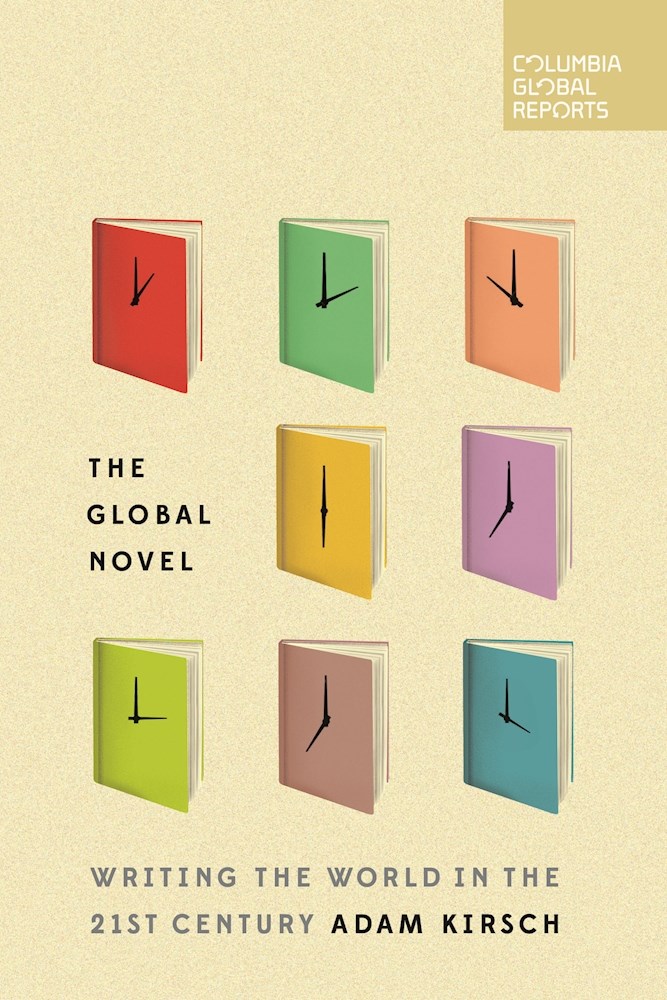
At the New Republic, Siddhartha Deb, author of The Beautiful and the Damned, reviews The Global Novel: Writing the World in the 21st Century by Adam Kirsch:

Foreign writers might still be considered strange or different, and they might not be covered at all. But even the notoriously elitist, insular establishment of book reviewers in New York did not see their novels as completely out of place in a world rapidly being shaped by globalization. In an era of cheap air travel, digital communications, consumerism, worldwide urbanization, and the dominance of English—all overseen by the United States as the world’s single remaining imperial power—readers, editors, and critics found it easy to welcome works by Haruki Murakami or Orhan Pamuk and the snapshots of foreign life they reveal.

In fact, the literary critic Adam Kirsch argues in his new book, The Global Novel, these circumstances have given rise to an entirely new literary category. No longer located tightly within national boundaries, and often written by authors who move between cultures, the global novel takes fiction’s usual remit—the examination of human nature—and places it in new cosmopolitan settings. The scope and structures of these books may vary: “A global novel can be one that sees humanity on the level of the species,” Kirsch proposes, “so that its problems and prospects can only be dealt with on the scale of the whole planet; or it can start from the scale of a single neighborhood, showing how even the most constrained of lives are affected by worldwide movements.” Yet such narratives are unified in their concern for “contemporary global problems, including immigration, terrorism, environmental degradation, and sexual exploitation”…

…In the midst of xenophobic populism—the age of Brexit and Donald Trump—Kirsch counters that the global novel bears out Goethe’s belief that “poetry is the universal possession of mankind.” And the fact that readers have come to appreciate it shows, for him, the currency of liberal values “like tolerance of difference, mutual understanding, and free exchange of ideas.”

Comments closed

Brutalist Dreams

At the New York Review of Books, American architecture critic Martin Filler casts a critical eye over a slew of new books on Brutalist architecture: 

In addition to its echoes of art brut—Jean Dubuffet’s name for outsider art—New Brutalism was also an oblique riposte to New Humanism, a set of beliefs inspired by Geoffrey Scott’s hugely influential book ‘The Architecture of Humanism’ (1914). But Scott’s call for a return to Arts and Crafts design principles was scorned as escapist nostalgia by many young midcentury modernists. Among them was the period’s foremost British architecture critic, Reyner Banham, who with his scant empathy for the Arts and Crafts Movement’s focus on social reform issues belittlingly described New Humanism as “brickwork, segmental arches, pitched roofs, small windows (or small panes at any rate)—picturesque detailing without picturesque planning. It was, in fact, the so-called ‘William Morris Revival,’ now happily defunct….”

Yet it was not a utopian nineteenth-century dreamland that Brutalism countered as much as the thin, commercialized version of the International Style that after World War II gained ascendance through economic expediency. Brutalism’s striking departure from the steel-skeleton-and-glass-skin conformity of this routine, profit-oriented modernism was defined by its contrary emphasis on raw concrete (‘béton brut’ in French) in massive forms of imposing scale, idiosyncratic shape, rough finish, and uncompromising forcefulness, with a building’s inner workings and services—structure, plumbing, electricity, heating, and ventilation—unabashedly exposed. Brutalism soon became a worldwide craze, as this comparatively economical means of fabrication offered a cost-effective alternative to hand-riveted metal construction and allowed a broader array of sculptural effects than those obtainable with rectilinear frameworks.

One gets the sense Filler is no fan of Brutalism — at least its bleak British incarnation — so there is, inevitably, a reference to J.G. Ballard’s dystopian novel High-Rise:

This was never a style that attempted to convey warmth, comfort, intimacy, or other qualities we tend to associate with an enjoyable way of life, and thus it never won much love except from architectural specialists. Brutalism posited an unsentimental, not to say harsh, view of the modern world, and however heroic its unflinching embodiment of hard realities may have been, most people do not enjoy a daily diet of architectural anxiety and alienation, especially in northern climates under cloudy skies.

One of the first signs of rejection came in J.G. Ballard’s dystopian novel ‘High-Rise (1975), which is set in a thinly fictionalized version of Ernő Goldfinger’s Trellick Tower in London’s North Kensington (1966–1972). (It is one of fifty-four sites highlighted in the ‘Brutalist London Map’, a useful guide to landmarks of the style in the British capital.) This thirty-one-story apartment block, commissioned by the Greater London Council, was based on Le Corbusier’s original Unité in Marseilles, although Goldfinger’s scheme is nearly twice as high as its prototype. Trellick Tower was well received by its first inhabitants, but as was also true of contemporaneous public housing projects in the United States, it quickly went to pot as funds for its upkeep and security were slashed, which resulted in a rapid descent into crime and squalor.

Neoconservative critics blamed the architecture, but as sociological studies have since proven, the claim that tall residential complexes breed social malaise is groundless. After Trellick Tower was privatized in the 1980s, when Margaret Thatcher got the British government out of the public housing business, the building’s owner-residents increased protection from intruders, paid for long-delayed repairs, and it is now a highly desirable property rightly appreciated for its design quality. 

If anyone can point me to a review of these books by someone a little more sympathetic to Brutalism, I’d be much obliged. 

Comments closed

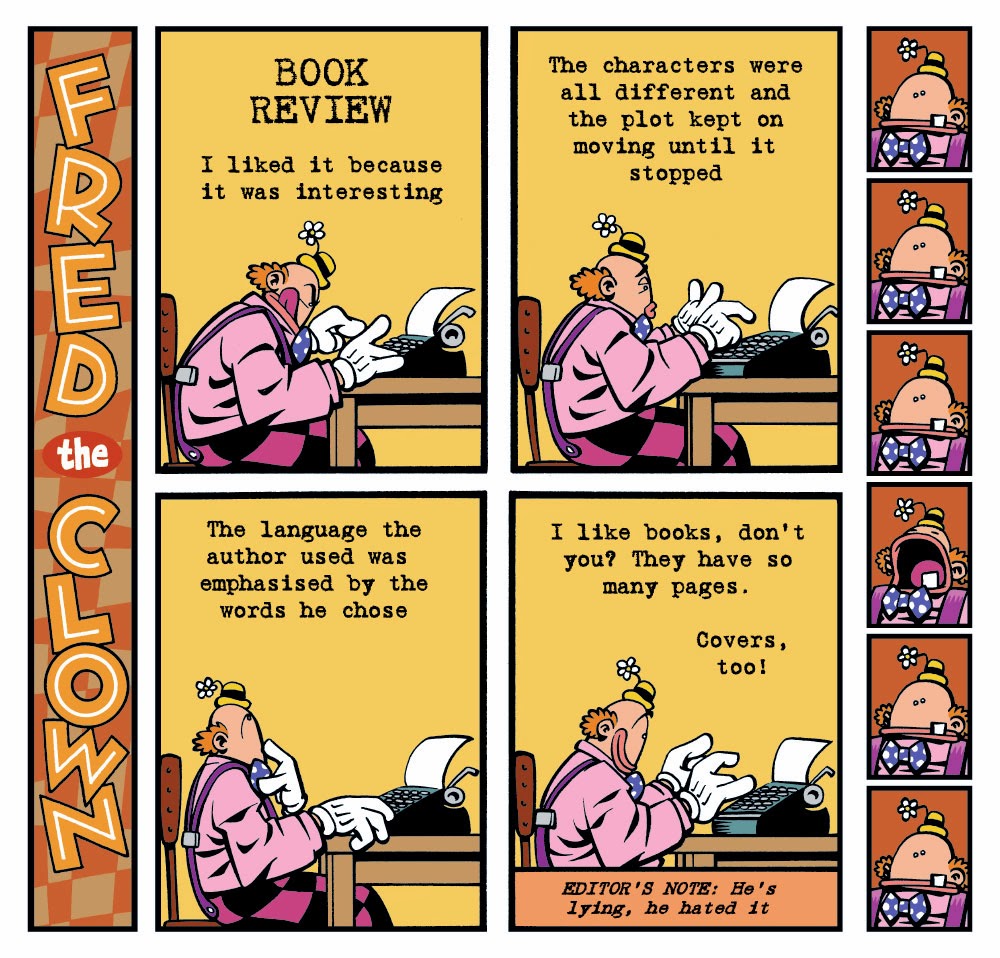
Fred the Clown: Book Review

fred_079-Book-Review
By Roger Langridge. I’ve read reviews like this (except the bit about liking books usually comes at the beginning).

Comments closed

Too Much Information

That the reality of machines can outpace the imagination of magic, and in so short a time, does tend to lend weight to the claim that the technological shifts in communication we’re living with are unprecedented… The scale of the transformation is such that an ever-expanding literature has emerged to censure or celebrate it. A series of books explaining why books no longer matter is a paradox that Chesterton would have found implausible, yet there they are, and they come in the typical flavors: the eulogistic, the alarmed, the sober, and the gleeful.

The New Yorker‘s critic-at-large Adam Gopnik reviews the recent spate of books about the internet and our minds — including Cognitive Surplus by Clay Shirky, The Shallows by Nicholas Carr, and Hamlet’s Blackberry by William Powers — neatly dividing them into the categories “Never-Betters”, the “Better-Nevers”, and the “Ever-Wasers”:

The Never-Betters believe that we’re on the brink of a new utopia, where information will be free and democratic, news will be made from the bottom up, love will reign, and cookies will bake themselves. The Better-Nevers think that we would have been better off if the whole thing had never happened, that the world that is coming to an end is superior to the one that is taking its place, and that, at a minimum, books and magazines create private space for minds in ways that twenty-second bursts of information don’t. The Ever-Wasers insist that at any moment in modernity something like this is going on, and that a new way of organizing data and connecting users is always thrilling to some and chilling to others—that something like this is going on is exactly what makes it a modern moment. One’s hopes rest with the Never-Betters; one’s head with the Ever-Wasers; and one’s heart? Well, twenty or so books in, one’s heart tends to move toward the Better-Nevers, and then bounce back toward someplace that looks more like home.

It is an article unlikely to satisfy either the evangelists or doom-mongers, but it sounds about right to me in a smart-alecky sort of way…
Comments closed

Midweek Miscellany

A true miscellany here: letterpress to Gil Scott-Heron with a lot of meat sandwiched in between… This is quite possibly why I blog…

Ditoria — An amazing video about showing the letterpress printing process by Roberto Bolado.

The Cost of Creating — Harvard Law Professor Lawrence Lessig, author of Free Culture (and others), discussing the Google Book Settlement on NPR’s On The Media last month (via INDEX//mb):

[W]e need to once again think about what the balance should be between free access to culture and metered access to culture, because both extremes are mistakes, either the extreme that says everything is free because then lots of people won’t create because they can’t cover their cost of creating, or the regime that says everything needs to be licensed, because in that world there’s a whole range of creativity… that can’t begin to happen because the cost of negotiating and clearing those rights is just so extreme.

Stopping Saying “Innovation”Scott Berkun, author of The Myths of Innovation, in The Economist (via Frank Chimero):

Worry more about being good because you probably aren’t. If your organization struggles to make half-decent products, has the morale of a prison, and nothing ever changes much less improves, why are you obsessing about innovation? You need to learn the basics of how to make something good, that solves real problems, works reliably, is affordable, and is built by a happy, passionate well rewarded staff that believes good ideas have a chance. If you can make the changes necessary for these basic but all too rare attributes to be true, then innovation, in all its forms, will be much easier to achieve, and it might just happen all on its own.

New Type York — A (beautifully designed) photoblog by graphic designer James Patrick Gibson recording the typographic artifacts of New York City.

And thinking of New York… The NY Times is planning to spin off its Book Review as a separate e-reader product.

The Vulture Gil Scott-Heron

A Wry Return — Sean O’Hagan profiles musician Gil Scott-Heron in The Observer, revealing an somewhat unexpected connection to Jamie Byng, director of Canongate Books. I say “somewhat” unexpected because having lived in Edinburgh just before Byng wrapped up his funk and soul club Chocolate City, it seems entirely reasonable to me now I stop and think about it:

The story of how Gil Scott-Heron’s new album came to be made is a long and convoluted one. It is, among other things, a testament to the abiding power of great music outside the mainstream to spread like a virus across cultures, across decades. It begins back in 1987 in a rented house in Edinburgh when a young student is mesmerised by his friend’s collection of soul and funk music from the halcyon days of the early 70s… “I was just taken aback by the voice, the words, the poetry,” remembers Jamie Byng who, 22 years on, is the director of Canongate Books and still a fervent soul fan… “Discovering those songs was an epiphanic moment for me…” So taken was Byng by those songs that, having bought and rebranded Canongate, he tracked down his hero and, in 1996, republished his two long-out-of-print novels, The Vulture and The Nigger Factory.

And here’s Gil Scott-Heron’s painfully appropriate cover version of Robert Johnson’s Me and the Devil:

Gil Scott-Heron’s books The Vulture and The Nigger Factory were recently reissued by Canongate.

3 Comments

Something for Weekend, May 29th, 2009

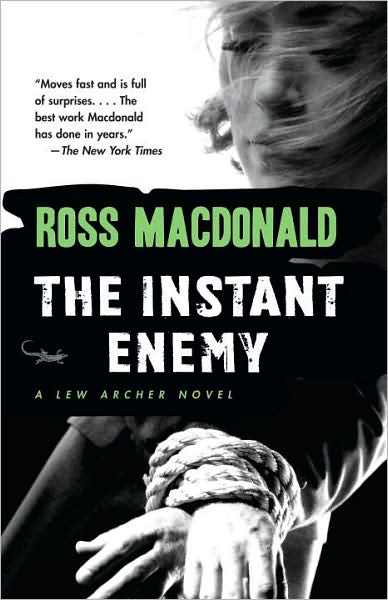
Hard-boiled — New designs for Ross MacDonald’s Lew Archer books by Joe Montgomery seen at FaceOut Books. I know I link to FaceOut just about every other week, but it’s an awesome site and the juxaposition of images in this series are great (as are some of the unused comps).

The Concierge and the BouncerPublishers Weekly report on Richard Nash (formerly of Soft Skull) and Dedi Felmen (formerly of Simon & Schuster) and their plans to “push back against the outmoded idea of publisher as cultural gatekeeper” with their new venture Round Table (announced at BEA this week):

The key is a shift from a caretaker mentality to a service mentality, from a linear supply-chain model to the idea of a free-floating, non-hierarchical “ecosystem” of readers, writers and authors… Nash and Felman’s idea of Publishing 2.0 could make a semi-professional reader, writer, editor and critic out of anyone with the desire.

Reading in a Digital World — A killer line in an otherwise blah article for Wired by Clive Thompson:

“We need to stop thinking about the future of publishing and think instead about the future of reading.”

Book Distribution in Canada — A Canadian Heritage study on book distribution in English Language Canada produced by Turner-Riggs dropped this week.

Can Editors Change Their Spots — David Hepworth’s thoughts on Robert G. Picard’s CS Monitor article ‘why journalists deserve low pay’,  and what “the new dispensation” means for  editors:

Magazine editors spend most of their time deciding what they’re *not* going to do and trying to arrive at a mix that the majority of people will like. They then find that whatever they’ve arrived at is too much for some people and not enough for others. This is made more difficult by the fact that their readers, being the most engaged in their particular area, are the people most likely to tap into other sources themselves. The people who value your mix most are also the people who would feel most qualified to mix it themselves.

The italics are mine.

Cover to Cover —  Steven Heller reviews newly released  ‘visual books’ in the New York Times with a nice accompanying  slide-show. (See image above, but hey NYT, when are you going to let people embed your slide-shows? When?).

Comments closed

Monday Miscellany, March 23rd, 2009

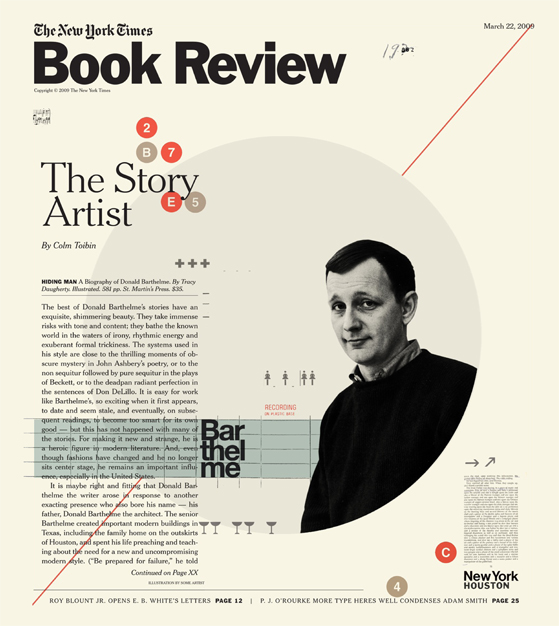
The Story Artist — Stand back and admire Cristiana Couceira’s cover for the New York Times Book Review (pictured above) illustrating Colm Toibin’s review of Hiding Man: A Biography of Donald Barthelme by Tracy Daugherty (St. Martin’s Press).  You can see more of Cristiana’s fabulous work at her blog Sete Dias.

ma collection de boîtes de conserves — Cartoonist Guy Delisle, author of Shenzhen, Pyongyang, and Burma Chronicles, displays his charming recycled pen-holders. Guy also has some great sketches of Jerusalem on his blog (an experience that is probably even better if your French is not rubbish like mine). (Via the D+Q blog and full disclosure etc: Raincoast Books distribute D+Q in Canada).

And speaking of D+Q,  John Wray’s much-praised novel Lowboy features a cover  by the very talented Adrian Tomine (pictured above). And über-critic James Wood reviews Lowboy in the latest New Yorker.

Paper Egg — Tobias Carroll has posted an interesting interview with Jonathan Messinger, co-publisher at  Featherproof Books:

[T]he line we’ve been delivering for a while now is that printed books will, eventually, go the way of vinyl. At some point, digital distribution will be the predominant method, but there will still be those who value and collect print, as people do records now (a fact that, it seems, has created a strong niche market for cool vinyl releases). But I’m not so sure that I completely buy that analogy, as fun as it is to repeat. Really, the debate seems pointless to me. What it always devolves to is one person clinging to what they’ve grown up with and accustomed to—the printed book, this classic, vaunted, untouchable commodity—and self-appointed visionaries who see digital distro as the obvious wave of the future, plowing down the fogies and fuddy-duddies.

If we de-politicize it, it becomes a much more open, interesting discussion. My feeling is that both media offer something that the other doesn’t. So why should one replace the other? … I’d rather just think about how best to use print creatively—what can it do that nothing else can, what are its limits and how do we test them?

Information revolution, c. 1455 — Murray Whyte looks at the “Gutenberg moment” in the Toronto Star:

as we appear finally to face the end, or partial end, of the Gutenberg era … it’s worth noting that sometimes, those things we view in hindsight as revolution are, in their own time, little more than a pebble in the pond, the resulting ripples needing generations, if not centuries, to be fully felt.

Comments closed

Something for the Weekend, Feb 27th, 2009

The 5 Rules of Book Cover Design Book — John Gall, VP and art Director at Vintage, talks about designing books at Barnes & Noble (video). There is also a nice print interview with John Gall from 2007 at STEP Inside Design magazine and another interview with the designer from the same year  at fwis Covers website (which is worth it just for the immortal line: “I want a telepathic dog.”) (John Gall at the Book Cover ArchivePragmatism: A Reader designed by John Gall,  pictured above)

Fear, panic, and a little bit of hope — Sarah Weinman discusses the perilous state of  the publishing industry on NHPR’s Word of Mouth.

Chapters-Indigo‘s move into e-books, Shortcovers, goes live to much curiousity and twittering. The Globe and Mail has the basics, The National Post’s The Ampersand rounds up some of the reactions, but O’Reilly’s TOC seems to sum up the general mood: “A Good Start, But Room for Reader Improvement”. Michael Serbinis, the executive VP, writes about the first day on the Shortcovers blog.

(NB – I’ve sort of been ignoring the Kindle2 stuff as it’s not available in Canada, but — just to have some balance — E-Reads has a nice round up of the coverage).

Influence the futureAnthro Goggles lists the first 4 SF books you should read if you work in social media.

Jacket Copy — An interesting interview with David L. Ulin, book editor of the Los Angeles Times (who folded their standalone book section 6-months ago), in PW:

Ulin takes a realistic, broad-ranging view of how book coverage will be presented in the future. “I’m committed to both print and Web. There are two readerships, and I’m not sure they’re the same. My main interest is, how do we get the most book coverage to the most people?” Ideally, Ulin would welcome a return to the stand-alone book review. “But we don’t have one now, and we’re not going to have one,” he says.

modernism 101 : from aalto to zwart — “We specialize in rare and out-of-print design books and periodicals. Our carefully-selected online inventory spotlights both famous and forgotten modernist architects, photographers, typographers, and industrial designers in all their published glory.” How could I not link to this? Even if you can’t afford the books (which I can’t) you can at least look at the covers! (The Twentieth Century Book by John Lewis pictured above). (via ISO150)

And on a related bookporn note, Grain Edit has some rather nice pictures of Typographica, the design journal edited by Herman Spencer…

Comments closed

The Confessions of a Literary Editor

With regard to the challenges facing book review editors, mentioned here yesterday, Scott Pack has posted an interesting Q & A with Robert McCrum, former literary editor of The Observer newspaper (and former editor-in-chief at Faber & Faber):

What criteria did you use as a literary editor when deciding which books to review?

I always tried to choose the very best books available on the shelves – and on many weeks I felt I never had enough space. Plus, I tried never to lose sight of the fact that The Observer is a news-paper. The books we covered had to satisfy some fairly basic (literary) news criteria. What do I mean by that? Well, a new novel by Philip Roth or Milan Kundera is automatically more newsy than almost any first novel, unless of course you decide — as literary editor — that, say, Zadie Smith is a new voice to watch out for.

It all seems so straightforward — and I do have some sympathy for this view — and yet it leaves you wondering what hope is their for debut authors, under-appreciated talents, and small presses? (Zadie Smith — if needs to be said — was published by Penguin and hyped to the gills). Perhaps it also gives some indication as to why all newspaper book sections look so similar and review so many of the same titles?

Link

Comments closed

The New Globe & Mail Books

As announced in December last year, The Globe and Mail replaced its standalone Books tabloid with a combined ‘Focus and Books’ section this weekend, simultaneously launching a new Books website that will feature, amongst other things, daily book reviews, news on books and the publishing industry, and blogs by Globe Book’s online communities editor Peter Scowen and Books editor Martin Levin.

In context of the numerous issues facing newspapers internationally, and the rapid decline of book review coverage in the US (and elsewhere) in recent years, the Globe’s long-foreshadowed shake-up has garnered barely a murmur outside of Canada. Nevertheless there has been some lively discussion on several Canadian book blogs.

Describing it as a “an inauspicious start” and “a work in progress”, That Shakespeherian Rag gives the new books coverage a thorough critical mauling, drawing particular attention a egregious error regarding the 2008 Giller Prize-winning novel Through Black Spruce by Joseph Boyden, and several other missteps. The Literary Lad’s final verdict: “[A] mixed, but generally underwhelming bag, with the online component scoring better than the new print format… Let’s hope that the early hiccoughs are just that, and not an indication of how things are to be run in the long term.”

Mark at INDEX // mb , who has clearly given this a lot of thought (he’s written about the launch too), isn’t keen on the presentation, but does give credit where he thinks it’s due: “The Globe team have given us a great online destination for Canadian readers. Congratulations to them for planning, creating, and delivering the new site.”

And despite some initial disappointments, Hugh at Book Oven is also optimistic, noting that the “decision to not just quietly kill their book section, as so many other papers have, but to relocate it is encouraging.”

Like Hugh, I’m grateful the Globe has decided to maintain some kind of book coverage in what is a horribly toxic environment for newspapers and book reviews. And I know book review editors (particularly, perhaps, Canadian ones) have a truly thankless task —  trying to please everyone means, inevitably, you please nobody (least of all bloggers!).

I am personally sad, however, to see two distinct sections that I liked unceremoniously (and somewhat incoherently) brought together in a expedient shotgun wedding. No doubt Focus and Books will grow into its new identity and improve with time, but the result this weekend lacked clarity and a sense of purpose. The new features appeared, well, rather desperate.

The online component — technical issues aside — feels a little belated to me and the Globe is lagging behind the extensive book coverage to be found elsewhere on the web, notably at the New York Times and the Guardian who committed earlier to being online. Better late than never though, and with an authoritative and informed focus on the Canadian literary scene, the Globe might be able to carve out a niche for itself given time.

Peter Scowen — who has been honourably responding  to the critical reactions on the Globe’s In Other Words blog — notes that the online launch did not go “without a hiccup” and I don’t suppose that producing the new print section was straightforward. Perhaps it is really too early to tell how this will all play out? Still, I must confess to being strangely ambivalent about the new section and website. With layoff expected at the Globe any day now, I can’t shake the feeling that they’re re-arranging the deckchairs…

1 Comment

Midweek Miscellany, Dec. 10th, 2008

NPR’s Best Graphic Novels of 2008 include Josh Cotter’s Skyscrapers of the Midwest, Local by Brian Wood and Ryan Kelly, Yoshihiro Tatsumi’s Goodbye, and Alan’s War by Emmanuel Guibert (pictured). There’s an excerpt available of each book selected. Nice. (Thanks Ehren!)

A new way to express an old idea – An interesting interview with Canadian designer David Drummond at Books Covered (via Design Observer):

I tend to start with a list of words. For example I am working on a cover now that is about a dog but can’t show the dog on the cover. I like those kind of problems. How do you show this without showing it?

Amazon’s Jeff Bezo is PW‘s Person of the Year.

“Suburban surrender”: James Wood revisits Richard Yates’ blistering novel Revolutionary Road in the latest The New Yorker.

Little to do with booksThe New York Times looks at the infighting and the politics of book groups:

Yes, it’s a nice, high-minded idea to join a book group, a way to make friends and read books that might otherwise sit untouched. But what happens when you wind up hating all the literary selections — or the other members? Breaking up isn’t so hard to do when it means freedom from inane critical commentary, political maneuvering, hurt feelings, bad chick lit and even worse chardonnay.

Russell Davies on “analogue natives”:

So much joyful digital stuff is only a pleasure because it’s hugely convenient; quick, free, indoors, no heavy lifting. That’s enabled lovely little thoughts to get out there. But as ‘digital natives’ get more interested in the real world; embedding in it, augmenting it, connecting it, weaponising it, arduinoing it, printing it out, then those thoughts/things need to get better. And we might all need to acquire some analogue native skills.

Comments closed