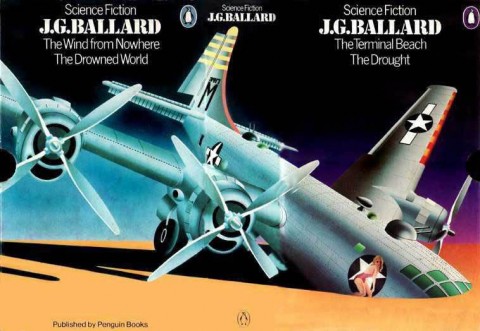
Atrocity Exhibition — Rick Poynor on the book covers and other visual interpretations of J.G. Ballard at Design Observer:
The repeated failure of editors, designers and illustrators to engage intellectually with The Atrocity Exhibition is all the more remarkable because the book offers a litany of Ballardian images: bunkers, concrete causeways, jutting balconies, crashed bombers, a drained sculpture fountain, a deserted beach resort, rubber mannequins and plastic dummies, as well as more ambiguous images such as a “conceptual auto disaster” or a “spinal landscape” — quite apart from its erotic content.
Cock of the Walk — Publisher Benedikt Taschen profiled in The Wall Street Journal:
Mr. Taschen admits he puts too much love and attention into his creations to ever go into the orbit of mass publishing, adding that he wants to make collectibles, not disposables. “Most books look so s— and dispassionately done; they are disposable from the beginning,” says the publisher. “Their books are not designed to become significant objects, so most books have no identity, no soul. I’m not saying all, but the vast majority [of publishing houses], with a few exceptions, have lost their profile and personality. It doesn’t look like they have spent a lot of care and love.”
The Lure of Lists — Literature professor Jeremy Dauber on the attraction of literary lists for More Intelligent Life:
Looking at the books double-stacked on shelves in my office, I can check off their provenance one by one: New York Times 10 Best Books of 2010; 500 Essential Graphic Novels; Harold Bloom’s guide at the end of The Western Canon; the awards list at the Locus Index to Science Fiction Awards; and the National Yiddish Book Centre’s 100 Greatest Works of Modern Jewish Literature. The stacks include the occasional recommendation of a friend or an impulse buy, but those are the exceptions to the list-derived rule.
I have never done a story in a shopping mall because, even if I’m not drawing it myself, I don’t want to see somebody draw a shopping mall. In the Hellboy world, and in other things I’ve done, those places almost don’t exist. When I do Eastern Europe—and I’ve been to Eastern Europe, and I’ve seen the shopping malls and the god-awful housing projects and things, and there are horror stories that take place in there, I have no doubt—but I gravitate toward the classic, clichéd, spooky places, whether they truly exist in this world or not.
Back in November, the chaps at The National Post asked me and a selection of eminently more qualified Canadian book types what we thought the most important publishing story of the past 10 years was. They ran the results at the weekend and the smart answers ranged from decline of literary magazines to the rise of Google.
I have to admit, I was at a bit of loss as to how answer the question. Decades are such arbitrary periods of time. I read somewhere that the 19th Century didn’t really end until 1914, and in a way I feel like the 21st Century didn’t really start until the day after 9/11 2001. And who is to say that epoch is over? So many things still look the same…
Of course I really have no idea what any of the last 10 years meant for books. I don’t have enough perspective. All I knew is that I wanted to say something positive (nobody likes a whiner) and avoid saying anything too obvious, boring or bullshitty (i.e. definitely no talk about either the “death of publishing” or “teh internetz”).
In the end I equivocated and then gushed about something close to my heart — comics:
“J.K. Rowling’s Harry Potter and online retailer Amazon dominated the decade, but they have their roots in the previous century (Amazon was founded in 1994, Harry Potter and the Philosopher’s Stone was published in 1997). George W. Bush surely has a claim — his crimes and misdemeanours created an industry within an industry and produced many fine books including The Dark Side by Jane Mayer and The Forever War by Dexter Filkins — but the very thought of the 43rd President of U.S. being the publishing story of the decade is simply too horrifying to contemplate seriously. Many people will no doubt say e-books, but I think they will be the story of the next decade. So I’m going to go with the popular success and the critical acceptance of long-form comics (the “graphic novel” if you must) as the big story. With the likes of Asterios Polyp, Black Hole, Bone, Epileptic, Fun Home, George Sprott, The Hunter, Jimmy Corrigan, Louis Riel, Paul Moves Out, Persepolis, Safe Area Gorazde, Scott Pilgrim, Skim and Shortcomings (not to mention the beautiful reprints of Peanuts and translations of Tezuka and Tatsumi) to name just a few, we really have had a wonderful decade.”
Perhaps, not the wisest thing I’ve ever written, but hey…
The Post also asked us to nominate our best books of the decade.
But with all those caveats firmly in place, here is my annotated and abridged list of the best books of the decade compiled for The Post:
Remainder by Tom McCarthy (Metronome 2005, subsequently published by Alma and Vintage)
Tom McCarthy’s Remainder was the first book I worked on at Raincoast Books — We briefly distributed the Alma Bookshardcover before Vintage published their own paperback edition (pictured above, cover design by John Gall of course,with the most unlikely of blurbs from Jonathan Lethem) in the US and Canada — so it has a special place on my shelf. Oh and it’s really good.
Here’s what I wrote for The National Post:
“If only for a fleeting moment Remainder, a dark and spare novel about personal authenticity and murderous re-enactment, seemed to offer a creative alternative to the cul-de-sac of overwrought and twee novels emanating from Brooklyn (and creative writing classes everywhere). Sadly the bloated and banal seem to have made a decided comeback (if they ever went away), but even so, the unashamedly intellectual Remainder stands out, perfectly capturing the fears and anxieties of the decade.”
Possibly the polar opposite of Remainder, Chabon’s literary Boy’s Own adventure hit a lot of my buttons: Golden Age Comics, Eisner, Steranko, European folklore, New York, and WWII. Really, what’s not to like? But my affection for this book ebbs with every new effort — including Chabon’s own — to repeat the formula and turn pulp into something politely literary. (And NB the Picador paperback cover design above is by Henry Sene Yee — you can see his sketches here).
Perhaps not my favourite graphic novel favourite of the decade (that slightly dubious honour would probably go to Tekkon Kinkreet — and although the English edition I own was published in 2007, the series itself is actually from the mid-90’s, so I didn’t think it qualified for this list), but Ware’s breakthrough graphic novel began the decade and went on to creatively define it for graphic novels. No Jimmy Corrigan, no McSweeney’s Issue 13.
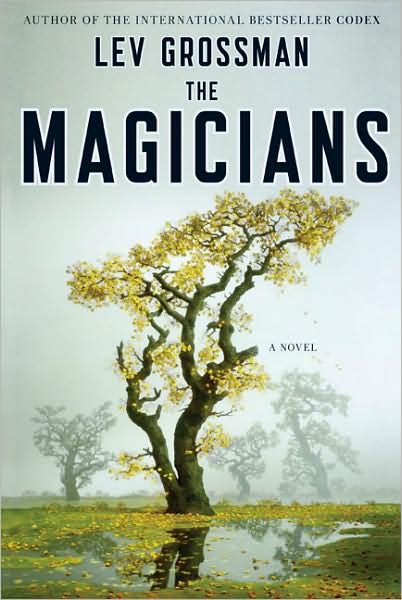
Like Kavalier and Clay, Ishiguro’s quietly evocative SF novel justifiably appeared on a lot of other Best of the Decade lists. It’s just beautifully, beautifully written and has a silver sliver of ice at its heart.
It’s almost impossible to think about books that are representative of the decade without including at least one on the Bush Presidency, 9/11 and the awful ‘war on terror’. The Dark Side could easily have been the aforementioned Forever War by Dexter Filkins, orGhost Wars by Steve Coll, or Imperial Life in the Emerald City by Rajiv Chandrasekaran, or one of the many other excellent books on these topics. But Mayer’s exposé of state-sanctioned torture chillingly underlines the bureaucratic banality of evil and the horror lived long in the mind after I finished reading it.
And, you know what? TheDark Side reminded me that books are important. They can and should be more than vehicles of self-promotion. Research — real research — requires more than Wikipedia. And — fuck it — we need to keep paying writers to write.
I suspect Louis Riel is now a creative and stylistic albatross for poor ol’ Chester Brown, but it was my joint first choice for the Canadian book the decade. This is what I wrote for The National Post:
“Not only is Louis Riel a uniquely Canadian story, it was published by Drawn + Quarterly (surely the most interesting Canadian publisher of the decade) and it epitomizes their success at unearthing and supporting creative talent. It isn’t a coincidence that Daniel Clowes—author of Ghost World and one the cartoonists of his generation—has decided to publish his new book with them.”
Although Pattern Recognition did not receive good reviews when it was first published and I bought the hardcover out of a reminder bin, it was my other pick for Canadian book of the decade. The book’s obsession with the fringes of pop culture and the dislocation and horror of the globalized world seemed to me (in some small way) to make it the first novel genuinely about the 21st Century. Even if it dates horribly (which many critics seemed to think it would), I think it’s a something of a cult classic. This is what I said to The National Post:
“A prescient post-September 11th novel about viral media, [Pattern Recognition is] the antithesis of the clunking, insular, parochial Canadian novel so beloved of literary prizes. The book is not without its flaws – it was not well received by the critics when it was published in 2003 – but it just fizzes with ideas, oddness, and energy. I can’t think of another Canadian novel that I refer to quite as often in everyday conversation. Give me flawed and brilliant over dull and worthy any decade of the century.”
OK — I love Pattern Recognition and I do talk about it a lot — but I was being a bit of a shit disturber here (which is probably why The Post ignored it). That said, Pattern Recognitionis better than several other books (that shall remain nameless) that did make the cut that’s for sure.
So, that’s my list. You can read the Post’s selections here. What did we miss out?
Unlike indomitable, indefatigable Sarah Weinman, I didn’t read over 462 books this year (think about it — that’s a book-and-a-quarter a day people!), so I couldn’t possibly post a best of the year list and keep a straight face. Still, I thought it might be nice to post an unscientific list of my 10 favourite new books of 2009 on the very last day of the year.
I also realised that — try as I might — it would be impossible to leave out books that I had worked on in some capacity. Apparently I need to get out more, but it I think this is a more universal symptom of work-life, digital-life, and “real” unplugged-life blurring (sometimes uncomfortably) for a lot of people in publishing (or is it just me?).
Anyway, with this in mind, all the books on this list distributed in Canada by Raincoast are identified with an asterisk. They’re here because I genuinely like them, but you’re an adult so you can make up your own mind about their merit.
And one last note: All the title links are to the Book Depository in the UK because they readily ship books worldwide. However, I have also linked to all the respective publishers, and added an IndieBound widget to the left sidebar (with links to all the listed titles) for anyone in the US who would like to support their local independent bookstore (Canadians: You can find your local indie via the CBA website).
My Advent Books recommendation for 2009, Asterios Polyp made it on to so many best of 2009 lists that Mazzuccelli’s beautifully understated and deceptively nuanced book almost feels over-hyped at this point. But you know what? It couldn’t possibly leave it off this list. I loved it. It’s a elegantly balanced combination of show and tell, and like Maus,Palestine, and, hell, even Watchmen before it, Asterios Polyp feel likes it expands the possibilities of the medium. Oh and Polyp reminds me of my art teacher at school — right down to the way he holds his cigarette — which, to be honest, is more than enough reason to be on this list.
A wonderful visual shopping list for any design-minded book collector, each of 100 classic graphic design books in this “ideal library” is shown with its cover and a number of spreads. It’s gorgeous and inspiring.
(NB: I’m hoping to have an interview with Jason in the New Year. Fingers crossed).
Zuckerman’s crisp hyper-real photographs (also see Creature, Wisdom) retain a warmth and genuineness that so often goes AWOL in contemporary digital photography. I mean god knows how much — or how little — work was actually done in Photoshop after the fact, but somehow the grace and natural beauty of the birds comes through. There is nothing clever, or even particularly gimmicky about this book, it is just really, really well done. The perfect coffee table book.
I’d been coveting the oversize and limited editions of this unashamedly beautiful collection of Harper’s paintings and illustrations for a while before Ammo released an affordable hardcover edition this year. This is simply a wonderful, inspiring book, and now there is no excuse not to own it.
Yoshihiro Tatsumi’s lovingly rendered 856 page manga portrait of an artist as a young man in post-war Japan was criminally overlooked in the best of the year lists in my humble opinion. It apparently took Tatsumi a decade to complete. “Epic” is just about the only word that covers it.
The subtitle — “A Collection of Letterpress Examples with Specimens of Type, Ornament, Corner Fills, Borders, Twisters, Wrinklers, and other Freaks of Fancy” — probably sums up this lovely book best. It is, admittedly, slightly bonkers, but it’s exactly the kind of thing that will eventually go out of print and then you’ll wish you’d bought one when you had the chance (and no, I won’t sell you mine).
THE HUNTERBY RICHARD STARK, ADAPTED & ILLUSTRATED BY DARWYN COOKE IDW, ISBN 9781600104930
Bleak, snappy, and fabulously illustrated, Darwyn Cooke’s adaptation of Richard Stark’s hardboiled Parker novel is pretty much pitch perfect. I only hope more Parker adaptations are on the way. Pretty, pretty please.
I deliberated over whether to include Philip Hoare’s charming book about whales in this list. Not that it isn’t worthy — it certainly is (it won the Samuel Johnson Prize for Nonfiction earlier this year) — but because it was first published in the UK 2008 and it is not available in North America until 2010 (HarperCollins’ Ecco imprint are releasing it under the title The Whale in February). So does it count as a 2009 title? In the end I decided it was eligible because it was published in paperback in 2009 and, ultimately, this is the year I read it (admittedly in hardcover) and it was too good to leave out. And Philip Hoare is from my home town. But that has nothing to do with it. Honestly.
The privileged offspring of Harry Potter and The Secret History (and/or Whit Stillman) invade Narnia and shoot things. It’s almost as good as it sounds, although it’s a shame the protagonist is, to be quite frank, a simpering cock. Nice villain though.
A tidy collection of contemporary graphic design inspired by the classic mid-century modern of Saul Bass, Lucienne Day, Alexander Girard, Charley Harper, and others. There are a few too many music posters perhaps, but Naïve is still neato coolsville.
So there you go, that’s my 10 favourite books of the year. What were yours?
 Atrocity Exhibition — Rick Poynor on the book covers and other visual interpretations of J.G. Ballard at Design Observer:
 A wonderful gallery of book trade labels.
 …On the list of all things awesome, BLDGBLOG interviewing Hellboy creator Mike Mignola ranks pretty highly (thanks @derekmurr):