Skip to content

Tag: biography

Life Stories

Grant Snider for the New York Times.

Comments closed

Choose Your Own Memoir

chooseyourownmemoir-web

Grant Snider for the New York Times Book Review.

Comments closed

A Publishing House of Her Own

LadyWiththeBorzoi.indd

Joanna Scutts reviews The Lady with the Borzoi, Laura Claridge’s new biography of Blanche Knopf, for the New Republic:

When the house of Knopf launched in 1915, publishing was a gentleman’s pursuit—amateur, clubbish, WASP, and above all, male. Blanche and Alfred navigated this casually anti-Semitic world, holding themselves aloof from their alcoholic, philandering competitor, the “pushy Jew” Horace Liveright, founder of the Modern Library and publisher of T. S. Eliot’s The Waste Land. Over the years there would be female secretaries, copywriters, reviewers, and editors at Knopf. There would be women in charge of little magazines and the children’s-book divisions of big publishers. But there would be no other woman in the publishing industry with the status of Blanche Knopf—either in the 1920s, when she signed Langston Hughes and Willa Cather, or in the 1950s, when she celebrated Albert Camus’s Nobel prize and oversaw the translation of Simone de Beauvoir’s The Second Sex. And despite it all, although her husband swore he’d put her name on the masthead, he never did…

…For the Knopfs, marriage proved much more difficult than publishing. In Claridge’s hands Alfred Knopf takes his place in twentieth-century literature’s crowded pantheon of assholes—his great loves were the American Southwest, expensive wine, and the ritual humiliations of his friends, his family, and most of all, his wife. One after another, acquaintances and co-workers attest to a relationship that today we’d call toxic; a stew of jealousy, incompatibility, violence, and—just when it couldn’t get worse—yearning affection.

Comments closed

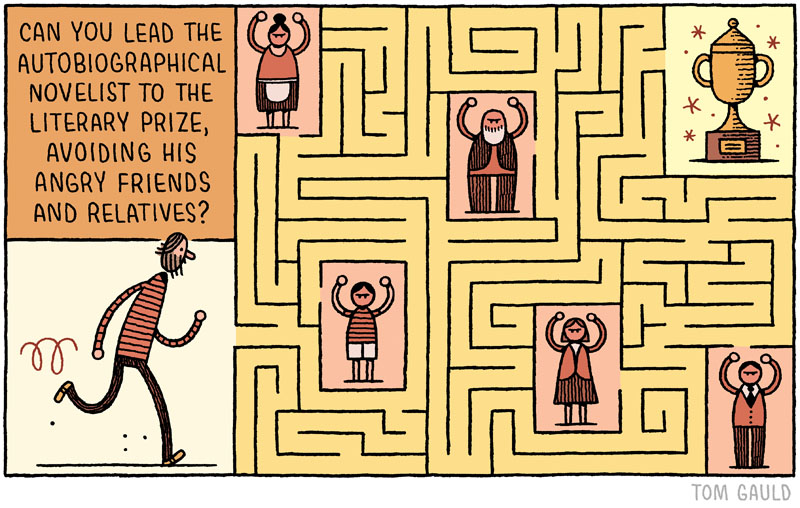
Lead the Autobiographical Novelist to the Literary Prize

autobiographical novelist Tom Gauld

Tom Gauld on Karl Ove Knausgaard for The Guardian.

Comments closed

Norman Rockwell, American Romantic

Christopher Benfey reviews American Mirror, Deborah Solomon’s recently published biography of artist Norman Rockwell, for the New York Review of Books:

Solomon spends more time than Rockwell did worrying about his status in comparison with what she calls the “Abstract Expressionist ilk,” who “glamorized direct and unmediated gestures” and dominated highbrow taste during the 1950s. Rockwell, who was remarkably uncompetitive and nonterritorial, said, disarmingly, “If I were young, I would paint that way myself.” The Connoisseur of 1962, a painting now in the collection of Steven Spielberg that Solomon considers a “masterpiece,” depicts a balding man seen from behind, in a gray suit with hat and umbrella in hand, contemplating what seems to be a Pollock painting. The floor, bluish-gray and white squares and triangles, constitutes a contrapuntal abstraction. Rockwell had fun making his own drip painting, canvas on the floor, and had a photographer record the event just as Hans Namuth, in 1950, had famously documented Pollock wielding a can of paint over the canvas. It’s charming to learn that Willem de Kooning, a longtime admirer of Rockwell, claimed to think that Rockwell’s Pollock was better than the real thing. “Square inch by square inch,” he said, “it’s better than Jackson!”

(American Mirror: The Life and Art of Norman Rockwell is published by Farrah, Straus & Giroux, and is distributed in Canada by my employer Raincoast Books)

Comments closed