Skip to content

Tag: berlin

Freunde von Freunden: Erik Spiekermann Interview

Freunde von Freunden visit the apartment and studio of designer and typographer Erik Spiekermann:

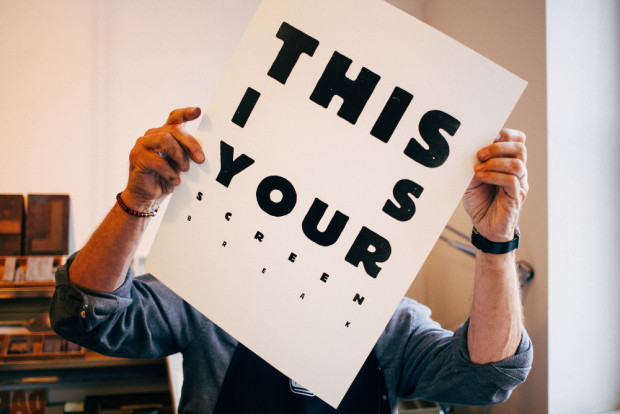
A look around his tidy, if eclectic, home offers an eye pleasing sampler of the designer’s interests. One of his home’s main attractions is his two-story bookshelf, mostly filled with titles pertinent to his profession and only accessible by the seated pulley system Spiekermann developed for one of his favorite leisure activities – browsing his massive library and getting lost in his passion for words and images. “It’s almost like a safety net having all my books here. I have a lot of cool stuff that other people don’t have, and I love browsing and discovering books I’ve had 50 years. I’d love to spend time just browsing through my bookshelves. Every time I go to look for something I find something else, you get totally stuck. There’s nothing better than getting stuck on a Sunday afternoon with books you’ve forgotten about.”
MG_9983

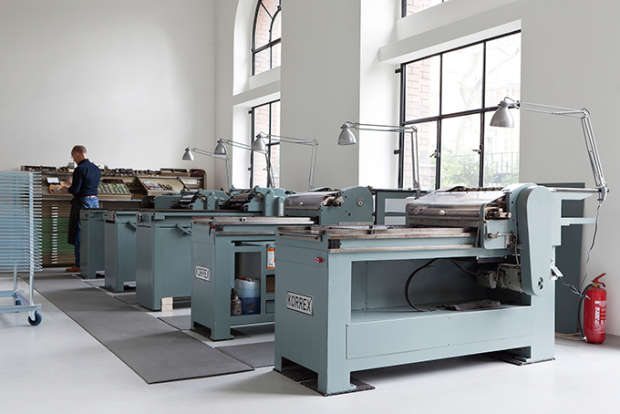
And on a related note, Madeleine Morley spends a day at Spiekermann’s print workshop, p98a for Port magazine:

The process of printing is repetitive, slow, and surgical, but also very peaceful and contemplative – like knitting or carpentry. We insert pieces of paper into the letterpress, rotate the handle, stack the print on a drying rack, re-ink the font, then start again. By this point, we begin to develop a consistent and robot-like rhythm, but we’re a clunky, less graceful team in comparison to  guild of typographers.

I ask [Alexander] Nagel why he prefers this method of design: “It has more… sinne,” he replies, using a German word that is difficult to translate. The term means ‘touch’ or ‘sense’. It refers to the haptic, but also means ‘significance’. This is something people say a lot about the printed page and its physical tangibility, but it’s something you don’t quite appreciate until you’re actually building one of these templates from metal, wood and paint.
Comments closed

Creative Characters: Erik Spiekermann

P98a-spiekermann

Type designer Erik Spiekermann recently spoke to MyFont’s Creative Characters newsletter about his career and his return to letterpress printing:

I think it’s very appropriate to discuss the new interest in analog technologies, and the ways that young people are now finding to combine the analog and the digital. In fact, the difference between the two is disappearing. As type specialist Indra Kupferschmidt also remarked recently — there’s no longer any reason to make things for the screen that look worse than designs made for print. Anybody who does layouts for the screen must know about type and typography just as well as someone who designs for paper. So what counts is, just like before, how to get the message across. We have the technology, there is no more excuse for a job badly done.

What I find very interesting is the movement of people who are savvy in digital design but are genuinely interested in analog techniques. It is now more than a passing trend; there must be a deeper motive why we are newly interested in the hand-made and the haptic, material and three-dimensional aspects of type and design.

Comments closed

I Am Not a World Improver: Mies van der Rohe and Building Seagram

Christopher Turner reviews Building Seagram by Phyllis Lambert and Mies van der Rohe by Franz Schulze and Edward Windhorst for February’s London Review of Books:

Mies had dreamed of building skyscrapers since the early 1920s when, as a young architect in Berlin recently returned from the war, he’d been seduced by images of the thrusting New York skyline. Influenced by the utopian futurism of Paul Scheerbart, author of Glasarchitektur, Mies proposed a 20-storey tower completely sheathed in glass. It would have loomed over Berlin like an enormous faceted crystal: each wall was positioned at a slight angle to reflect and refract the light. He was fond of quoting St Augustine – ‘beauty is the radiance of truth’ – and wanted to celebrate rather than disguise structural form. ‘Only skyscrapers under construction reveal the bold constructive thoughts,’ Mies wrote, ‘and then the impression of the high-reaching steel skeletons is overpowering.’ In his glass tower, the bones of the building, with their cantilevered floor slabs, would have been visible through a shimmering, crystalline skin.

The glass skyscraper was, as Schulze and Windhorst put it, ‘beyond the threshold of constructability’ (and would only be possible in the 1970s – Mies was fifty years ahead of his time), but it was intended less as a realistic proposal than a radical, modernist statement. It would thrust him to the forefront of the European avant-garde.

Comments closed

Midweek Miscellany

Ruined… For Life — Yuka Igarashi on the consequences of copy-editing at Granta:

There is a danger to copy-editing. You start to read in a different way. You start to see the sentence as machinery. You focus on the gears and levers that connect words to one another; you hunt for the wayward semicolon, the unintentionally ambiguous phrase, the clunky repeated word. You even hope they appear, so you can kill them. You see them when they’re not even there, because you relish slashing your pen across the paper. It gets a little twisted.

As with any kind of technical knowledge or specialization, it is possible to take copy-editing too far, to be ruled by it, to not quite be able to shut it off when it ought to be shut off.

(As if to prove the point, the article itself is copy-edited in the comments)

The Undercoat of Modernity — Mathias Schreiber on Berlin in the ‘Golden Twenties’ for Der Spiegel:

Looking back on the period, playwright Carl Zuckmayer… who lived in Berlin from 1924 to 1933, wrote: “The arts blossomed like a meadow just before being mowed. This explains the tragic yet brilliant charm that is associated with this era, often seen in the images of poets and artists who died prematurely.”

The realization that this euphoria could not last undercoats the best works of art of these years with the metallic tone that soon became the trademark of artistic modernity. This applied, quite literally, to the refined simplicity of the anti-plush, steel-tube furniture of Bauhaus designer Marcel Breuer and the architecture of the same movement, fashioned from strictly functional steel skeletons… Metaphorically speaking, the tendency toward metallic, unadorned expression also applied to the literature of the period, and certainly to the objectivist collage technique employed by Alfred Döblin in his novel “Berlin Alexanderplatz” (1929). Döblin blends together the sound of wind, the rhythmic thud of the steam pile-driver, quotations from newspaper advertisements, stock market reports, soldiers’ songs, nursery rhymes and prostitutes’ patois with expressive, poetic flights of fancy, and injects all of these noises and fragments of language into the protagonist’s stream of consciousness… This first important big-city novel in the German language was also the first great 20th-century novel about the working classes.

And finally…

Purpose in the Wreckage — Simon Hattenstone’s endlessly quotable interview of media-shy musician Scott Walker, for The Guardian:

When [Walker] returned in 1995, it was as a fully fledged modernist composer. On the surface, there couldn’t have been a more unlikely transformation – imagine Andy Williams reinventing himself as Stockhausen. Yet in a way it was all of a piece. His latest album, Bish Bosch, is only his third in 17 years, all of them elaborate, epic and inaccessible. It is a post-apocalyptic opera of sorts, with blasts of rams’ horn, dog barks, scraping swords, machetes. The music nods at Gregorian chant, doffs its cap to Shostakovich, gives a thumbs up to industrial metal, and is uniquely Scott Walker. The lyrics reference sexual disease, brown dwarf stars, court jesters and dictators, all delivered in a strangulated baritone, as if Walker’s testicles were being squeezed. At times there’s a terrible beauty to his poetry (“Earth’s hoary/fontanelle/weeps softly/for a/thumb thrust”) while at others there’s a bloodthirstiness that could be straight out of Jacobean tragedy (“I’ve severed my reeking gonads, fed them to your shrunken face”). It’s brilliant and bonkers. The opposite of a guilty pleasure: a guilty torture.

And why not?

Comments closed