Skip to content

Tag: bauhaus

Moholy-Nagy: Future Present

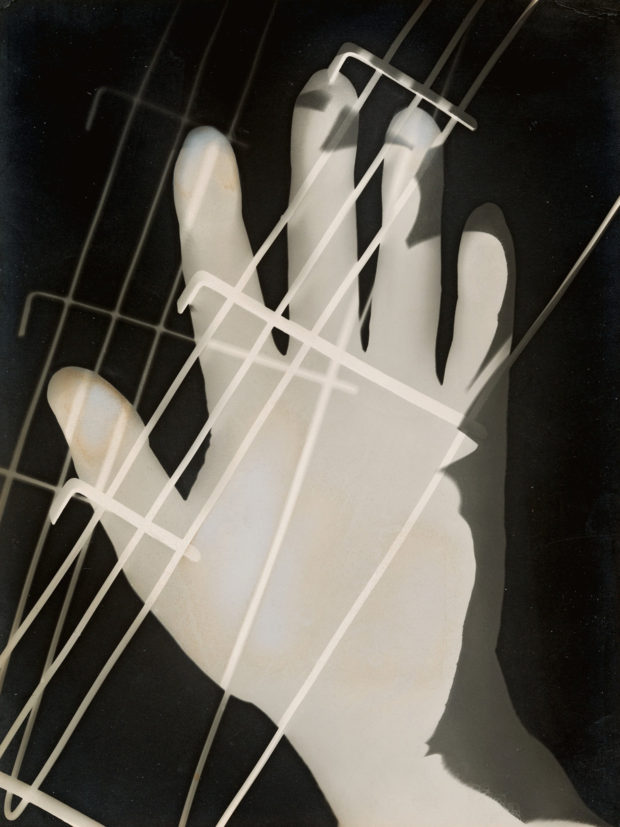
“Photogram” (1926) by Lazlo Moholy-Nagy.
“Photogram” (1926) by Lazlo Moholy-Nagy

The New York Times on a new exhibition of work by Hungarian artist and designer Laszlo Moholy-Nagy at the Guggenheim in New York:

The first large Moholy-Nagy exhibition in this country in over 50 years may also be, its organizers say, the largest anywhere. It packs around 300 works into Frank Lloyd Wright’s great spiral — perhaps a record itself. They represent some dozen mediums including painting and sculpture, film and projection, works on paper as well as graphic, set and exhibition design and several forms of photography.

The show provides a bracing picture of both the extent and the unity of Moholy-Nagy’s art as it moves up the ramp, superbly styled for the occasion by Kelly Cullinan, the museum’s senior exhibition designer. Her scheme separates Moholy-Nagy’s achievement into separate strands and then braids them together fluidly. The abstract paintings and sculptures dominate the museum’s signature bays; most films are displayed in small alcoves between the ramps. Moholy-Nagy’s extensive writings and graphic design are displayed on each level in vitrines, whose bright rectangular lids manage to evoke the colorful trapezoids in his paintings. And his complex involvement with photography is played out on free-standing partitions, enabling close study of the interplay of documentary, photomontage and camera-less photograms — a term he invented — sometimes made using his own sculpture. Certain forms and motifs reappear in different mediums, and the give and take between photography and painting is one of the show’s driving forces.

It sounds like a must-see.

Moholy-Nagy: Future Present is at the Guggenheim until September 7. The exhibition is also travelling to Chicago and Los Angeles.

Comments closed

I Am Not a World Improver: Mies van der Rohe and Building Seagram

Christopher Turner reviews Building Seagram by Phyllis Lambert and Mies van der Rohe by Franz Schulze and Edward Windhorst for February’s London Review of Books:

Mies had dreamed of building skyscrapers since the early 1920s when, as a young architect in Berlin recently returned from the war, he’d been seduced by images of the thrusting New York skyline. Influenced by the utopian futurism of Paul Scheerbart, author of Glasarchitektur, Mies proposed a 20-storey tower completely sheathed in glass. It would have loomed over Berlin like an enormous faceted crystal: each wall was positioned at a slight angle to reflect and refract the light. He was fond of quoting St Augustine – ‘beauty is the radiance of truth’ – and wanted to celebrate rather than disguise structural form. ‘Only skyscrapers under construction reveal the bold constructive thoughts,’ Mies wrote, ‘and then the impression of the high-reaching steel skeletons is overpowering.’ In his glass tower, the bones of the building, with their cantilevered floor slabs, would have been visible through a shimmering, crystalline skin.

The glass skyscraper was, as Schulze and Windhorst put it, ‘beyond the threshold of constructability’ (and would only be possible in the 1970s – Mies was fifty years ahead of his time), but it was intended less as a realistic proposal than a radical, modernist statement. It would thrust him to the forefront of the European avant-garde.

Comments closed

Design is Fine


Design is Fine. History is Mine, an eclectic design history blog compiled by Rea Riegel, a copy writer and lecturer from Germany, is one of my favourite new Tumblrs. Go take a look.

(Pictured above: Pierre Reverdy and Pablo Picasso Le chants des morts, 1948)

2 Comments

Design in a Nutshell


The Open University has created a fun series of short animated introductions to six of the most important movements in design history. Starting with the Gothic Revival, it looks at the Arts and Crafts movement, Bauhaus, Modernism, American Industrial Design, and  Postmodermism.

Here are the films on the Bauhaus and Modernism:

(via Coudal / Open Culture)

1 Comment

Midweek Miscellany

Ruined… For Life — Yuka Igarashi on the consequences of copy-editing at Granta:

There is a danger to copy-editing. You start to read in a different way. You start to see the sentence as machinery. You focus on the gears and levers that connect words to one another; you hunt for the wayward semicolon, the unintentionally ambiguous phrase, the clunky repeated word. You even hope they appear, so you can kill them. You see them when they’re not even there, because you relish slashing your pen across the paper. It gets a little twisted.

As with any kind of technical knowledge or specialization, it is possible to take copy-editing too far, to be ruled by it, to not quite be able to shut it off when it ought to be shut off.

(As if to prove the point, the article itself is copy-edited in the comments)

The Undercoat of Modernity — Mathias Schreiber on Berlin in the ‘Golden Twenties’ for Der Spiegel:

Looking back on the period, playwright Carl Zuckmayer… who lived in Berlin from 1924 to 1933, wrote: “The arts blossomed like a meadow just before being mowed. This explains the tragic yet brilliant charm that is associated with this era, often seen in the images of poets and artists who died prematurely.”

The realization that this euphoria could not last undercoats the best works of art of these years with the metallic tone that soon became the trademark of artistic modernity. This applied, quite literally, to the refined simplicity of the anti-plush, steel-tube furniture of Bauhaus designer Marcel Breuer and the architecture of the same movement, fashioned from strictly functional steel skeletons… Metaphorically speaking, the tendency toward metallic, unadorned expression also applied to the literature of the period, and certainly to the objectivist collage technique employed by Alfred Döblin in his novel “Berlin Alexanderplatz” (1929). Döblin blends together the sound of wind, the rhythmic thud of the steam pile-driver, quotations from newspaper advertisements, stock market reports, soldiers’ songs, nursery rhymes and prostitutes’ patois with expressive, poetic flights of fancy, and injects all of these noises and fragments of language into the protagonist’s stream of consciousness… This first important big-city novel in the German language was also the first great 20th-century novel about the working classes.

And finally…

Purpose in the Wreckage — Simon Hattenstone’s endlessly quotable interview of media-shy musician Scott Walker, for The Guardian:

When [Walker] returned in 1995, it was as a fully fledged modernist composer. On the surface, there couldn’t have been a more unlikely transformation – imagine Andy Williams reinventing himself as Stockhausen. Yet in a way it was all of a piece. His latest album, Bish Bosch, is only his third in 17 years, all of them elaborate, epic and inaccessible. It is a post-apocalyptic opera of sorts, with blasts of rams’ horn, dog barks, scraping swords, machetes. The music nods at Gregorian chant, doffs its cap to Shostakovich, gives a thumbs up to industrial metal, and is uniquely Scott Walker. The lyrics reference sexual disease, brown dwarf stars, court jesters and dictators, all delivered in a strangulated baritone, as if Walker’s testicles were being squeezed. At times there’s a terrible beauty to his poetry (“Earth’s hoary/fontanelle/weeps softly/for a/thumb thrust”) while at others there’s a bloodthirstiness that could be straight out of Jacobean tragedy (“I’ve severed my reeking gonads, fed them to your shrunken face”). It’s brilliant and bonkers. The opposite of a guilty pleasure: a guilty torture.

And why not?

Comments closed

Something for the Weekend

A stunning jacket design by the great Isaac Tobin for After Freud Left, published by University of Chicago Press.

You can read my interview with Isaac from 2009 here.

Bauhütte to Bauhaus — A fascinating overview of the Bauhaus by Frank Whitford, author of the Thames & Hudson ‘World of Art’ book Bauhaus,  for the TLS:

The structure of the Bauhaus… followed, as Gropius thought, medieval principles. He coined the school’s name so as to echo the word Bauhütte, in the Middle Ages the German for a guild of masons, builders and decorators. And the teaching was based on specialist workshops where you learned your trade by carrying out actual projects, graduating from apprentice to journeyman and master. The teachers were at first called Masters and not Professors, a revolution in a country where academic snobbery was the norm.

Calligraphica — A new tumblr devoted to calligraphy and hand drawn type (pictured above: ‘One Hope One Quest’, by Greg Papagrigoriou).

Persuasion — Michael Bierut talks to Designers & Books about his collection 79 Short Essays on Design:

Even the best designers have to persuade people all the time. They have to persuade people to hire them; then they have to persuade people to go with the recommended solution; then they have to persuade people to realize that solution in the best possible way. Simply showing someone a nice design is almost never enough. This constant effort—and all the rejection that inevitably ensues—obviously requires healthy confidence and nerves of steel, if not a strong ego.

And finally…

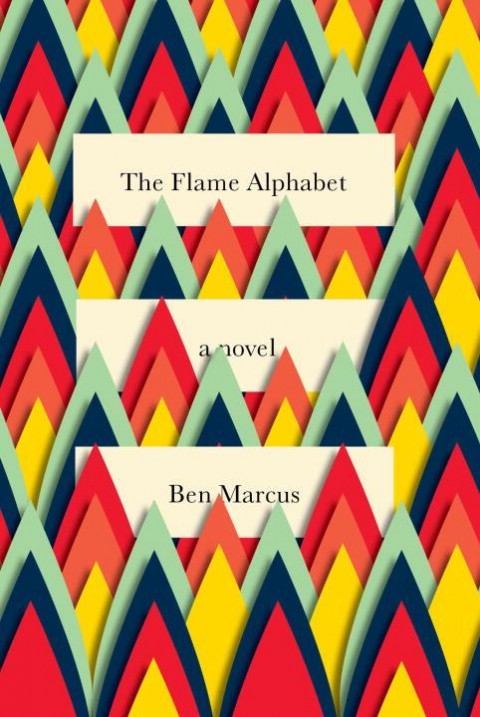
Critic James Lasdun reviews The Flame Alphabet by Ben Marcus for The Guardian:

Language, the debasement, banality and ultimate toxicity thereof, is his subject. It’s a staple topic of avant garde literature, from the Prenzlauer Berg writers of the former East Germany to the Language poets of the American academy. All proceed, more or less, on the basis that verbal communication has been fatally corrupted by political or literary abuse and can be rescued only by a total dismantling and reassembly. Results vary (I’ve yet to read a Language poem that didn’t make me want to dissolve it in acid), but Marcus’s own, especially in The Age of Wire and String, have been haunting and inventive.

Comments closed

Midweek Miscellany

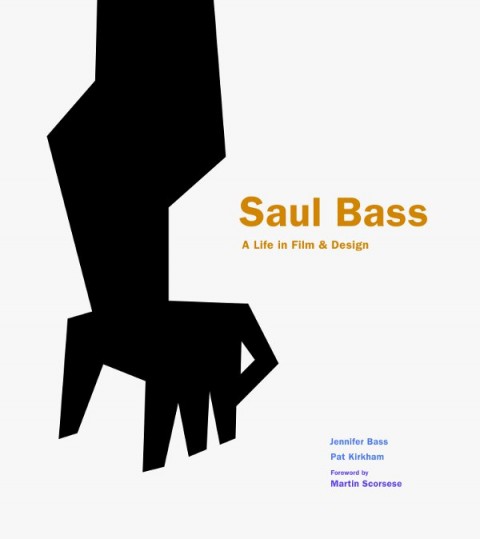
Lyra Kilston reviews Saul Bass: A Life in Film and Design for the LA Review of Books.

The Well-Made Book — An interesting article by Michael Agresta on how printed books, and their design, are changing in the digital age:

Now, as we move into the digital age, the well-made copy has come to occupy a familiar, almost nostalgic middle ground between the aura of an original and the ghostly quality of a computer file. A mass-produced paper book, though bulkier and more expensive, may continue to be more desirable because it carries with it this material presence. And presence means something—or it can, at least, in the hands of a good book designer.

Innards and Interiors — The Bauhaus: Art as Life exhibition at the Barbican reviewed at The Financial Times:

Paul Klee favoured risotto with steamed calf’s heart, sour liver and lung ragout: in the kitchen, as in his paintings, he was obsessed with innards, interiors, reconfiguring essential forms. Wassily Kandinsky lived in a streamlined white apartment but, incongruously, cooked on a “kamin” – a Russian wood-burning stove made from heavily ornamented black iron. Josef Albers claimed “I paint the way I spread butter on pumpernickel” – robustly and straightforwardly; he called the colour mixes in his “Homage to the Square” series his “recipes”. And Swiss painter and vegetarian zealot Johannes Itten was driven out of Weimar because he hijacked the Bauhaus kitchen and alienated director Walter Gropius by producing only “uncooked mush smothered in garlic”. The Barbican’s new exhibition… gives a whole new flavour to the story of the art school long seen to embody sober, purist German modernism.

Weird Comics — Local small press publisher Annie Koyama profiled in the Quill & Quire:

Koyama says her strategy for the year ahead is “to throw everything against the wall and see what sticks,” but she acknowledges her biggest business challenge is twofold: increasing print runs to improve margins and lining up reliable distribution for the fledgling firm. After working around the clock for nearly four years… she says her goal now is to create a sustainable enterprise that can continue to fulfill its artist-centric mandate… She’s also considering expanding into children’s books. But not in the way you’d expect. “While there are a million good kids’ books out there, there aren’t a million good kids’ comics I can see – especially not weird ones,” she says.

And finally…

Maurice Sendak, “author of splendid nightmares” has passed away aged 83. The New Yorker has made a short Art Spiegelman comic about meeting Sendak available online. And here is a wonderful interview with author from December last year:

Comments closed

Midweek Miscellany

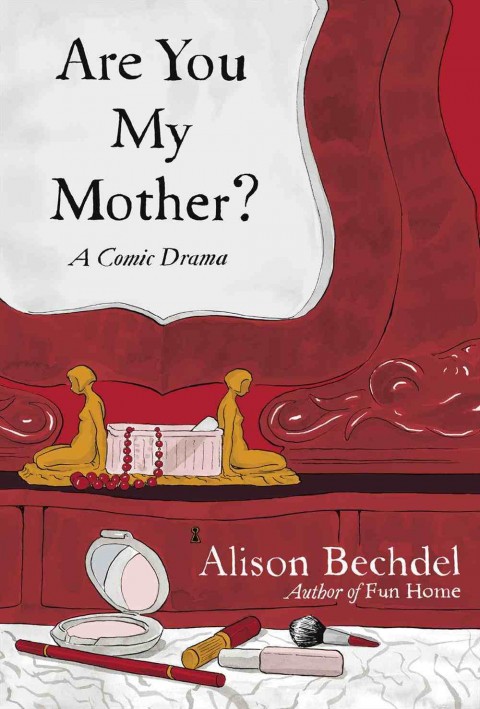
This Precarious Balancing Act — Maud Newton talks to Alison Bechdel, author of (the astonishingly good) Fun Home, about her new graphic novel Are You My Mother?. Fascinating stuff:

I feel like cartooning for me has been like a way to be a crypto-writer. I couldn’t ever say I wanted to be a writer because my mother was a writer, and even now I’ve had to find this alternative way of expressing myself as a writer. I don’t want to diminish the drawing. I think it’s integral to what I do. But I’m kind of a secret writer… I’m very wordy for a cartoonist. I’m always struggling against that, because the more space your words take up the less room you have for pictures. So it’s always this precarious balancing act.

School Disco — Mark Medley’s latest National Post piece on House of Anansi Press follows the publisher to the London Book Fair:

The London Book Fair, now in its 41st year, is one of the biggest, and most important, in the world — though it is dwarfed by Frankfurt, which takes place in October. This year, the fair hosted more than 1,500 exhibitors from 57 countries and expected more than 25,000 attendees, almost half from overseas. During the festival’s three days, MacLachlan describes it variously as “a meeting of the tribe,” “highly social,” and “like [a] school dance. The cool kids are in one corner, the nerds are somewhere else.”

Confused By the eBook Lawsuit? So Is Everyone else” — Peter Osnos, founder of Public Affairs Books, writing at The Atlantic.

And finally…

With the Bauhaus: Art as Life exhibition opening at the Barbican tomorrow, author Fiona MacCarthy (William Morris: A Life for Our Time)  looks back at the revolutionary design school at The Guardian:

Gropius’s idea for the Bauhaus emerged from his experience of the first world war in which he served as a cavalry officer on the western front for almost the whole four years. His response to the devastating scenes he lived through was a stark determination to “start again from zero”. Only a new outlook on design and architecture could provide the means for a shattered civilisation literally to rebuild itself… Gropius’s vision was for the “unification of the arts under the wings of great architecture”. It was a democratic concept of art for the people, art for social betterment in which everyone would share. The Bauhaus aesthetic replaced bourgeois furbelows with a geometry of clarity, sharp angles and straight lines.

The Guardian’s art critic Adrian Searle reviews the show here.

2 Comments

Something for the Weekend

A stunning new cover for James Joyce’s The Dubliners by German designer Apfel Zet (which reminds me — in a good way — of Tony Meeuwissen’Woodbine-inspired cover for Billy Liar published by Penguin in the 1970’s).

Consistent Forms of Hostility — With an exhibition opening in May at the Barbican in London, Rowan Moore looks at the enduring influence the Bauhaus school at The Guardian:

Not much united Walter Ulbricht, the Stalinist dictator of East Germany for two decades, and Tom Wolfe, celebrant of the splendours and follies of American capitalist excess. Not much, except a loathing of the Bauhaus and the style of design it inspired. Ulbricht called it “an expression of cosmopolitan building” that was “hostile to the people” and to “the national architectural heritage”. Wolfe called it “an architecture whose tenets prohibit every manifestation of exuberance, power, empire, grandeur or even high spirits and playfulness”.

For Ulbricht it was alien to Germany, for Wolfe it was alien to America. Both agreed that it was placeless, soulless and indifferent to ordinary people’s needs. And if the Bauhaus attracted such consistent forms of hostility, that is due to the power and coherence of the image it presented to the world, of disciplined and monochrome modernist simplicity, usually involving steel and glass.

Translators Jay Rubin and J. Philip Gabriel talk about translating Haruki Murakami into English at the SF Bay Guardian.

And finally…

A Very American Critic — Elaine Showalter on film critic Pauline Kael at the TLS:

Cosmopolitan in her reading, sophisticated about international cinema, and au courant with theories of the auteur, Kael was nonetheless a very American critic. She was forty-seven before she ever travelled to Europe, and from the very beginning, she used her reviews and essays to explore what it meant to write film criticism in the United States, where the movies were always a compromise between art and commerce. “The film critic in the United States”, she wrote in “Movies, the Desperate Art” (1959), “is in a curious position; the greater his interest in the film medium, the more enraged and negative he can sound”. American film critics risked the temptations of selling out to Hollywood, or expressing contempt for mass market films. Kael prided herself on both her knowledge of the film medium and her deep love for the movies, trashy and avant-garde alike. Movies, she wrote in “The Function of a Critic” (1966), “are one of the few arts (along with jazz and popular music) Americans can respond to without cultural anxieties”. She did not intend to condescend to her readers or tell them that their tastes were wrong.


1 Comment

Something for the Weekend

Imprint talks to John Bertram about his Recovering Lolita project:

For obvious reasons, of course, [Lolita] remains as controversial a novel as it was a half century ago, if not more so. And, probably helped along by Kubrick’s breezy film, and many very terrible covers, the term “Lolita” has come to popularly mean something quite the opposite of the novel’s namesake, so a designer has that to contend with as well. On the one hand, then, designers face the very real challenge of communicating some of that complexity in a cover, which can easily become overwhelming… On the other hand, I think there are also important ethical considerations that require careful negotiation since, whatever people may think, we are talking about a novel which has child rape at its core.

There is more about  the project here (pictured above: Lolita designed by Rachel Berger).

The Bare Specificities — A really lovely profile of Portland-based book-scout Wayne Pernu at The New Yorker:

On the job, Pernu keeps a few principles in mind—first and foremost, the importance of condition. For example, with its original dust jacket, the value of a first-edition “The Great Gatsby” can multiply from two thousand five hundred dollars to more than two hundred thousand. “That little piece of paper on the book is often worth thousands and thousands of dollars, much more than the book itself,” Pernu says. “Specificity is really crucial as well. A book called ‘World History’ isn’t going to do well, but a book called ‘Peruvian Shovel Makers in the Seventeenth Century,’ that’s going to be worth a lot of money to someone. You always get excited when you see something that specific, no matter what it is.”

Also really nice: An interview with English letter carver Fergus Wessel for I Love Typography:

Eric Gill is my hero! His lettering, in my opinion, remains unsurpassed, partly because of its honesty. We are all striving for perfection, but there really is no such thing of course. If we try to control it and attempt to be too artistic, we are in danger of losing that honesty. One has to let the letters flow a little.

There are certainly strict rules of good layout and lettering, but rules are there to be broken. But in order to bend the rules, one has to know them in the first place, and attain that initial discipline. This requires years of experience and practice; it is something that evolves and it is during this evolution that you develop your own individual style and form.

And finally…

Alexandra Harris, author of Romantic Moderns, on Modernism at The Browser:

To an extent, yes. But take [Nikolaus] Pevsner for example, who was one of the great exponents of the Bauhaus version of modernism in England. Because there’s such a strong German tradition of minimal, pared down, internationalist architecture, for him it was a kind of nostalgia. It wasn’t our English tradition but a German tradition, so it seemed to us very brutal and modernist. But to him it was laden with associations and emotions, as it was for the other émigré artists like [Laszlo] Maholy-Nagy and Naum Gabo.

Again, what seems very new is actually attached to a tradition, and is so much more interesting that an absolute break with the past. A lot of these buildings that seem very modern are deeply entangled with a tradition of classical architecture using the same classical symmetries and the sense of elegance and refinement that comes straight down from Greece and Rome, and it doesn’t get more traditional than that. So there’s always a traditionalism in the modern.

Comments closed

Something for the Weekend

Blown Covers — The New Yorker art editor Françoise Mouly has a Tumblr (pictured above:  “Eustace at a Stoplight—Right?,” by David Urban)

Spanking — Charles McGrath remembers the late Barney Rosset in the New York Times:

Mr. Rosset was far from a highbrow. Sometimes he signed up books without having read them. He determined to publish “The Autobiography of Malcolm X,” for example, while riding in a cab and hearing on the radio that other publishers had turned it down. And he was proud of publishing a profitable line of Victorian spanking pornography. To a considerable extent the dirty books made the arty ones possible, and Mr. Rosset wasn’t the least abashed about it.

See also: WNYC has reposted two archive interviews with Rosset from 1995 and 2008, and John Gall has posted a collection of links to reminiscences about Rosset on his blog Spine Out.

Form and Fortune — A fascinating  review  of  Walter Isaacson’s biography of Steve Jobs by Evgeny Morozov, author of The Net Delusion, in The New Republic which discusses Apple’s relation to the Bauhaus and Braun:

The design philosophy of Dieter Rams, Braun’s legendary designer, has shaped the feel and the look of Apple’s latest products more than any other body of ideas. Since joining Braun in 1955, Rams—who likes to describe his approach to design as “less, but better”—began collaborating with the faculty at the Ulm School of Design, which tried to revive the creative spirit of Bauhaus with a modicum of cybernetics and systems theory. Eventually Rams produced his own manifesto for what good design should accomplish. His “ten principles of good design” encouraged budding designers to embrace innovation and make products that were useful but environmentally friendly, thorough but simple, easy to understand but long-lasting, honest but unobtrusive. Rams wanted his products to be like English butlers: always available, but invisible and discreet.

See also:  Maureen Tkacik’s on Steve Jobs and Isaacson’s biography at Reuters.

And lastly…

James Wood reviews Edward St. Aubyn’s Patrick Melrose novels for The New Yorker:

Patrick Melrose, the protagonist of what is now a quintet of novels devoted to the Melrose family, is the scion of a wealthy dynasty almost as monstrous as the dodgier Roman emperors; he has spent much of his adult life trying to kill himself with drugs and booze. St. Aubyn’s novels have an aristocratic atmosphere of tart horror, the hideousness of the material contained by a powerfully aphoristic, lucid prose style. In good and bad ways, his fiction offers a kind of deadly gossip, and feeds the reader’s curiosity like one of the mortal morsels offered up by Tacitus or Plutarch in their chatty histories.

Comments closed

Midweek Miscellany, October 21st, 2009

The lovely folks at Book City Jackets (mentioned previously here) have just released Artist Edition No.2 featuring original work by Nishat Akhtar, Cheeming Boey and Michael C. Hsiung.

“Can’t We All Just Get Along?” — Steve Ross, Former President at HarperCollins and Sr. VP at Random House, on publishing, e-books, and pricing at the Huffington Post:

Permeating… the conversation… is the sense that publishers are resistant to e-books for some reason. But publishers want e-books to succeed because they have the potential not only to expand readerships but leapfrog us over the historically insuperable and tenacious cancer at the heart of the business model; returnable books.

The New Old Thing — Jane Friedman, former president and chief executive of HarperCollins Publishers Worldwide, has launched Open Road which will focus on publishing e-book editions of backlist titles by well-known authors. Does this sound a lot like the original Penguin model for paperbacks to anyone else? There are more details at PW

Stet — editor and author Diana Athill is interviewed by Vit Wagner in today’s Toronto Star. Granta recently released Life Class, which collects Athill’s memoirs Yesterday Morning, Instead of a Letter, Stet, and Somewhere Towards the End in a single volume. Athill is appearing with Alice Munro at IFOA this evening.

Vit also interviewed the fascinating Antony Beevor, author of the Stalingrad and Berlin: The Downfall 1945, earlier this week.

Designer and design blogger David Airey has launched a graphic design bookstore on Amazon with his book recommendations.

And finally…

I came across this lovely looking new book on the Bauhaus while browsing  D.A.P.‘s Fall 09 catalogue. The book accompanies the exhibition Bauhaus 1919-1933: Workshops for Modernity at MoMA in New York, November 8, 2009 — January 25, 2010.

The Museum of Modern Art, New York
2 Comments