Skip to content

Tag: avant-garde

New Directions Staying Small

Maria Bustillos visits New Directions and talks to publisher and president Barbara Epler about the business for The New Yorker:

Today’s visitor to New Directions’ elegantly shabby offices, in Chelsea, may stand on the nineteenth-floor balcony beside Epler, who is in her fifties and has a big, throaty laugh, under a pair of carved stone lions silently roaring high above, downtown and the Hudson River spread out beneath, and be forgiven for thinking that he has somehow stepped into a lovely and improbable alternate universe.

Inside, there are small, quiet, old-fashioned offices, one per person. On the walls, there are treasures: the firm’s original colophon, the unmistakable work of Rockwell Kent; an original Alvin Lustig mechanical with tissue overlay for the jacket of “Nightwood”; notes written on the famous prescription pad of WILLIAM C. WILLIAMS, M. D.; a photograph of Laughlin, who died in 1997, in silhouette. Epler, who joined the company as an editorial assistant fresh out of college, in 1984, and went on to become editor-in-chief in 1996, publisher in 2008, and president in 2011, seemed to be giving not an office tour so much as a museum one, especially when she opened the door to a small room containing one copy of each of nearly all of the more than thirteen hundred books published here so far. Céline, Nabokov, Tranströmer and Bolaño, Williams and Neruda and Sartre and Brecht and so many others: Laughlin believed in keeping the good stuff in print (or reprint). Many are bound in Lustig’s iconic, modernist covers.

“Andy Warhol used to design for us before he was famous,” she said. “Isn’t that a scream?”
Comments closed

In Thrall to Machines: Italian Futurism, 1909–1944

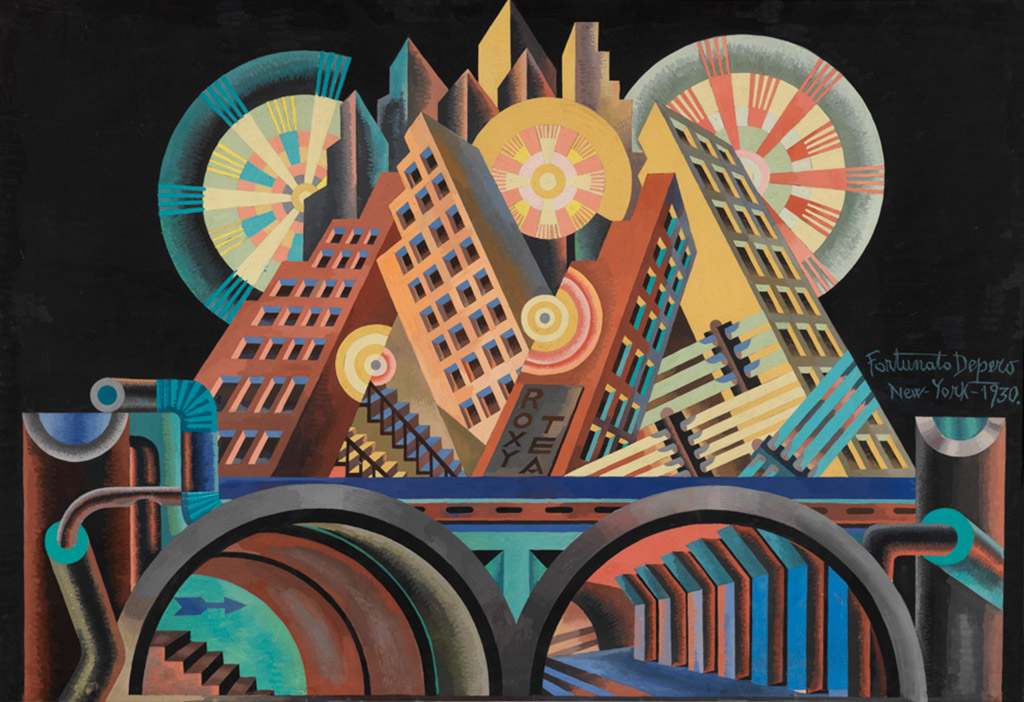
ex_depero_Skyscrapers-and-Tunnels

The New York Times reviews Italian Futurism, 1909–1944: Reconstructing the Universe, a new exhibition at the Guggenheim:

Was any avowedly modern art movement as obnoxious and noisily contradictory as Italian Futurism? By turn aesthetically revolutionary and politically reactionary, farsighted and visually challenged, not to mention officially misogynist, it is both a stain on the Modernist brand and a point of pride. It needs all the help it can get and it receives a large dose from “Italian Futurism, 1909-1944: Reconstructing the Universe,” an epic exhibition at the Guggenheim Museum.

Cool Hunting talks to curator Vivien Greene about the exhibition:

The show has a lot of didactics. Some of the artwork addresses that directly, so it’s easy enough to see their ideas, but we walk people through it as well. They celebrated war as this kind of cleansing medium, and a part of it was because Italy was seen as being so staid and so bourgeois, and after Italian unification in 1860, all those ideals of the Risorgimento really never come to fruition. So this idea of burn down the past and start fresh, be super modern—there were a lot of ideas of regeneration. But they also were very pro war because they wanted to enter World War One to get back the lands that were still under the rule of the Austro-Hungarian empire that were part of the Italian peninsula. So that’s a really practical historical reason that goes beyond you know, Sorelian ideas of the mob and violence—although Georges Sorel does inform them too, but sort of at different levels… [They] also were very aggressive: they start off as a left-wing revolutionary movement and then—how it often happens when you’re at one extreme of something totalitarian—you shift to the other and end up being on the right. They disagreed with the anarchists because the anarchists, although they were running around throwing bombs, had a more pacifist goal in mind.

Italian Futurism, 1909–1944: Reconstructing the Universe opens 21 February 2014 and runs through 1 September 2014.

(pictured above: Fortunato Depero, Skyscrapers and Tunnels (Gratticieli e tunnel), 1930.)

Comments closed

The Mounting Tide of a Mass Avant-Garde

Phil Ford, author of Dig: Sound and Music in Hip Culture, reviews Loren Glass’ new book on Grove Press, Counterculture Colophon: Grove Press, the Evergreen Review and the Incorporation of the Avant-Garde, for the LA Review Books (which is, by the way, probably the most consistently interesting place around to read about books right now):

Grove Press and its charismatic owner, Barney Rosset, sit right at the center of postwar intellectual history. Glass notes early that if Rosset made a lot of impulsive bad decisions, he was guided steadily by a shrewd understanding of where American culture was headed. In the 1950s, Americans were beginning to go to college en masse, and when they got there they would seek out whatever was chic, daring, avant-garde, experimental — in a word, hip. Counterculture, the notion of seceding from the mainstream and dwelling in an autonomously created realm of liberated culture, was perhaps the most potent dream of the postwar age. Everybody wanted in. Against the mounting tide of a mass avant-garde, the old censorship codes could not long endure.

But while it’s hard not to be inspired by the story Grove Press, it’s also important to note the less savoury side of it, and how it was overtaken by the cultural changes Rosset helped start:

Those who harkened to Evergreen Review’s call to “join the underground” constituted the higher-brow version of the man who read Playboy: a 1966 advertising survey discovered that he was “a 39-year-old male, married, two children, a college graduate who holds a managerial position in business or industry, and has a median family income of $12,875.” (That’s about $92,000 in 2013.) It turns out that “Chuck,” the everysquare in a 1965 Evergreen Review spoof of Charles Atlas ads, painted a pretty realistic portrait of the Grove readership. But with the emergence of a feminist critique made possible by the very cultural revolution Rosset served, the masculine literati no longer enjoyed the privilege of guiltless consumption, and modernist experimentalism no longer provided a dignified alibi for it. In the 1970s, the Evergreen Review image of the hip intellectual soured. We might imagine Chuck a decade later, up to his ears in alimony, parted hair modishly grown out though thinning and combed-over on top, paunch swelling under a safari suit coat, leering at younger women who wish he would drop dead.

Read the whole review.

Comments closed

Midweek Miscellany

An incredible Flickr set of 20th Century avant-garde book covers (via Quipsologies).

The Lottery — Ruth Franklin, author of A Thousand Darknesses, on the history of the American bestseller for Book Forum:

Trends come and go, but the best seller remains essentially serendipitous. An editor can be no more certain of finding the next one than a writer can be assured of writing it. “As a rule of thumb,” writes John Sutherland, an English scholar who has studied the phenomenon, “what defines the bestseller is bestselling. Nothing else.”

Dystopia — Malcolm McDowell, Jan Harlan and Christiane Kubrick discuss the remastered 40th anniversary edition of Stanley Kubrick’s adaptation of A Clockwork Orange with Guardian film critic Xan Brooks (video).

Multitasking — Wyndham Wallace on the demands currently placed on musicians for The Quietus (via BookTwo):

“When you’re in Hollywood and you’re a comedian,” another tragically deceased stand-up, Mitch Hedberg, joked, perhaps bitterly, “everybody wants you to do things besides comedy. They say, ‘OK, you’re a stand-up comedian. Can you act? Can you write? Write us a script?’ It’s as though if I were a cook and I worked my ass off to become a good cook, they said, ‘All right, you’re a cook. Can you farm?’” This is the position in which our musicians now find themselves. They’re expected to multitask in order to succeed. Their time is now demanded in so many different realms that music is no longer their business.

And lastly…

Old ‘Boofy’ Halberstam — P. G. Wodehouse’s American Pyscho at McSweeney’s Internet Tendency:

“What, old ‘Boofy’ Halberstam on some kind of psychotic killing spree? That’s hardly the sort of thing that would stand up in court—I mean to say, there was that business with the policeman’s helmet back at Harvard, true enough, but even so—”

“Not to worry, Patrick. You see, yesterday evening I took the further liberty of murdering Mr. Halberstam.”

I stood agog.

AGOG.

Comments closed

H.N. Werkman

Every day,  Eric Baker,  of Manhattan-based design firm Eric Baker Design Associates,  spends 30 minutes before work looking for “images that are beautiful, funny, absurd and inspiring”, and each Saturday he posts his selections to the Design Observer.

Eric’s selections for  14th February were all drawn from a great collection of images that Miguel Oks has posted to Flickr,  including  some amazing sets of 20th Century avant-garde books.

The covers pictured here are by the brilliant Hendrik Werkman (H.N. Werkman)  for the literary typographic journal Next Call , and are taken from the Dutch Books set.

Yale University Press published a lovely book by Alston W. Purvis on Werkman in 2004 as part of their Monographics series.

Comments closed