Skip to content

Tag: apple

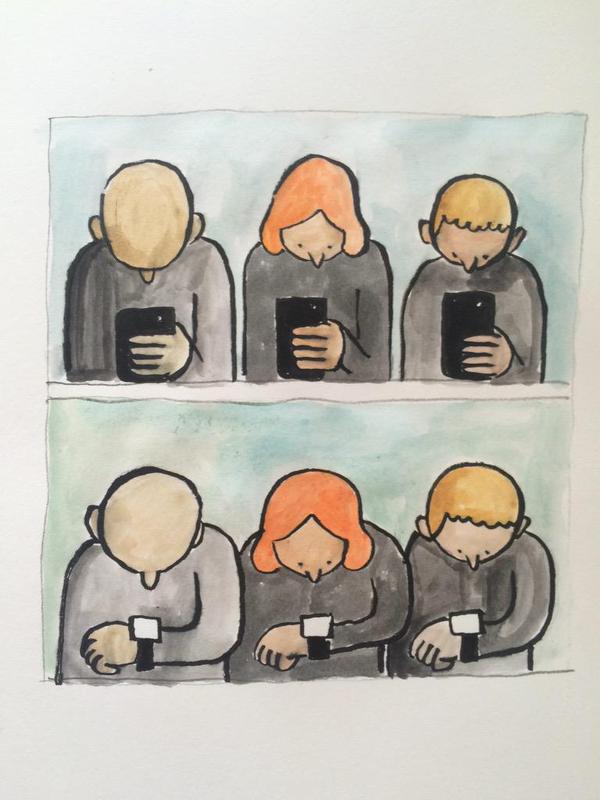
Apple Announces Revolution

apple-i-watch-jean-jullien

Jean Jullien

Comments closed

The Shiny Surface of Jonathan Ive

My ‘longreads’ to-read list is as bad, if not worse, than the pile of books I have to read right now, so it’s taken me until today to get to that very, very long New Yorker profile of Jonathan Ive, the senior vice-president of design at Apple.

Unfortunately, the whole thing is a bit disappointing and, I thought, even a little sad. By the end, Ive remains an enigma. What lingers is his famous friends, love of bland luxury brands, and just how remarkably wealthy he is (writer Ian Parker reminds you several times that Ive owns a private jet).

It seems Ive is either depressingly shallow or, more likely, these superficial things are all that he is willing to reveal about himself, which is depressing too in its own way. Ive is, no doubt, just politely protecting his privacy, but he comes across as peevish and sadly unlikeable, which is a shame. Or maybe I’m just not interested enough in industrial design and luxury brands, or Apple if it comes to that.

The article does, however, give me an excuse to post this blistering 15 minute video of NYU Stern marketing professor Scott Galloway talking a mile-a-minute about Apple, Amazon, Facebook and Google. I’m sure he’s wrong about a lot of things, but not only does he talk about Apple’s transition from tech company to luxury brand, he also offers some of the most cogent insights into the current problems facing Amazon I’ve heard in a while:


Interestingly, Ian Parker says in his New Yorker article that watch manufacturers are not worried about Apple stepping into the market. Galloway says they should be. I guess we’ll see who is right.

Comments closed

Something for the Weekend

You’re All Just Jealous of My Jetpack — Tom Gauld has a Tumblr (The title is a reference to this of course).

Legacy Issues — Stephen Page, chief executive of Faber & Faber, writing at The Guardian:

Let’s deal with technological obsolescence. Media businesses are not technology businesses, but they can be particularly affected by technology shifts. I run a so-called legacy publishing house, Faber & Faber. Most of our business is based on licensing copyrights from writers and pursuing every avenue to find readers and create value for those writers. We are agnostic about how we do this. For our first 80 years, we could only do it through print formats (books); now we can do it through books, ebooks, online learning (through our Academy courses), digital publishing (such as the Waste Land app) and the web. Technology shifts have tended to result in greater opportunity, not less.

Bibliophiles in London — The Economist on The London International Antiquarian Book Fair:

Most interesting, perhaps, is the air of optimism—there is not the slightest whiff of gloom at the state of the book world. The internet, paradoxically, has made books “à la mode”, says Claude Blaizot of the Librarie August Blaizot in Paris, purveyor of first editions of “Tintin” and fantastically bound livres d’artiste. “It has brought people to books, and shown them booksellers they never would have known existed before,” he says. Clive Farahar, the Antiques Roadshow’s book specialist, agrees that technology has opened up the book trade, and made the world of books much more accessible to all. “It’s not just the dim little shop on the high street anymore,” he said. “We can learn so much now we never would have known before.”

Simplicity — A two-part interview with Apple designer Jonathan Ive at The Telegraph:

“Simplicity is not the absence of clutter, that’s a consequence of simplicity. Simplicity is somehow essentially describing the purpose and place of an object and product. The absence of clutter is just a clutter-free product. That’s not simple.”

(part two)

And finally…

Daniel Clowes at wired.com:

“Digital seems like such a step back from a printed book… For me, the whole process involves envisioning this book in my head as I’m working. That is what I’m trying to create. That’s the work of art. That’s the sculpture I’m chipping away at, and when I’m finally done, I will arrive at that perfect 3-D object. The iPad version would be like a picture of the book, which doesn’t hold any interest at all for me. Even if I only had 10 readers, I’d rather do the book for them than for a million readers online.”

Comments closed

Midweek Miscellany

Obituary for artist Jean Giraud, AKA Moebius, in The Guardian:

Giraud… had an impact on the visual arts that went beyond comics. He was seen as a figurehead linking bandes dessinées with modernism and nouveau réalisme. As the co-creator of Métal Hurlant magazine, he took comics to an older, more literate audience. In cinema, his fans ranged from Federico Fellini to Hayao Miyazaki and his style influenced dozens of others, including Ridley Scott, George Lucas, James Cameron and Luc Besson.

Tom Spurgeon also has an in-depth obituary at The Comics Reporter:

Giraud would… describe the revolution driven by his work and others as one of creative choice rather than content, that the feeling of the artist inhabiting the work was more important than the kind of work being done. He drew a connection to the undergrounds and cartoonists like Robert Crumb, although he felt that the work of he and his peers existed in an entirely different cultural context.

See also: The comics industry remembers Moebius at Robot 6.

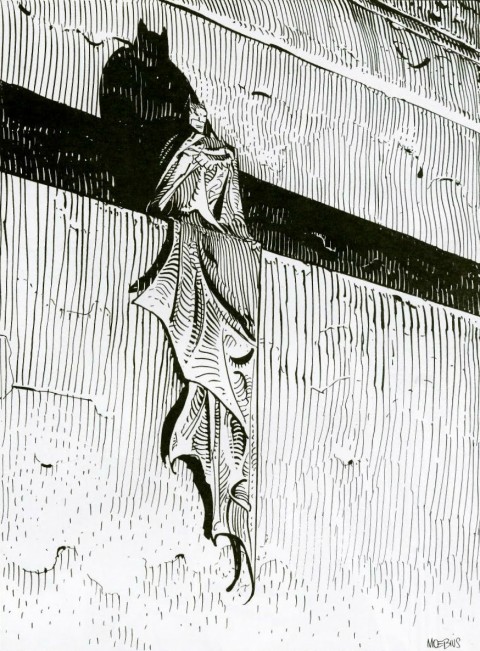
(I remember being very disappointed when I discovered that the drawing above was a standalone piece, and not a panel from a complete Batman story illustrated by Moebius. Heartbreak.)

Material Conversations — An interview with Jonathan Ive, Apple’s Senior Vice President of Industrial Design, in The Evening Standard:

What I love about the creative process, and this may sound naive, but it is this idea that one day there is no idea, and no solution, but then the next day there is an idea. I find that incredibly exciting and conceptually actually remarkable. The nature of having ideas and creativity is incredibly inspiring. There is an idea which is solitary, fragile and tentative and doesn’t have form. What we’ve found here is that it then becomes a conversation, although remains very fragile. When you see the most dramatic shift is when you transition from an abstract idea to a slightly more material conversation. But when you made a 3D model, however crude, you bring form to a nebulous idea, and everything changes – the entire process shifts. It galvanises and brings focus from a broad group of people. It’s a remarkable process.

And finally…

Boredom — Geoff Dyer, author Zona: A Book About a Film About a Journey to a Room, in conversation with Ethan Nosowsky at The Believer:

Boredom is often a side effect of something else. The apparent boredom inflicted by Stalker is actually the friction between the pace of the film and one’s expectations of how a film should proceed, so you just need to give yourself over to it. But then I think some so-called art films are irredeemably and inherently boring. As soon as I say that, though, I realize that the most boring films are the big, moronic action-blockbusters. They really bore the crap out of me. There’s an essential relationship between boring art films and moronic blockbusters because, as Ernst Fischer pointed out, any art form that glories in being understood only by a few—that worships at the altar of its own tedium, as it were—opens the floodgates for trash for the masses. At a certain point, as filmmakers got serious, they willingly took on a slowness that could easily become boring. But there was a long period before that when boredom was just inconceivable, not part of the equation.

Comments closed

Something for the Weekend

Blown Covers — The New Yorker art editor Françoise Mouly has a Tumblr (pictured above:  “Eustace at a Stoplight—Right?,” by David Urban)

Spanking — Charles McGrath remembers the late Barney Rosset in the New York Times:

Mr. Rosset was far from a highbrow. Sometimes he signed up books without having read them. He determined to publish “The Autobiography of Malcolm X,” for example, while riding in a cab and hearing on the radio that other publishers had turned it down. And he was proud of publishing a profitable line of Victorian spanking pornography. To a considerable extent the dirty books made the arty ones possible, and Mr. Rosset wasn’t the least abashed about it.

See also: WNYC has reposted two archive interviews with Rosset from 1995 and 2008, and John Gall has posted a collection of links to reminiscences about Rosset on his blog Spine Out.

Form and Fortune — A fascinating  review  of  Walter Isaacson’s biography of Steve Jobs by Evgeny Morozov, author of The Net Delusion, in The New Republic which discusses Apple’s relation to the Bauhaus and Braun:

The design philosophy of Dieter Rams, Braun’s legendary designer, has shaped the feel and the look of Apple’s latest products more than any other body of ideas. Since joining Braun in 1955, Rams—who likes to describe his approach to design as “less, but better”—began collaborating with the faculty at the Ulm School of Design, which tried to revive the creative spirit of Bauhaus with a modicum of cybernetics and systems theory. Eventually Rams produced his own manifesto for what good design should accomplish. His “ten principles of good design” encouraged budding designers to embrace innovation and make products that were useful but environmentally friendly, thorough but simple, easy to understand but long-lasting, honest but unobtrusive. Rams wanted his products to be like English butlers: always available, but invisible and discreet.

See also:  Maureen Tkacik’s on Steve Jobs and Isaacson’s biography at Reuters.

And lastly…

James Wood reviews Edward St. Aubyn’s Patrick Melrose novels for The New Yorker:

Patrick Melrose, the protagonist of what is now a quintet of novels devoted to the Melrose family, is the scion of a wealthy dynasty almost as monstrous as the dodgier Roman emperors; he has spent much of his adult life trying to kill himself with drugs and booze. St. Aubyn’s novels have an aristocratic atmosphere of tart horror, the hideousness of the material contained by a powerfully aphoristic, lucid prose style. In good and bad ways, his fiction offers a kind of deadly gossip, and feeds the reader’s curiosity like one of the mortal morsels offered up by Tacitus or Plutarch in their chatty histories.

Comments closed

The Fantastic Flying Books of Mr. Morris Lessmore

Inspired by the Wizard of Oz, Buster Keaton movies, and a whimsical love of books, The Fantastic Flying Books of Mr. Morris Lessmore is an award-winning 15 minute animated short by William Joyce, Brandon Oldenburg and Moonbot Studios:

The film is one of five animated shorts nominated for an Oscar this year,  and there is an interactive version of the story available for the iPad from the app store.

1 Comment

Midweek Miscellany

A little late on this, but 50 Watts has posted the winners of  Polish Book Cover contest. Will Schofield’s co-judges were Aleksandra and Daniel Mizieliński, editors of 1000 Polish Book Covers, and Peter Mendelsund. All the amazing entries are here. Pictured above: A Clockwork Orange by Chris Taylor.

Fragments of Experience The Guardian reviews Modernist America by Richard Pells:

Film editing, he tells us, owes debts to cubism, futurism and surrealism. Cutting from one shot to another enables the cinema to “create a feeling of movement as well as a sometimes fractured sense of time and reality. The fragments of experience, captured in a single shot and then juxtaposed with other shots to produce a multiplicity of perspectives, are the cornerstones of the cinema, and they are also central to the modernist view of the world.”

Music from Nowhere — Rob Young, author of Electric Eden, interviewed in the LA Times:

[P]art of my argument is that the British folk revival did actually begin much earlier than… the 1950s — you have to look back at the late 19th century and the Victorian folk collectors… [William] Morris is important because what you find in the 1880s and ’90s is a surge of conservation and preservation projects starting up, mainly by people who were horrified at the destructive effects of industrial progress on the landscape, the environment and the labor conditions of the working class. Morris was at the forefront of this, and his time-travel novel “News from Nowhere” sets out the utopian conditions of a better world in which the future is actually like a medieval golden age.

Gestalt-Ingenieur — Dieter Rams on design, Jonathan Ives and Apple for The Daily Telegraph:

I am troubled by the devaluing of the word ‘design’. I find myself now being somewhat embarrassed to be called a designer. In fact I prefer the German term, Gestalt-Ingenieur. Apple and Vitsoe are relatively lone voices treating the discipline of design seriously in all corners of their businesses. They understand that design is not simply an adjective to place in front of a product’s name to somehow artificially enhance its value. Ever fewer people appear to understand that design is a serious profession; and for our future welfare we need more companies to take that profession seriously.

And finally…

Music for Dieter Rams — a mini-album by Jon Brooks (via The Donut Project):

“Every sound on this record, from the melodic sounds to the percussion, the atmospheric effects to the bass lines originates from the Braun AB-30 alarm clock.”

Awesome.

Comments closed

Midweek Miscellany

Pharmaceutical Sincerity — Michael Bourne on Fear and Loathing in Las Vegas 40 years on for The Millions:

I can still remember sitting in the basement of my parents’ house in Northern California, practically whizzing myself with delight at that dizzying list of pharmaceuticals. I was fourteen and I’d read Catcher in the Rye and A Separate Peace and all the other books about and for nice, well-heeled boys whose lives have gone a little off the rails, but Fear and Loathing in Las Vegas was different. It wasn’t just the mind-blowing drug use or the lusty middle finger Thompson seemed to be giving straight America; no, what was so startling, so riveting to my fourteen-year-old’s mind was how sincere the whole thing seemed.

Base Camp — Levi Stahl compares J.G. Ballard to Joseph Conrad (via The Second Pass):

Ballard’s scientists, marooned on far-flung outposts throughout the galaxy, are merely Conrad’s company agents and traders thrown into the future.

Like Conrad’s characters, Ballard’s have been nominally put in charge of places that are only barely understood back home–and whose history, culture, traditions, and dangers are almost entirely a secret. Their knowledge is limited where it isn’t totally useless; their true dominion extends no farther than the walls of their base camp; and the culture they represent is utterly unwanted, even insignificant when set against against the inescapable age of the universe around them.

Disrupting Molecules — Apple designer Jonathan Ive profiled in the Daily Mail (of all places):

Ive is not like other product designers, who too often trade in slick superficialities and press releases. Ive prefers to be engrossed in fundamentals and has very little interest in personal publicity. To him, the way a thing is made is fundamental to its character: his mind occupies a workshop, not an artist’s atelier.

With an Ive product, it is impossible to say where the engineering ends and the ‘design’ begins. It’s a continuum. He thinks and thinks about what a product should be and then worries it into existence. It’s what Ive calls ‘effort and care beyond the usual’. He has very few distractions…

…With the MacBook Air, he told me it’s, metallurgically speaking, about as far as you can actually go with aluminium before you start disrupting molecules. A calm and engaging personal manner becomes almost excitable when he describes the outer limits of transforming stainless steel. This Zen-like obsession with materials, with getting to what he calls the ‘local maximum’, is what gives Apple products their extreme appearance.

Semantic Slippage — The Information by James Gleick reviewed in The New York Times:

[In] its ordinary usage, “information” is a hard word to get a handle on (even after a recent revision, the Oxford English Dictionary still makes a hash of its history). It’s one of those words, like “objectivity” and “literacy,” that enable us to slip from one meaning to the next without letting on, even to ourselves, that we’ve changed the subject.

That elusiveness is epitomized in the phrase “information age,” which caught on in the 1970s, about the same time we started to refer to computers and the like as “information technology.” Computers clearly are that, if you think of information in terms of bits and bandwidth. But the phrases give us license to assume that the stuff sitting on our hard drives is the same as the stuff that we feel overwhelmed by, that everybody ought to have access to, and that wants to be free.

Kick Out the Jams — Wired Magazine profiles everyone’s favourite funding platform Kickstarter (via Waxy):

While plenty of people are willing to extol Kickstarter’s earth-shattering potential, its founders are not among them. “We never had change-the-world aspirations,” says cofounder Yancey Strickler, who insists he just wanted to help artists get stuff made. (Strickler’s team approves every project before it’s posted, and Strickler has personally funded 340 of them, making him the site’s greatest patron.) But the world may have other plans for the site. The Kickstarter guys may have kick-started something bigger than they ever intended…[J]ust as Twitter outgrew its beginnings as a humble messaging system, Kickstarter may not be able to maintain its low profile much longer. “The most interesting companies demonstrate emergent behavior,” says Fred Wilson, a venture capitalist at Union Square Ventures, which invested in Kickstarter. “People’s use of the service is never what the creators intended.”

And finally… Just in case you’ve been in a dark room with the lights off for the last 24 hours (and who could blame you?),  a US federal judge has rejected Google’s legal settlement with authors and publishers reached in 2008. Read about at The Guardian, The New York Times, or the media outlet of your choice.  MobyLives stops just short of dancing on it’s grave, and Jacket Copy looks at what might come next.

Comments closed

Agents of Change

There’s a great op-ed by Stephen Page, chief executive of Faber & Faber, in today’s Guardian about the iPad and publishing:

It’s clear that publishers must move faster to establish our compelling and useful role in the modern life of reading. While acquiring new expertise, we must assert the best of our traditional strengths; providing capital (in the form of advance payments), offering editorial expertise, and creating a readership by designing, creating, storing, promoting and selling the works of writers. But that’s not enough. Publishers also have to explain what value they are bringing to the relationship between writers and readers, a conversation that is made far more transparent through digital media and digital texts.

Page goes on to list what he sees as guiding principles for publishing going forward. These include retaining print and digital rights, reviewing royalties, flexible pricing, connecting to readers, and excellent metadata. He concludes:

The iPad launch is not the moment, but that’s because the moment has passed. We need to work with authors in new ways, and keep pace with reading’s evolution, or better still become agents of change ourselves.

It’s a must-read. If you work in publishing, send it to your CEO.

1 Comment

Midweek Miscellany

A Wall in Palestine — more quiet mastery from Henry Sene Yee who excels in projects that require maximum discretion and minimal commentary. Like his cover design for ColumbineA Wall in Palestine is notable for what it leaves out. An early contender for cover the year. You heard it here first.

Making the World Fun to Look At — The Cleveland Plain Dealer has (what is believed to be) the first interview with Bill Watterson, creator of Calvin and Hobbes,  since 1989:

I think some of the reason “Calvin and Hobbes” still finds an audience today is because I chose not to run the wheels off it.

I’ve never regretted stopping when I did.

Amen.

Seven Things Publishers Need to Remember — A nice post by Kobo Books exec (and compulsive list maker) Michael Tamblyn on e-books and pricing:

A reader should never have to worry about “leaving books behind” or “losing their library”. If you can’t download it and move it somewhere else, it’s worth less. Seriously. They’re books, not Atari 2600 video game cartridges.

(But I’m waiting for the “7 Things E-tailers Need to Remember” post Michael. When’s that coming? You can post here if you want)

The Lost 1970 Man Booker Prize — Commemorating novels missed out because of rule changes in 1971. Bonkers. But kind of great.

Problem SolverIan Shimkoviak of The Book Designers interviews the legendary Carin Goldberg for their new blog CoveredUp:

I’m not a sentimentalist. The e-book is inevitable. And they make sense. The publishing industry can’t sustain the old/current model for making/selling books. It’s wasteful and unsustainable. They have to embrace change. Good content will continue to be created whether it’s represented on paper or on a screen.  And there will always be a market, albeit small, for beautiful picture books. The role of the graphic designer is shrinking but it’s in our court to get involved in the next wave of imagery and ideas.

And finally…

Jonathan Lethem, author of Chronic City (which I liked, but wanted to like more), interviewed on KCRW’s Bookworm (via the incroyable Largehearted Boy):

2 Comments

Obligatory Apple/Amazon Post

It somehow seems terribly appropriate that I spent the week Apple unveiled the iPad battling with problems with my own PC laptop (*sigh*) and missed a lot of the excitement.

Even at the best of times, I am usually at least a day behind the news cycle, and so not for the first time, I thought I’d write a post as a way to get myself up to speed over the weekend. But, just when I started to think I had a handle on it all, I got sideswiped by the not unrelated kerfuffle between Macmillan and Amazon… (*sigh*)

Needless to say, things are happening at a frightening pace and so this post will probably be out of date even before it is live. It should also go without saying — although I’d better say it anyway — that any opinions expressed here are my own, not those of my employer…

So, as I was saying, Apple launched the iPad and iBooks store.

Many in the tech crowd — who were apparently expecting Jesus 2.0 — were, unsurprisingly, a little disappointed by the name and the lack of features such as multitasking, Flash, and a camera.

But, even if you don’t accept that disappointment is the condition of our age, the loquacious Stephen Fry pointed out that many the same critics were also underwhelmed by the iPhone and look how that turned out:

[E]ven if they couldn’t see that three billion apps would be downloaded in two years… could they not see that this device was gorgeous, beautifully made, very powerful and capable of development into something extraordinary? I see those qualities in the iPad. Like the first iPhone, iPad 1.0 is a John the Baptist preparing the way of what is to come, but also like iPhone 1.0 (and Jokanaan himself too come to that) iPad 1.0 is still fantastic enough in its own right to be classed as a stunningly exciting object, one that you will want now and one that will not be matched this year by any company.

Fry believes (and rightly I think) that the big impact of iPad will be on the media and the way we consume it:

[I]t is a whole new kind of device. And it will change so much. Newspapers, magazines, literature, academic textbooks, brochures, fliers and pamphlets are going to be transformed.

Ivor Tossell makes a similar point in today’s The Globe and Mail. According to Tossell, the iPad will essentially be used to “piss away time on the Internet”:

[S]o now we have a tablet that’s perfect for the couch, and the restaurant table, and the party, and the lecture hall; for reading in the bathroom, for floating in space, and possibly for using in the space-bathroom. Who knows – the future is grand… The question, in the end, isn’t whether you want to spend hundreds of dollars on a new tablet computer. It’s about whether you really want the Internet lying around the house like that.

Of course, this is not news to book folk. I think we have always seen e-readers as a new way to read in the bath.

Nevertheless, the iPad’s sleek design, intuitive interface, and startling low starting price of $499 USD, make it welcome alternative to Amazon’s somewhat ‘fugly’ Kindle. Mashable (although they were not alone) were quick to give reasons why the Kindle is Dead (while others have been equally quick explain why it isn’t).

And then there is the iBooks store. Not only does it support e-Pub, but most of major publishing houses — Penguin, HarperCollins, Simon & Schuster, Macmillan and Hachette (although notably NOT Random House) — have signed up. As Sarah Weiman noted at Daily Finance :

If it wasn’t clear that iPad and iBooks are two shots across the bow of Amazon’s…. Kindle e-reader, Jobs’s left-handed compliments drove the point home: “Amazon has done a great job of pioneering this….We’re going to stand on their shoulders”

It has, of course, been something of an open, if largely misunderstood, secret that publishers are not happy with Amazon pressuring them on prices, discounts, and marketing dollars (although I’m not quite sure anyone expected Steve Jobs to say it aloud) and so it is not surprising that publishers are embracing the iPad. But, with apps for the kindle, better terms for self-published authors, and persistently loud (if vague) announcements about sales, Amazon had clearly been preparing for this moment for some time.

It was still a shock however, when after a disagreement of pricing and terms, Amazon (briefly) upped the stakes even further by withdrawing both print and digital titles published by Macmillan from their site. That Macmillan was coincidentally one of the publishers signed up for iBooks was not lost on people.

As Cory Doctorow notes at BoingBoing, Macmillan were not blameless, but Amazon — perhaps fearing a PR disaster after Macmillan CEO John Sargent went public — quickly capitulated (albeit grudgingly and, as Fast Company and Moby Lives noted, somewhat disingenuously) and things are beginning to quieten down, at least for now.

Others — notably Andrew Wheeler (a braver soul than me), the indefatigable Sarah Weinman, and author John Scalzi (another brave soul), not to mention the mainstream media et al — have done a far better job of unpacking this farrago than I could, especially since I have to be somewhat guarded in what I say.  I’m just going to end by saying that this fight was probably inevitable — predictable even — but, if nothing else, this is surely a sign of things to come…

Update:

For more of the industry nitty-gritty and some (estimated) numbers around the Amazon-Macmillan disagreement, Mike Shatzkin’s post on the subject is also worth reading…

Update 2:

Two things:

One, if I was going to rewrite the part of this post about Amazon (heaven help me), I would  say — and say early — that despite all of the complaints about Amazon, they are good at selling stuff. Publishers like Amazon’s sales figures and relatively low return rates. If Amazon were just rubbish, this wouldn’t be half as complicated as it is…

Two, I wanted to post this from Bobby Solomon’s blog Kitsune Noir on the iPad:

For those who are disappointed by it, who think it’s a rehash of the iPhone, I honestly feel bad for you. I know it doesn’t cook you toast, and I know you wanted it to have lasers, but you’re completely overlooking the fact that no one else on Earth could make a device anything like this. Please prove me wrong, I would love to see some competition on this device…  P.S. They could call it the iDouche for all I care, if it’s amazing who gives a rip?
6 Comments

Midweek Miscellany

The Backwards Novel Seen Backwards by Tom Gauld.

I also love Tom’s Lost Fairy Tales for a promotional concertina booklet made by his agent Heart (surely there’s a full length book to be had here?).

Ways of Reading from A Working Library:

Every book alights a path to other books. Follow these paths as far as you can.

Lovely.

Back to BasicsBooktwo.org‘s James Bridle on the Apple tablet (what else?):

I’ve spent several years urging publishers to get on board with new technologies and try new things, but equally I hope there’s space for a lot of publishers to get back to concentrating on what they do best: acquiring, editing, producing and publishing books… [W]e should probably stop scrambling to get on the latest bandwagon (vanilla Books-as-Apps, I’m looking at you), and concentrate on the basics: ebook production, metadata, integrated marketing, quality and consideration. There is a lot to be done, but this or that device will never be the be-all-and-end-all of the future of publishing.

I think James has a point. But honestly, no one I know (and that is an admittedly limited sample) believes “this-or-that device” will magically “save” publishing. Surely it is only bloggers in need of straw men and ‘journalists’ paid to hyperventilate who say that kind of shit?

Moving (swiftly) on…

Modern Myths — Will Self on H. G. Well’s The War of the Worlds in The Times:

The War of the Worlds is one of those books that demonstrates our culture’s surprising ability to continue the manufacture of myth. I say surprising, because one would think, with all the technological reproducibility of art now at our disposal — from raw print, to film, to digitisation — that there would be no room left for that hazy instability within which myth thrives.

(Pictured above: The NYRB edition of The War of the Worlds with illustrations by Edward Gorey)

And finally, completely unrelated to books…

Dear Coffee I Love You… Yes, yes, I do. (Pictured above: What I’d Rather Be Doing)

2 Comments