Skip to content

Tag: antiquarian books

The Custodian of Forgotten Books

In a lovely piece for The New YorkerDaniel A. Gross talks to blogger Brad Bigelow, the man behind the Neglected Books, about rediscovering forgotten literature:

Most novels are forgotten. Glance at the names of writers who were famous in the nineteenth century, or who won the Nobel Prize at the beginning of the twentieth, or who were on best-seller lists just a few decades ago, and chances are that most of them won’t even ring a bell. When “The Moonflower Vine” resurfaced and ricocheted around the publishing world, it became an unlikely exception.

What’s strange about the journey of that book—and about our moment in the history of publishing—is that its rediscovery was made possible by an independent blogger, named Brad Bigelow. Bigelow, fifty-eight, is not a professional publisher, author, or critic. He’s a self-appointed custodian of obscurity. For much of his career, he worked as an I.T. adviser for the United States Air Force. At his home, in Brussels, Belgium, he spends nights and weekends scouring old books and magazines for writers worthy of resurrection.

“It can just be a series of almost random things that can make the difference between something being remembered or something being forgotten,” Bigelow told me recently. On his blog, Neglected Books, he has written posts about roughly seven hundred books—impressive numbers for a hobbyist, though they’re modest next to the thousands of books we forget each year. “It’s one little step against entropy,” he said. “Against the breakdown of everything into chaos.”
Comments closed

Saying Goodbye to a Secret Bookstore

Also at The New Yorker, Brian Patrick Eha writes about the closure of Brazenhead Books, Michael Seidenberg’s secret New York bookstore:

Michael Seidenberg’s one-of-a-kind bookshop, Brazenhead Books, closed last month. For seven years, it operated out of an apartment at 235 East Eighty-fourth Street. Of course no bookstore or other business had any business being there, in that rent-stabilized apartment, so it was, strictly speaking, illegal, and because it was illegal it had to be secret. The secret was known to a small number of discreet patrons and shared strictly by word of mouth. (At first, Michael saw customers by appointment only.) Inside, the windows were blacked out and covered with shelves. On bookcases, in every room, volumes of all sizes in serried ranks rose two deep from floor to ceiling. More were stacked on desks and tables and grew in unsteady columns from the floor. There was a stereo (covered in books), a few chairs, and a large desk in the front room (likewise all but submerged), on which Michael kept a half dozen or so bottles of wine and spirits, a tower of plastic cups, and a bucket of ice.

Walking in, you might find a handful of patrons lounging on chairs with drinks in their hands, or browsing amiably, making conversation, generally about books, but often ranging widely into art, politics, personal life stories, and the history of New York. In the same way that children imagine adults living in perfect freedom, enjoying all the cookies and television they want and staying up till all hours, Michael’s shop was what a bookish child might dream up as a fantasy home for himself, a place far from any responsibilities, where he would never run out of stories.

The good news is that Seidenberg plans to reopen the store elsewhere. Until then, you can watch this video about the old location.

Comments closed

A Secret History of Manhattan’s Book Trade

Don’t miss Dwight Garner’s New York Times review of Martial Bliss.: The Story of the Military Bookman, Margaretta Barton Colt’s account of running an antiquarian bookstore in Manhattan that sold only military titles. If you ever worked in an independent bookstore, you’ll probably relate…

Historians and journalists were devoted to the store, and leaned on it for their research. No one is lonelier than the author of a forgotten book. Ms. Colt speaks for many writers who walked into the Military Bookman when she says of one, “He loved to come to a place where the denizens knew what he had done”…

…Ms. Colt, who had previously worked in publishing, didn’t suffer fools — or ghouls. Here she is on one customer: “Lean and mean, with a crew cut, he was a real right-winger, collecting Holocaust memorabilia while being a Holocaust denier: a misanthrope with a sour sense of humor and guns in a secret closet.”

The store kept sometimes mischievous notes on its customers. These had observations like “tire-kicker, quote-dropper, reservation-dropper (particularly heinous), unredeemed check-bouncer (even worse). Also: cheapskate, picky, SS tendencies, questionable dealings, edition or d/j freak, and other sins and misdemeanors.” (The “d/j” refers to dust jackets.)

If it sounds as if the patrons were a band of brothers, yes, they were mostly men. The store maintained a comfortable chair for wives and girlfriends. Ms. Colt, who loved her work, writes terrifically about trying to maintain her sang-froid in this testicular environment.

Comments closed

The Antiquarian Bookshops of Old London

L1000142

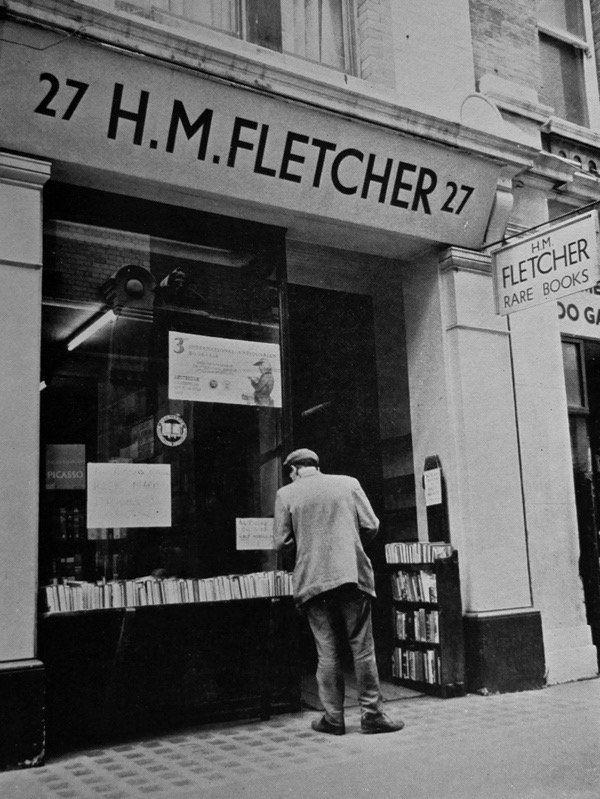
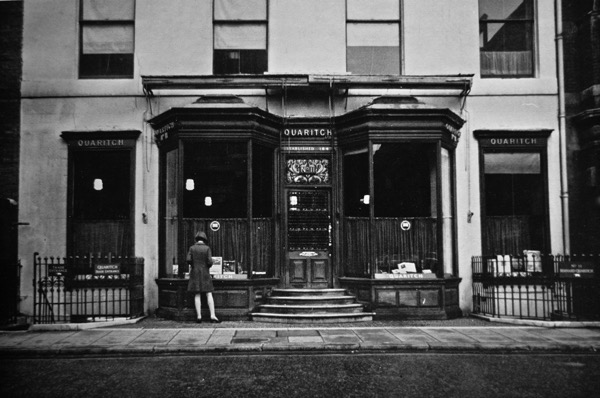
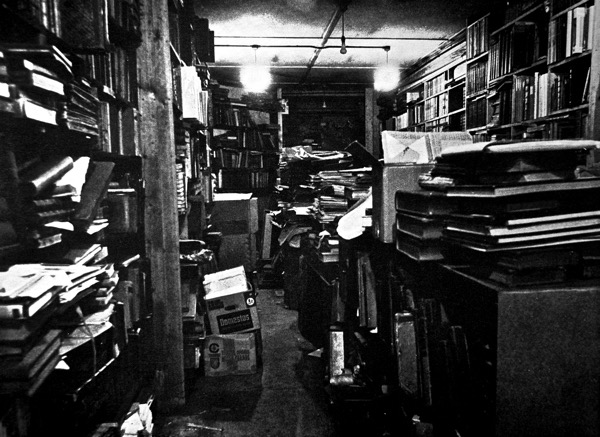
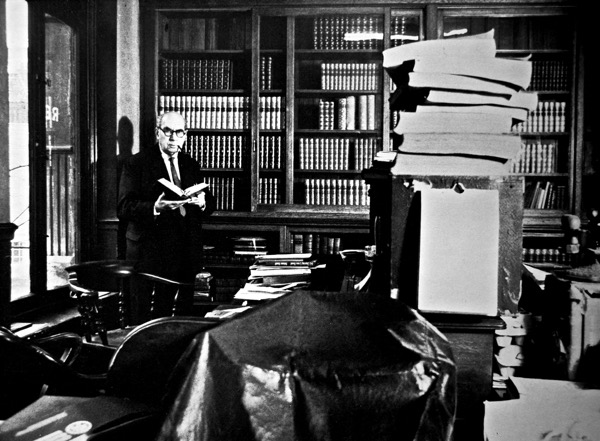
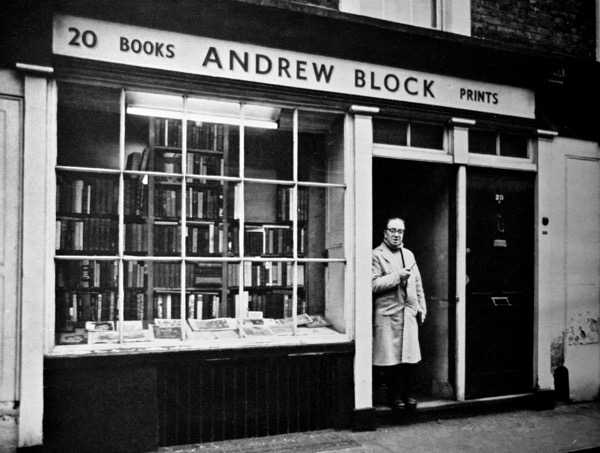
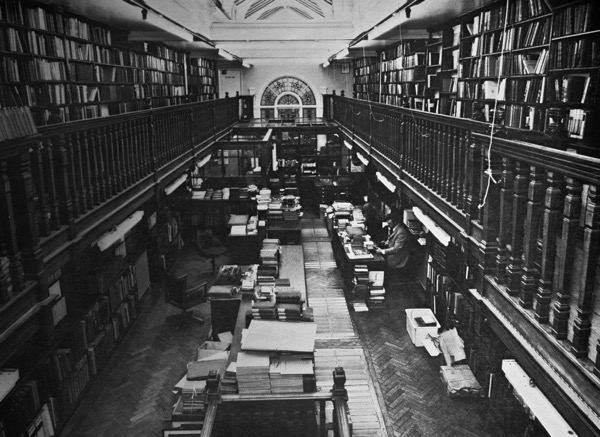
At the lovely Spitalfields Life blog, the Gentle Author reminisces about buying and selling used books in London, and shares some wondeful black and white photographs of the city’s secondhand bookshops taken in 1971 by Richard Brown:

Frustrated by my pitiful lack of income, it was not long before I began carrying boxes of my textbooks to bookshops in the Charing Cross Rd and swapping them for a few banknotes that would give me a night at the theatre or some other treat. I recall the wrench of guilt when I first sold books off my shelves but I found I was more than compensated by the joy of the experiences that were granted to me in exchange.

Inevitably, I soon began acquiring more books that I discovered in these shops and, on occasion, making deals that gave me a little cash and a single volume from the shelves in return for a box of my own books. In this way, I obtained some early Hogarth Press titles and a first edition of To The Lighthouse with a sticker in the back revealing that it had been bought new at Shakespeare & Co in Paris. How I would like to have been there in 1927 to make that purchase myself.

L1000109 L1000152 L1000167 L1000136 L1000132


Comments closed

Something for the Weekend

The brilliant Jon Gray and Jamie Keenan reveal the 20 irrefutable theories of book cover design. All of them are great.

Also at The Guardian: Ahdaf Soueif, author most recently of Cairo: My City, Our Revolution, on fiction and the revolution in Egypt:

Attempts at fiction right now would be too simple. The immediate truth is too glaring to allow a more subtle truth to take form. For reality has to take time to be processed, to transform into fiction. So it’s no use a story presenting itself, tempting, asking to be written, because another story will – in the next minute – come roaring over it, making the same demand. And you, the novelist, can’t grab one of them and run away and lock yourself up with it and surrender to it and wait and work for the transformation to happen – because you, the citizen, need to be present, there, on the ground, marching, supporting, talking, instigating, articulating.

The Last Book Sale — A charming piece for the NYRB by Larry McMurty, book dealer and author of The Last Picture Show, on an auction of his books in Archer City:

Everything sold but the fiction. Everyone who deals in fiction has plenty, and more is spilling onto the market from the sale of the Serendipity Bookshop stock now being dispersed on the West Coast. Many people asked me if I was sad to see so many books go. I wasn’t—mainly I was irritated to discover that I still had 30,000 novels to sell.

And finally…

 Put A Bird On It — The New York Times on the city’s boutique art bookstores:

perhaps because the physical book is coming to seem more like an object than ever before, the current landscape of shops blurs the line between bookstore and gallery in rollicking, unpredictable fashion. And because the shops are not nearly as tethered to high-end economics as art galleries, the mélange of stuff that results, some for sale and some not, can be strange and wonderful, like highly personalized cross sections cut from the culture at large.

1 Comment

Something for the Weekend

You’re All Just Jealous of My Jetpack — Tom Gauld has a Tumblr (The title is a reference to this of course).

Legacy Issues — Stephen Page, chief executive of Faber & Faber, writing at The Guardian:

Let’s deal with technological obsolescence. Media businesses are not technology businesses, but they can be particularly affected by technology shifts. I run a so-called legacy publishing house, Faber & Faber. Most of our business is based on licensing copyrights from writers and pursuing every avenue to find readers and create value for those writers. We are agnostic about how we do this. For our first 80 years, we could only do it through print formats (books); now we can do it through books, ebooks, online learning (through our Academy courses), digital publishing (such as the Waste Land app) and the web. Technology shifts have tended to result in greater opportunity, not less.

Bibliophiles in London — The Economist on The London International Antiquarian Book Fair:

Most interesting, perhaps, is the air of optimism—there is not the slightest whiff of gloom at the state of the book world. The internet, paradoxically, has made books “à la mode”, says Claude Blaizot of the Librarie August Blaizot in Paris, purveyor of first editions of “Tintin” and fantastically bound livres d’artiste. “It has brought people to books, and shown them booksellers they never would have known existed before,” he says. Clive Farahar, the Antiques Roadshow’s book specialist, agrees that technology has opened up the book trade, and made the world of books much more accessible to all. “It’s not just the dim little shop on the high street anymore,” he said. “We can learn so much now we never would have known before.”

Simplicity — A two-part interview with Apple designer Jonathan Ive at The Telegraph:

“Simplicity is not the absence of clutter, that’s a consequence of simplicity. Simplicity is somehow essentially describing the purpose and place of an object and product. The absence of clutter is just a clutter-free product. That’s not simple.”

(part two)

And finally…

Daniel Clowes at wired.com:

“Digital seems like such a step back from a printed book… For me, the whole process involves envisioning this book in my head as I’m working. That is what I’m trying to create. That’s the work of art. That’s the sculpture I’m chipping away at, and when I’m finally done, I will arrive at that perfect 3-D object. The iPad version would be like a picture of the book, which doesn’t hold any interest at all for me. Even if I only had 10 readers, I’d rather do the book for them than for a million readers online.”

Comments closed