Skip to content

Tag: america

Fade to Black

Hilton Als on James Baldwin, movies, and Raoul Peck’s documentary I Am Not Your Negro, for The New Yorker:

One has the sense, in the sections of “I Am Not Your Negro” that are devoted to Baldwin’s relationship to film, that Peck is stepping in to make the film that Baldwin couldn’t make. From the beginning of his career, Baldwin longed to make movies. In the introduction to his 1955 landmark collection, “Notes of a Native Son,” he wrote, “About my interests: I don’t know if I have any, unless the morbid desire to own a sixteen-millimeter camera and make experimental movies can be so classified.” To my knowledge, Baldwin never satisfied that desire (morbid, perhaps, because he knew of the herculean effort that goes into getting any movie made), but he never stopped yearning to be a filmmaker. Like a number of other significant twentieth-century authors—James Agee, Truman Capote, Susan Sontag, and his friend Norman Mailer—he knew that the page was not enough in the modern world; cinema was a powerful medium with many more “readers.” What would his life as an artist have been like, and what would American cinema be like now, had it opened itself up to him?

Comments closed

Philip K. Dick’s Vision of Fascism in America

I have to confess that I haven’t seen the TV adaptation of Philip K. Dick’s The Man in the High Castle, but I found Aaron Bady’s discussion of the series — and how it differs from the book — at The New Yorker, quite interesting:

In another year, the show’s insistence on humanizing fascists might have seemed like a provocative choice—an effort, like Arendt’s, to understand how normal people can find it in themselves to commit the worst atrocities. In 2017, however—when it is more urgent than ever to distinguish right from wrong, real news from fake, and differences of political opinion from the dangerous undermining of democracy—it feels instead like a pernicious cynicism. At the same time, the series depicts the ideological excesses of the Resistance in the most unforgiving light. More like Al Qaeda than French partisans of the nineteen-forties, they are grim, unsympathetic zealots, who use scattershot terror tactics and have no qualms about causing the suffering of innocent bystanders…

…This nihilism would have been alien to Philip K. Dick… Dick’s “The Man in the High Castle” focussed on how everyday people struggle to carve out lives of integrity in the face of evil, even while knowing—perhaps especially while knowing—that their actions will not ultimately change the course of history. In the novel, Frank Frink’s primary struggle is how to be an artist, not how to overthrow the Reich. In Dick’s view, this, too, was a form of resistance: his major theme as a novelist was the unavoidable complicity of living “normally” under empire; he believed in evil because he saw it everywhere. But if there wasn’t much hope in Dick’s fiction, that was exactly the point of writing it: even in the midst of a triumphant fascist dystopia, the quest for intellectual autonomy lived on in the dissident imaginations of those who could envision a different kind of world. It is telling, too, that the “man in the high castle” was in Dick’s novel not a collector of film reels but a novelist—an eccentric inventor of alt-histories who served as a stand-in for Dick himself. The character was, above all, a tribute to artists who dare to resist power in dark times.

The cover of the Penguin Modern Classic edition (pictured above) was design by Jim Stoddart.  

Comments closed

Robert Frank: The Man Who Saw America

05mag-05index-t_CA0-jumbo
Katy Grannan for The New York Times

This weekend’s New York Times Magazine has a remarkable profile of photographer and filmmaker Robert Frank by writer Nicholas Dawidoff:

Frank absorbed artistic influences all over New York. Edward Hopper’s moody office-scapes, restaurant interiors and gas pumps were not in fashion when Frank discovered the painter: ‘‘So clear and so decisive. The human form in it. You look twice — what’s this guy waiting for? What’s he looking at? The simplicity of two facing each other. A man in a chair.’’ Frank’s creative day to day was informed by the Abstract Expressionist painters he lived among. Through his window, Frank studied Willem de Kooning pacing his studio in his underwear, pausing at his easel and then walking the floor some more. ‘‘I was a very silent unobserved watcher of this man at work. It meant a lot to me. It encouraged me to pace up and down and struggle.’’ He also saw the downside of an artist’s life: ‘‘I used to watch de Kooning work, and then I’d walk down the street and see him drinking and lying in the gutter. Somebody’s bringing him upstairs. You drink because you have doubts. Things seem to crumble around you.’’

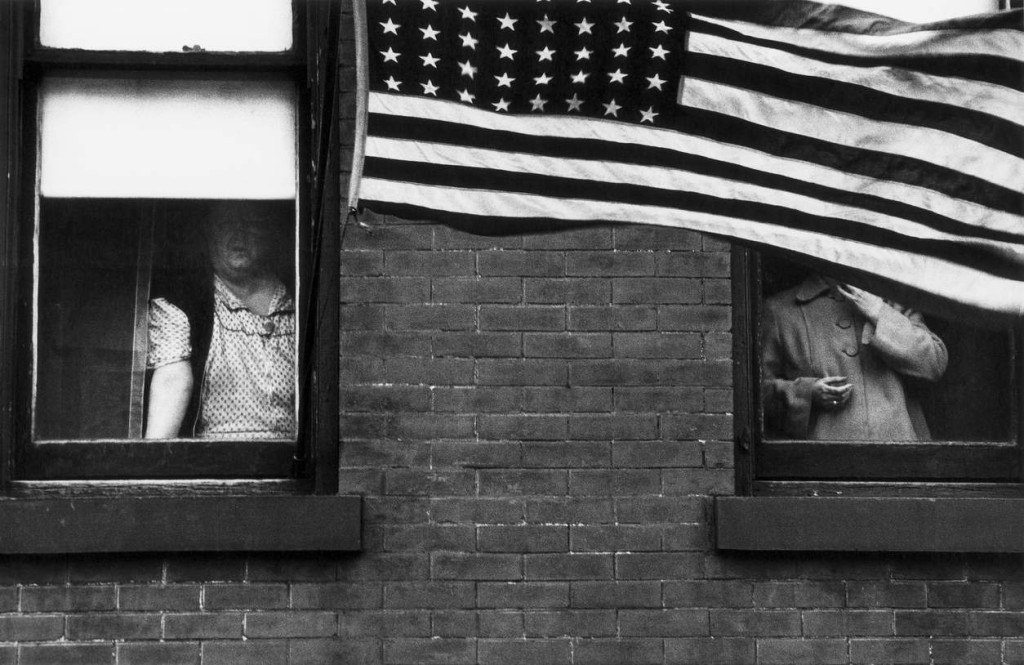
Online, the Times also revisits The Americans, Frank’s best known work and “one of the most influential photography books of all time.”

“Parade — Hoboken, New Jersey,” 1955. Robert Frank
Comments closed

Norman Rockwell, American Romantic

Christopher Benfey reviews American Mirror, Deborah Solomon’s recently published biography of artist Norman Rockwell, for the New York Review of Books:

Solomon spends more time than Rockwell did worrying about his status in comparison with what she calls the “Abstract Expressionist ilk,” who “glamorized direct and unmediated gestures” and dominated highbrow taste during the 1950s. Rockwell, who was remarkably uncompetitive and nonterritorial, said, disarmingly, “If I were young, I would paint that way myself.” The Connoisseur of 1962, a painting now in the collection of Steven Spielberg that Solomon considers a “masterpiece,” depicts a balding man seen from behind, in a gray suit with hat and umbrella in hand, contemplating what seems to be a Pollock painting. The floor, bluish-gray and white squares and triangles, constitutes a contrapuntal abstraction. Rockwell had fun making his own drip painting, canvas on the floor, and had a photographer record the event just as Hans Namuth, in 1950, had famously documented Pollock wielding a can of paint over the canvas. It’s charming to learn that Willem de Kooning, a longtime admirer of Rockwell, claimed to think that Rockwell’s Pollock was better than the real thing. “Square inch by square inch,” he said, “it’s better than Jackson!”

(American Mirror: The Life and Art of Norman Rockwell is published by Farrah, Straus & Giroux, and is distributed in Canada by my employer Raincoast Books)

Comments closed

The Mounting Tide of a Mass Avant-Garde

Phil Ford, author of Dig: Sound and Music in Hip Culture, reviews Loren Glass’ new book on Grove Press, Counterculture Colophon: Grove Press, the Evergreen Review and the Incorporation of the Avant-Garde, for the LA Review Books (which is, by the way, probably the most consistently interesting place around to read about books right now):

Grove Press and its charismatic owner, Barney Rosset, sit right at the center of postwar intellectual history. Glass notes early that if Rosset made a lot of impulsive bad decisions, he was guided steadily by a shrewd understanding of where American culture was headed. In the 1950s, Americans were beginning to go to college en masse, and when they got there they would seek out whatever was chic, daring, avant-garde, experimental — in a word, hip. Counterculture, the notion of seceding from the mainstream and dwelling in an autonomously created realm of liberated culture, was perhaps the most potent dream of the postwar age. Everybody wanted in. Against the mounting tide of a mass avant-garde, the old censorship codes could not long endure.

But while it’s hard not to be inspired by the story Grove Press, it’s also important to note the less savoury side of it, and how it was overtaken by the cultural changes Rosset helped start:

Those who harkened to Evergreen Review’s call to “join the underground” constituted the higher-brow version of the man who read Playboy: a 1966 advertising survey discovered that he was “a 39-year-old male, married, two children, a college graduate who holds a managerial position in business or industry, and has a median family income of $12,875.” (That’s about $92,000 in 2013.) It turns out that “Chuck,” the everysquare in a 1965 Evergreen Review spoof of Charles Atlas ads, painted a pretty realistic portrait of the Grove readership. But with the emergence of a feminist critique made possible by the very cultural revolution Rosset served, the masculine literati no longer enjoyed the privilege of guiltless consumption, and modernist experimentalism no longer provided a dignified alibi for it. In the 1970s, the Evergreen Review image of the hip intellectual soured. We might imagine Chuck a decade later, up to his ears in alimony, parted hair modishly grown out though thinning and combed-over on top, paunch swelling under a safari suit coat, leering at younger women who wish he would drop dead.

Read the whole review.

Comments closed