Skip to content

Tag: alexandra lange

Richard Sapper’s Vision of the Future

richard-sapper-jonathan-olivares-book-cover

At Curbed, Alexandra Lange discusses the work of German-born industrial designer Richard Sapper, and a new book about his work published by Phaidon:

When Los Angeles-based designer Jonathan Olivares first met Richard Sapper in 2008 in Milan, Sapper’s adopted home, he put it more bluntly: Why black?

“I expected him to come back with a hardcore minimalist modernist objective,” says Olivares who, like Sapper, has designed for Knoll. But Sapper said something different. “Black looks good in all kinds of interiors: old interiors, messy interiors, a clean modern interior. It ages really well. It doesn’t look dirty. You don’t see the seams. He told me, Next time, look at a white car and look at a black car. On a white car you see all the joints.” Sapper told two different stories about the shape of the ThinkPad. One is that he was inspired by the cigar box, the other by the bento box. In either case, a deceptively dark, plain exterior opens to a world of flavor. The red nub is either a beautiful cigar wrapper or a nice piece of tuna. It’s such a practical explanation it takes a moment to sink in. It’s as if this product designer knew your life…

…Sapper lived with multitudes and made multitudes, and his idea of the future didn’t involve getting rid of everything past, whether personal or visual. Technology, in his world, could co-exist with sentiment and age. To the end, he was still trying to invent a lamp for people who couldn’t hardwire to the ceiling above their tables. It was based on a fishing rod. That was the kind of “perching” that was of interest to him.


Save

Save

Comments closed

The Real-World Architecture of Monument Valley

monument valley

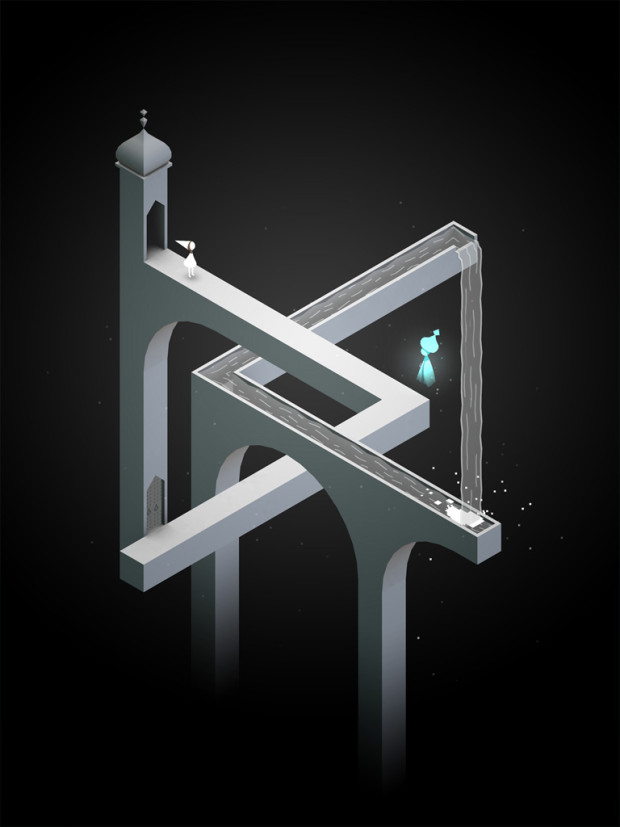
Architecture critic Alexandra Lange, author of Writing About Architecture, talks to the creators of Monument Valley — an award-winning video game in which players must navigate the Princess Ida through a maze of impossible buildings and architectural puzzles — for Curbed:

Much of Monument Valley operates in the impossible space drawn by M. C. Escher, whose 1960 drawing ‘Ascending and Descending’ Monument Valley lead designer Ken Wong has acknowledged as an inspiration. The Escher drawing even features a couple of figures scratching their heads about how to get around. The connection between Escher’s drawing and Wong’s original Monument Valley concept sketch is clear; Wong’s is also strikingly similar to the finished product. The whole structure floats in space in a way that suggests infinity, and it features the same isometric perspective, same gelato colors, and a similar sequence of steps and ladders and domes to give it a touch of character. In Monument Valley, sometimes you seem to be floating on water and sometimes in space; sometimes positive and negative are reversed, and you may be underground in paths and tunnels carved from rock. “We were all so taken with [Escher’s] image,” says [Neil] McFarland, that the designers said, “We don’t know what this game is, but if we can make that into a game we will be really happy.”

For the design buff, the game seems rife with visual cues, allusions to the built world, and academic references. Even if Monument Valley’s designers aren’t familiar with deconstructivism, 1970s architecture may have infiltrated its digital world sideways, as architecture-school graduates turn into programmers and once rarefied ideas turn into placeless pins. Monument Valley’s chapters have to cover a lot of territory, in scale and geography.

Sometimes Ida seems very small, like an earlier puzzle-solving heroine in a gridded Wonderland, wending your way through a music box. Sometimes she appears to be climbing a pixel version of Philip Johnson’s concrete-block Monument to Lincoln Kirstein (1985), “a staircase to nowhere.” Sometimes she finds herself holding a red flower, laying it on a rectangular sarcophagus in a sea of sarcophagi that strongly resemble Eisenman’s Berlin Memorial to the Murdered Jews of Europe (2004). Sometimes you find yourself tripping along a wall that resembles Bofill’s La Muralla Roja housing project (1968), “characterized by a series of interlocking stairs, platforms, and bridges.” Elsewhere the game recalls Tarsem Singh’s cult movie The Fall, filmed at the Lake Palace Hotel in Udaipur (a real-life white, floating world) and the Chand Baori stepwell, a Qbert landscape made exclusively of blocks. Some scenes are more perplexing, and require your seven-year-old to show you which button to push or which screw rotates the cube so that what was once an unbridged gap closes, in digital space, and allows you to cross.

I really don’t play a lot video games, but I do love Monument Valley.

Comments closed