Skip to content

Tag: adrian tomine

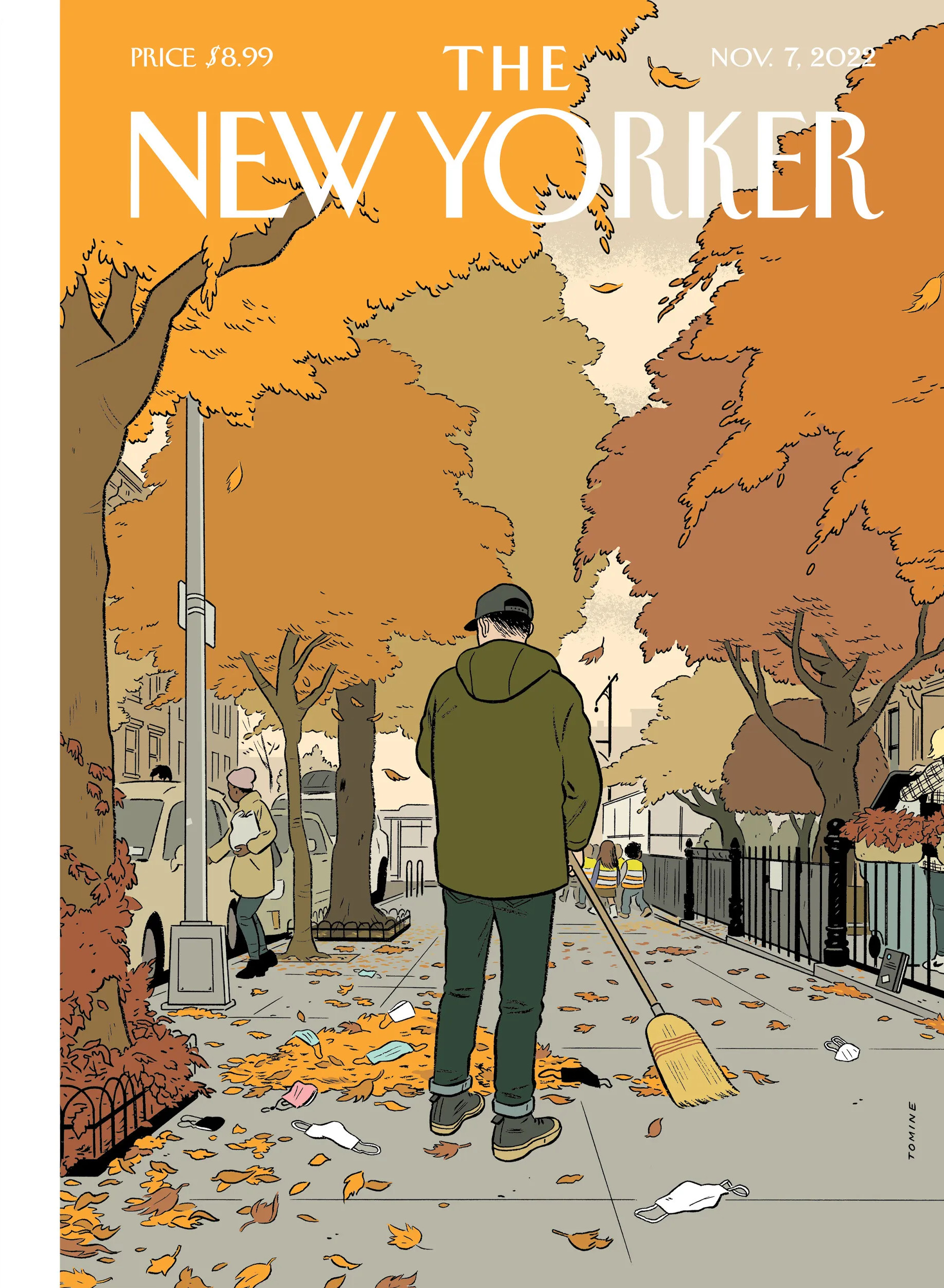
Adrian Tomine’s “Fall Sweep”

I was raking leaves in Toronto last night where it also feels like a lot of folks have discarded masks, so Adrian Tomine‘s latest cover for The New Yorker resonated with me.

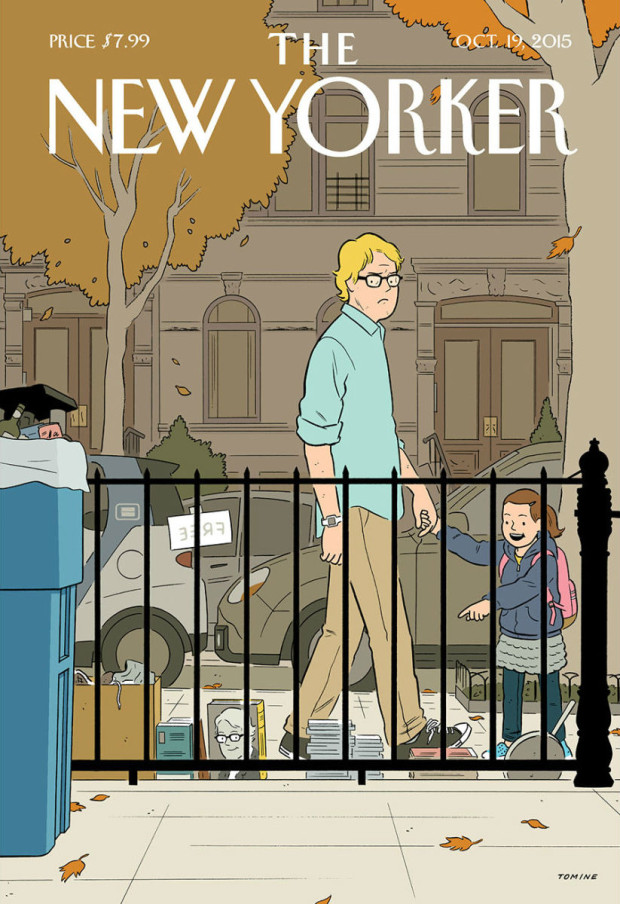
The copy of The Loneliness of a Long-Distance Cartoonist propped up against the railing is also a nice touch.

1 Comment

Recognition

CoverStory-Tomine-Recognition

Adrian Tomine’s latest cover for The New Yorker. Adrian’s new book, Killing and Dying, is out now.

Comments closed

Françoise Mouly and the One-Image Narrative

R. Fiore reviews In Love With Art, Jeet Heer’s shory book on Françoise Mouly, for The Comics Journal:

At this point is there any more important editor in periodical illustration than Françoise Mouly? With so many erstwhile venues for illustration being driven online, where any illustration is rendered into spot illustration, The New Yorker could be the big time all by itself. Unless Spiegelman comes into the office with her we have to assume this is an adventure without him. The New Yorker cover of the William Shawn era was essentially wallpaper, the perfect decoration for the better kind of dentist’s office. (Not least because it didn’t matter how old the magazine was.) The New Yorker cover of the Mouly era is not only more topical than it used to be, but is also frequently a one-image narrative. The ultimate Mouly-era narrative cover is Adrian Tomine’s November 8, 2004 cover: A young man and woman spot each other reading the same book in subway trains going in opposite directions, and not only have not encountered but will lose each other in a second’s time. (Though it would have been a hell of an advertisement for Chance Encounters classifieds if they had them.) The effect is to put the cartoonist at the center of the world of illustration.

Comments closed

Midweek Miscellany

Look Closer — Adrian Tomine talks about moving to New York, and his new book of drawings with The New Yorker:

I’m not one of those artists with an incredible imagination who can just make things up out of nothing, and I’m not the kind of person who would throw himself into some exciting or dangerous situation just to get material. So I tend to go about my normal, boring life, and just try to look at things a little more closely. And even though I’ve lived in New York for eight years now, I still feel like a recent transplant, and I think that’s a big influence on how I see and draw the city.

Invisible — Jeanette Winterson on Tove Jansson and the Moomins, for The Telegraph:

I keep the Moomin books in my study and if I am tinkering about preparing for work I will often open one at random and read a page – they are funny and subversive, (Hemulens of either gender only wear dresses). And playful. Whatever happened to playfulness? Why, as adults, is serious/superficial the boring binary of our lives?… Tove Jansson believed in happy endings… Not the Disney kind but more solid and ambiguous, which is a paradox, but more truthful than black-and-white solutions. Ever-after is what is invisible on the next page.

Approaching Zero — Michael Faber reviews How Music Works by David Byrne, for The Guardian:

Everyone knows that the music industry is in terminal decline. Unlike many doomsayers, however, Byrne feels the changed landscape is good for musicians. Even 20 years ago, any artist wishing to make a record needed a huge sum of money to pay for studio time (and thus needed a large corporation to loan it to him). A lucky few shifted the millions of units necessary to repay the industry’s investment, but the majority got hopelessly into debt. Nowadays, recording costs are “approaching zero”. Distribution costs in the digital era are also negligible compared to the days of physical warehousing. As long as artists can find ways of holding on to a fair percentage of their income (an impossible challenge in the heyday of the record companies), even modest sales can sustain a career. Indeed, says Byrne, “there have never been more opportunities for a musician to reach an audience.”

And finally…

A Short Lesson in Perspective — A fantastic essay by Linds Redding. First published in March of this year, this seems to have taken on a life of its own. If you work in a ‘creative industry’ and haven’t read it yet, make sure you read the whole thing:

The compulsion to create is unstoppable. It’s a need that has to be filled. I’ve barely ‘worked’ in any meaningful way for half a year, but every day I find myself driven to ‘make’ something. Take photographs. Draw. Write. Make bad music. It’s just an itch than needs to be scratched. Apart from the occasional severed ear or descent into fecal-eating dementia the creative impulse is mostly little more than a quaint eccentricity. But introduce this mostly benign neurosis into a commercial context.. well that way, my friends lies misery and madness.


Comments closed

Midweek Miscellany

A fantastic new cover for the Vintage (UK) edition of Gravity’s Rainbow by Thomas Pynchon, designed by Matt Broughton (via the Vintage Books design Tumblr CMYK)

CTRL+C; CTRL+P — Music critic Simon Reynolds, author of Retromania, on remix culture and ‘recreativity’ at Slate:

Recreativity has many proponents and represents a wide spectrum of opinion. Still, it’s striking how easily some of these critics and theorists glide from relatively sensible talk about the role of appropriation and allusion in art to sweeping claims of an ontological or biological nature. They seem so confident. How they can be certain that nobody has ever just come up with some totally new idea, ex nihilo? The remixed nature of everything (not new) under the sun has become an article of faith. Impossible to prove, these assertions tell us way more about our current horizons of thought and our cultural predicament than they do about the nature of creativity or the history of art.

The A.V. Club list their 50 best films of the ’90s. (Their list of their most-hated movies is here).

Picture This — Cartoonist Adrian Tomine discusses his work and his new book New York Drawings with the The Paris Review:

If you were to go back in time and talk to the people who invented cartooning, and were doing it for newspapers, and told them that there were going to be guys who were going to do twenty-four-page long stories, they would think that was a strange use of the medium. And if you then said, they’re going to try and inject that with a singular vision and personal experience and do six-hundred-page long stories—I mean, their heads would have exploded.

See also: Adrian on his first cover for The New Yorker at the The Thought Fox, the blog of his UK publisher Faber & Faber.

And Finally…

Speaking of The Paris Review, an interview with editor Lorin Stein at the LA Review of Books:

The tradition of discovering new writers makes it easy to go out and find stuff that excites me, and at the same time feels of a piece with the history… To me it’s like that line in the great Italian novel, Lampedusa’s The Leopard. If you want things to stay the same, everything’s going to have to change. Nowadays we have to exist in the digital world if we don’t want to be strictly of the digital world.

2 Comments

Something for the Weekend

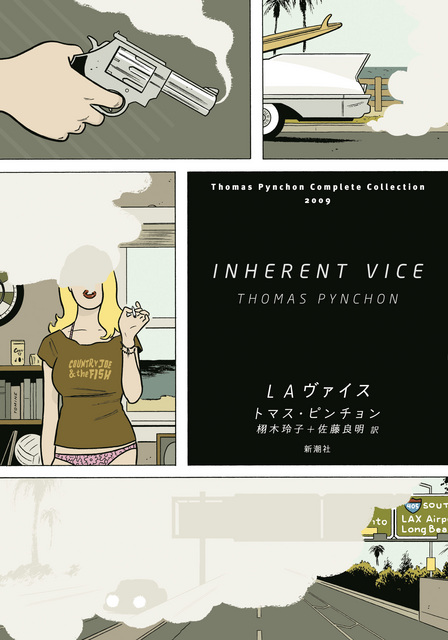
Cover illustration by Adrian Tomine for the Japanese edition of Inherent Vice by Thomas Pynchon, published by Shinchosha Publishing.

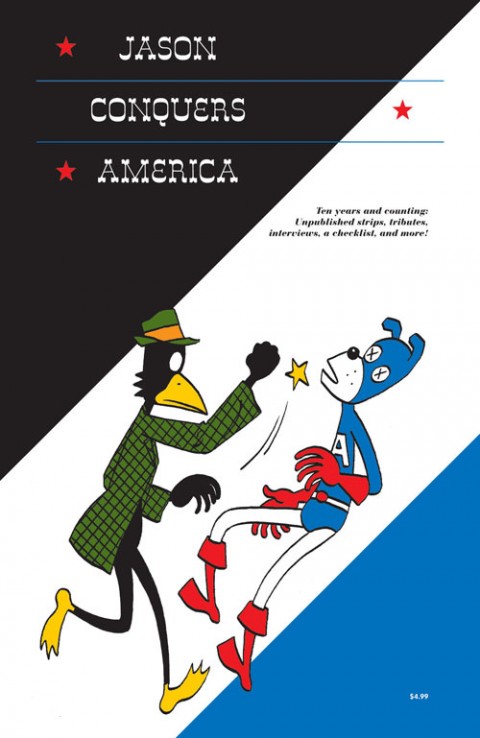
The Darkness — Norwegian cartoonist Jason profiled in The National Post:

“A comedy that has some darkness, like The Apartment, is more appealing than if it’s just fluff. Ingmar Bergman’s best film, to me, is Fanny and Alexander, that is dark, like many of his early films, but there is a joy also, an affirmation of life,” he continues. “Darkness just for being dark doesn’t interest me that much. … I prefer the vitality of something that isn’t perfect.”

Jason will be at the Toronto Comic Arts Festival this weekend, and you can read my Q & A with him here.

Bam… Bam… Bam… David L. Ulin, writing at the LA Times, on interviewing William S. Burroughs:

“Life is a cutup,” Burroughs says about halfway through his conversation with Ginsberg, referring to his technique of bisecting pieces of text and reconfiguring them as collages, letting the juxtapositions create a meaning that transcends traditional narrative. “And to pretend that you write or paint in a timeless vacuum is just simply … not … true, not in accord with the facts of human perception.”

Yes, yes, I found myself thinking, not least because four years later, Burroughs had said virtually the same thing to me. “Life is a goddamn cutup,” is how he put it. “Every time you look out the window, or answer the phone, your consciousness is being cut by random factors. Walk down the street — bam, bam, bam…. And it’s closer to the facts of your own perception, that’s the point.”

Ulin is referring to a conversation between Allen Ginsburg and Burroughs recently published in Sensitive Skin magazine.

And finally…

A Deadman’s Masterpiece — Gabriel Winslow-Yost on Tarkovovsky’s movie Stalker, the Chernobyl disaster, and the S.T.A.L.K.E.R. series of video games, for the NYRB:

The Zone in the video games is a beautifully dangerous place, bigger and grimmer than Tarkovsky’s, but somehow still appropriate. There are plenty of long, tense walks through damp weather or empty, creaking tunnels. Packs of dogs wander the landscape, ruined farmhouses give shelter from the rain; here and there the ground ripples strangely. Stalkers gather around campfires, bandits take potshots at passersby, and a man lies wounded in a ditch, begging for help. Watching Stalker, one is occasionally brought up short by remembering that it was not filmed in Chernobyl, so perfect an analogue does that event seem for the film’s images of technology and nature, beauty and danger in strange alliance. The games, at their best, can seem like a sort of miracle: a dead man’s masterpiece, come home at last.

Comments closed

Monday Miscellany

As mentioned earlier, I was in Vancouver last week and I wasn’t able to post as regularly as I would have liked to. So to make up for Friday’s missing links, here are a few things of interest to start the week off…

Adrian Tomine (Shortcomings) discusses his latest work, Optic Nerve #12, and an unfinished graphic novel with Comic Book Resources:

When I finally sat down to work on my next comics project, I felt obligated to attempt a real “graphic novel.” I was looking at these giant tomes that some of my peers were working on, and I felt really envious of that kind of achievement. It also just seemed like that was the direction everything was moving in, and my old habit of publishing short stories in the comic book format was already an anachronism. So I pursued that for awhile, doing a lot of the kind of preparatory work which is actually the hardest part for me, and the whole time I had these nagging thoughts like, “Do I really want to work on this for ten years? Do I want to draw and write in the same way for that long? Does the material really merit that much of an investment?”

Hard Won — Yet another review for MetaMaus in The New York Times:

Spiegelman recalls the struggles of researching “Maus” at a time before scholarship was widely available to a mass audience. Pre-Internet, he depended on his parents’ collection of pamphlets written and drawn by survivors, and on research visits to Poland. On his second trip to Birkenau, in 1987, Spiegelman was baffled to find a perfectly preserved barracks where once there had been only rubble; it turned out to be a re-creation built for a Holocaust movie, left standing by Polish authorities because it looked accurate. He admits he was jealous of the moviemakers’ unlimited resources, when “every scrap of information I needed for ‘Maus’ was so hard-won.”

With It — Michael Farr, author of Tintin: The Complete Companion, talks about Tintin and discusses five books related to Herge and his creation at The Browser:

If you didn’t meet Hergé, you wouldn’t realise how funny he was – he saw the humorous side of almost everything. He was visually terribly aware, he didn’t miss anything which he saw. He was in his seventies then and I was in my mid-twenties, and I think that’s the reason why he agreed to see me. Younger, a French-speaking British journalist, I was slightly exotic and that intrigued him. Hergé was terribly young for his age. To use an expression that was used more then than now, he was very “with it”. When we got talking about music, he asked me what my favourite Pink Floyd songs were.

You see all this in the books. In many respects, Hergé is Tintin himself.

See also: Hal Foster, art critic and author of The First Pop Age (i.e. not THAT Hal Foster), on pop art at The Browser.

And finally…

Art critic Robert Hughes on his first visit to Rome, excerpted from his new book about the city, in The WSJ:

It was being gradually borne in on me by Rome that one of the vital things that make a great city great is not mere raw size, but the amount of care, detail, observation and love precipitated in its contents, including, but not only, its buildings. And it goes without saying, or ought to, that one cannot pay that kind of attention to detail until one understands quite a bit about substance, about different stones, different metals, the variety of woods and other substances—ceramic, glass, brick, plaster and the rest—that go to make up the innards and outer skin of a building, how they age, how they wear: in sum, how they live, if they do live.
Comments closed

Midweek Miscellany

Risky Business — Cartoonist Adrian Tomine talks about his new book Scenes From An Impending Marriage, which originally started life as a mini-comic for his wedding guests, with More Intelligent Life:

I probably first started thinking about publishing it when a copy appeared on eBay. I assumed that since it was only given to close friends and family, that would never happen, but I was wrong. And like I said, since I was slowly adding pages to the book, I eventually found myself with 50 or 60 pages worth of material, and I just proposed the idea to my publisher. If he had declined, I would’ve happily filed it away…

AND Adrian and his wife Sarah Brennan talk about the new book with NPR’s All Things Considered.

(For the record, Scenes From An Impending Marriage is distributed in Canada by my employer Raincoast Books).

Sunny-Side — Jonathan Lethem talks to Carolyn Kellogg at The LA Times about decamping from Brooklyn to Southern California. There is more of their conversation at TimesJacket Copy blog:

I’ve only probably reviewed seven or eight novels. It’s really problematic. I’m gregarious with writers; I like novelists. I don’t want my sympathies to cause me to write a review that’s in any kind of bad faith, nor do I want to destroy some pleasant, even if it’s slight, collegial feeling. I try to review the dead guy — Bolaño — or the biography of the dead guy, because I like being in the conversation. Sometimes I look at what Updike did at the New Yorker. I don’t know if many people have the temperament, let alone the incredible set of skills he brought to that, the versatility, the endless curiosity, to identify with so many different kinds of novelists who were not doing what he does.

The Price of Zero — David Carr on media companies and unpaid contributors for The New York Times:

For those of us who make a living typing, it’s all very scary, of course. It’s less about the diminution of authority and expertise, although there is that, and more about the growing perception that content is a commodity, and one that can be had for the price of zero… For the media, this is a Tom Sawyer moment. “Does a boy get a chance to whitewash a fence every day?” he says to his friends, and sure enough, they are soon lined up for the privilege of doing his chores. That’s a bit like how social networks get built. (Just imagine if Tom had also schooled them in the networking opportunities of the user-generated endeavor: “You’re not just painting a fence. You’re building an audience around your personal brand.”)

And finally…

In the Age of Screens — A serialized essay about contemporary book discovery and reading by Chad W. Post, publisher of Open Letter Books, editor of  the Three Percent blog:

[W]e’ve stripped away all the institutions that supported the ways in which most outsiders found their literature, leaving texts to float untethered in the ether, there to be found… There is no serendipity… And yet, for the long-term benefit of society, we need people to have—and be exposed to— ideas from the out-of-­nowhere.

The complete essay is available as a PDF.

we’ve
stripped
away
all
the
institutions
that
supported
the
ways
in
which
most
outsiders
found
their
literature,
leaving
texts
to
float
untethered
in
the
ether,
there
to
be
found
.
.
.
Comments closed

Monday Miscellany

These are mostly links I was going to post on Friday, but with a long post on Mendelsund and a last minute WordPress fail (to add to all the usual pressures of part-time blogging) I thought I might as well hold them over until today. Think of it less as a bad end to last week, and a great start to this one (or something like that)…

Designer Eric Skillman on Adrian Tomine’s illustrations for the Criterion boxed set of Yasujiro Ozu’s The Only Son/There Was a Father.

And on the subject of Adrian Tomine, David L. Ulin reviews his new book Scenes From an Impending Marriage for The LA Times:

Tomine has always been a master of the small gesture, as anyone familiar with his work knows. Such encounters motivate the deceptively informal stories in his series “Optic Nerve,” as well as his graphic novel “Shortcomings,” which explores the limits of identity and intimacy. With “Scenes from an Impending Marriage,” though, he seems almost willfully understated, tracing, in a series of offhand comics, the peculiar rigors of the wedding dance, from guest lists to seating charts to invitations and beyond.

(For the record: several of Adrian’s books, including the new one, are distributed in Canada by my employer, Raincoast Books).

The Impulse to Write — Patti Smith talks about her writing and music in The Guardian:

“More than anything that’s been the thread through my life – the desire to write, the impulse to write. I mean, it’s taken me other places, but it was the impulse to write that led me to singing. I’m not a musician. I never thought of performing in a rock’n’roll band. I was just drawn in. It was like being called to duty – I was called to duty, and I did my duty as best as I could.”

And finally…

London Intrusion — China Miéville, author most recently of The City and The City and Kraken, is posting a webcomic on Tumblr (via Robot 6).

(And speaking of Tumblr… Posts from here and The Accidental Optimist are now also available on Tumblr if that’s your thing.)

Comments closed

Something for the Weekend

[A quick note about the poll: thanks to everyone who voted, left a comment or sent me note this week — I really appreciate it. The feedback has been great. I’m going to shut the poll down at midnight tonight, but please let me know if you have any further thoughts about the direction of The Casual Optimist.]

Lauren Kaiser’s Little Red Riding Hood seen at Type Theory (pictured above).

liza-pro-underwareThe Oscars of Type — Ellen Lupton’s list of the year’s top typefaces at Print magazine. “Best Actress” was awarded to Underware’s Liza Pro (pictured above). My interview with Ellen Lupton is here.

Happiness as By-product — Jessa Crispin founder of Bookslut interviewed by Jeff VanderMeer, author of Booklife (which Crispin was critical of interestingly):

I was having a conversation with a writer the other day, and he stated that the best things are always by-products. Happiness is a by-product, and I loved that he said that. You can plot your journey to success or happiness or wealth or whatever it is you’re looking for, but if you’re too focused on the end result, you’re going to miss anything good going on around you… Not that we should all sing songs around the campfire and braid each other’s hair, but there has to be a combination of the two, forward motion and goal planning, but while taking a look at the people around you.

Comics Studies Reader — Jeet Heer on comics and comic scholarship at Books@Torontoist:

I think there’s a wide variety of things that can be done with comics, and I think we’ve only scratched the surface… One of the interesting things about manga is that kids are reading translated manga that reads right to left. Part of the reason that’s possible is because comics are both words and pictures – half of the translation work is already done. So you can look at a comic book in a language you don’t know and you won’t get everything but you can still get a fair bit of what it’s about. And so they have this sort of function as cultural ambassadors. You can actually learn a lot about a culture just by looking at the comics.

The New Yorker 85th anniversary covers by Chris Ware, Adrian Tomine, Dan Clowes, and Ivan Brunetti seen at the Creative Review blog (Adaptation by Tomine pictured below).

Art Spiegelman and Francoise Mouly (art editor at the aforementioned New Yorker) discuss The Toon Treasury of Classic Children’s Comics with (a particularly gushy) Michael Silverblatt for KCRW’s BookWorm :

Comments closed

Monday Miscellany, March 23rd, 2009

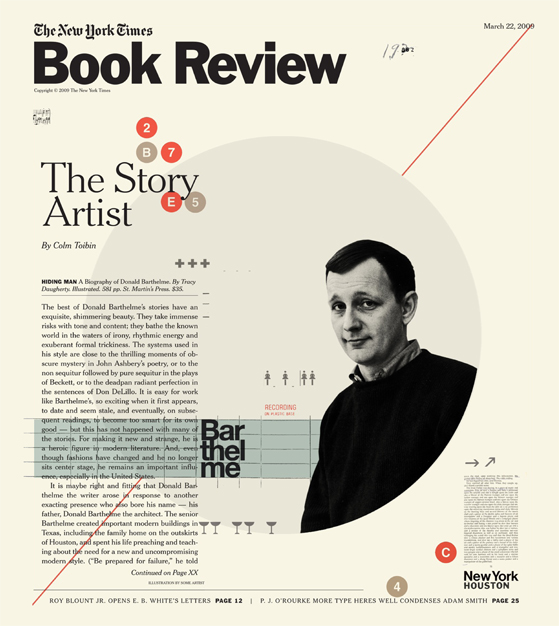
The Story Artist — Stand back and admire Cristiana Couceira’s cover for the New York Times Book Review (pictured above) illustrating Colm Toibin’s review of Hiding Man: A Biography of Donald Barthelme by Tracy Daugherty (St. Martin’s Press).  You can see more of Cristiana’s fabulous work at her blog Sete Dias.

ma collection de boîtes de conserves — Cartoonist Guy Delisle, author of Shenzhen, Pyongyang, and Burma Chronicles, displays his charming recycled pen-holders. Guy also has some great sketches of Jerusalem on his blog (an experience that is probably even better if your French is not rubbish like mine). (Via the D+Q blog and full disclosure etc: Raincoast Books distribute D+Q in Canada).

And speaking of D+Q,  John Wray’s much-praised novel Lowboy features a cover  by the very talented Adrian Tomine (pictured above). And über-critic James Wood reviews Lowboy in the latest New Yorker.

Paper Egg — Tobias Carroll has posted an interesting interview with Jonathan Messinger, co-publisher at  Featherproof Books:

[T]he line we’ve been delivering for a while now is that printed books will, eventually, go the way of vinyl. At some point, digital distribution will be the predominant method, but there will still be those who value and collect print, as people do records now (a fact that, it seems, has created a strong niche market for cool vinyl releases). But I’m not so sure that I completely buy that analogy, as fun as it is to repeat. Really, the debate seems pointless to me. What it always devolves to is one person clinging to what they’ve grown up with and accustomed to—the printed book, this classic, vaunted, untouchable commodity—and self-appointed visionaries who see digital distro as the obvious wave of the future, plowing down the fogies and fuddy-duddies.

If we de-politicize it, it becomes a much more open, interesting discussion. My feeling is that both media offer something that the other doesn’t. So why should one replace the other? … I’d rather just think about how best to use print creatively—what can it do that nothing else can, what are its limits and how do we test them?

Information revolution, c. 1455 — Murray Whyte looks at the “Gutenberg moment” in the Toronto Star:

as we appear finally to face the end, or partial end, of the Gutenberg era … it’s worth noting that sometimes, those things we view in hindsight as revolution are, in their own time, little more than a pebble in the pond, the resulting ripples needing generations, if not centuries, to be fully felt.

Comments closed

Monday Miscellany, March 16th, 2009

Beyond Miffy —  Caustic Cover Critic on Dutch illustrator and graphic designer Dick Bruna, best known for Miffy, but who also designed some very cool book covers for crime novels (picture above).

Cautiously Hopeful — Literary agent Nathan Bransford, who has been talking about remaining positive in the face of negativity on his own blog recently,  interviewed by Alan Rinzler on The Book Deal blog:

The role of publishers especially is going to change dramatically as there will be tremendous downward pressure on prices and publishers increasingly retrench behind “known” commodities and bestsellers.

Publishers will live and die by their big bets if they aren’t cultivating any small bets that have the potential of panning out in a big way.

6 Projects That Could Change Publishing for the Better — Michael Tamblyn’s  presentation from the BNC Tech Forum is available online.

Open Baskerville — An open source project to create a digital version of Fry’s Baskerville,  originally created by  Isaac Moore a punchcutter at the typefoundry of Joseph Fry in the 18th Century (via Eightface):

With the written word an absolute fundamental component of daily communication, typography and fonts have are vital to providing aesthetic harmony and legibility to our textual works. There are thousands of fonts available, of which only a small number are useful or any good for setting vast quantities of text, and of which an even smaller number are available to be freely distributed and shared. This project aims to help close that hole, beginning with a Baskerville revival.

Optic Nerve — the fabulous Adrian Tomine interviewed at the Creative Review (illustration above).

Why Kindle On The iPhone Matters — Michael Gaudet on the iPhone Kindle app at E-Reads:

What Amazon is finally acknowledging is that E-Books are a multi-device service and that Kindle is not just a device but an E-Book platform. E-Books may be commodities, but reading is a user habit that has always required a distribution service that anticipates the creative ways readers are looking to acquire new content.

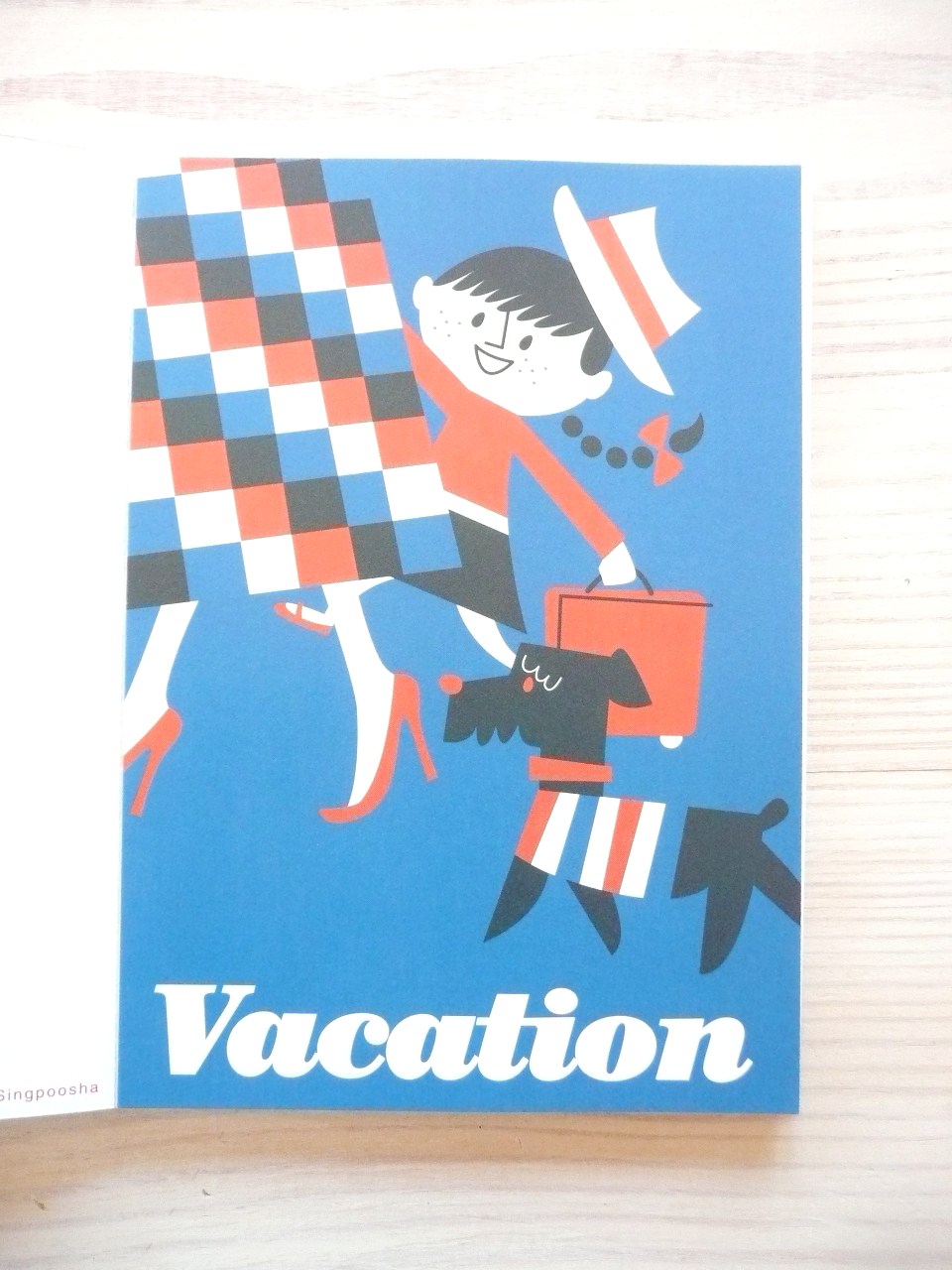
Books and Stuff — Illustrator and designer Amy Cartwright, who blogs about vintage kids books and modern design at Stickers and Stuff, shares some wonderful pictures of her favorite books and “the stories behind some of her finds” at the always awesome Grain Edit (including the Cosy Tomato Post Card Book pictured above).

Comments closed