Skip to content

Category: Online

“A hint of optimism”

Publishers Weekly is reporting that following “one of publishing’s bleakest weeks” in living memory, there’s a reason for us to keep on living in the form of two recent digital announcements from Penguin and Random House.

Penguin have launched Penguin 2.0 which includes more online content, e-books and POD, as well as an app imaginatively called ‘Penguin Mobile’ which makes the features from Penguin’s website available on the iPhone.

In the meantime, Random House have announced a partnership with Stanza “the popular iPhone e-book reader from Lexcycle” that will make e-books by several RH authors available for free on the platform. According to the press release, the books available “will be drawn from each author’s backlist and will include excerpts for any new hardcovers coming in 2009.”

I have to say I was really surprised how much I like e-books on the iPhone. But what does this mean for single-purpose devices like Sony’s e-Reader and Amazon’s Kindle?

Comments closed

My Internet (or the importance of contact information)

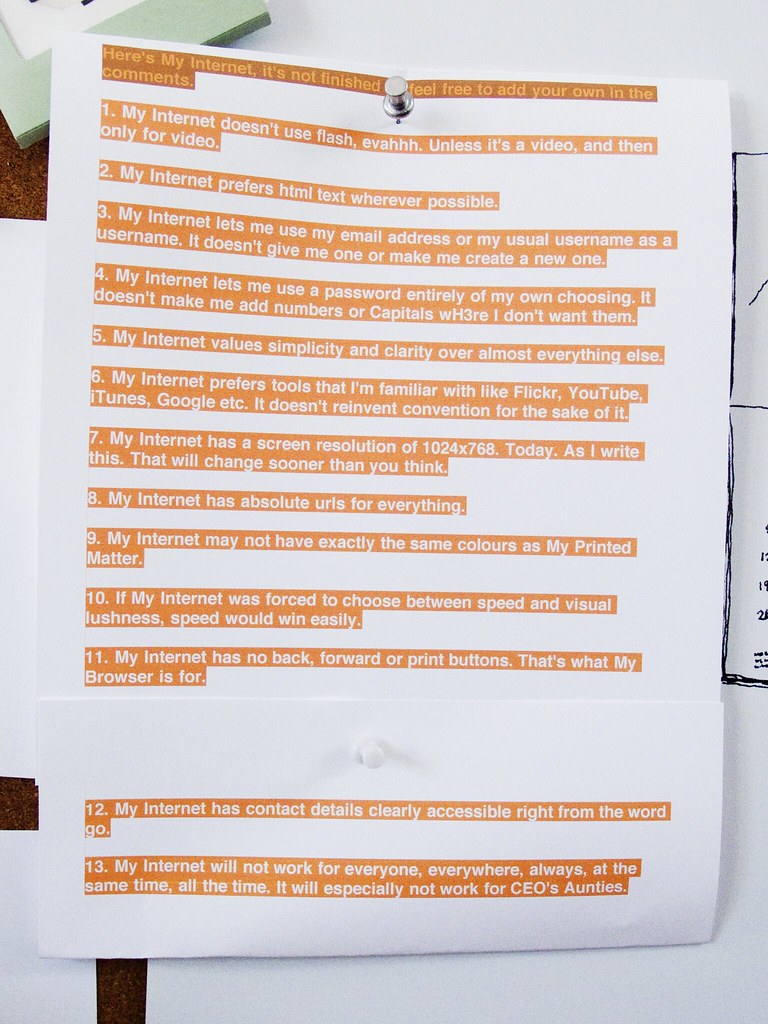
Ben Terrett’s My Internet (redesigned and posted by Michael at DesignNotes):

My internet also includes clearly accessible contact details from the word go. It’s amazing how often we (marketing monkeys, publishers, media types) get this wrong. My internet doesn’t include contact forms either. I would like to email a person please.

And don’t even get me started on Flash…

Link

3 Comments

Generous Criticism

“Being generous in speaking of another’s work doesn’t mean “heaping praise”. It means delivering the critique from a place deeper than the insignificant nitpicking that comes so easily, deeper still from a place that harbors no envy, and even further down where the critique is offered in a genuine effort to improve the project, to the benefit of the discipline as a whole. Everyone wins.”

I came across Nam Henderson’s  Archinect op-ed on ‘Generous Criticism’ via Michael Surtees DesignNotes.

Design blogs, like DesignNotes, Design Observer, Ace Jet 170, Grain Edit,  and Swissmiss – to name just a few – are such an inspiration. The breadth of the design community’s interests, the generosity, willingness to share, and sheer enthusiasm for what they do is remarkable.

I wish I saw more of this kind of online dialogue about publishing.

The best lit-blogs, like ReadySteadyBlog, and Sarah Weinman’s blog, Confessions of an Idiosyncratic Mind, rightly save their enthusiasm for writing and writers. But blogs that concern themselves with the business of books lack that kind of energy.

Although there are notable exceptions –  James Bridle’s booktwo and Shelf Awareness come to mind – the book business seems to have very little to say for itself, and even less that is positive. We hear so little  about the agents, publishers, editors, designers, publicists, sales reps and booksellers who just nail it. Instead our conversations are dominated by  hell-in-a-handcart pessimists or told-you-so digital evangelists. We link to the same gossipy controversies and angry rants. We take cheap shots and wonder why we’re being marginalized by things that are more fun.

We seem short generosity and lacking in curiosity.

Publishing is not perfect, but we do some great stuff. Of course we should be critical, but we should do it to improve what we do, not to tear it down. To go back to Nam Henderson:

“we should, as a community of professionals, be able to expect respectful commentary, considered and generous… if something is bullshit, SAY SO… If someone is skating by on laziness, call them out and challenge them – positively – to make a better effort. And challenge yourself, in every critique, to be generous: reflect on what you’re seeing in the bigger context…, identify the elements that are good, apply the logic of the good parts to the overall scheme to see where improvements can be made. Think about how much effort you would want a critic to put into a comment made to you.”

I can’t say I am without fault. I’m as snarky as the next guy. But I hope — and strive — for something better.

2 Comments

Are E-Books Shovelware?

Introducing his five-part series BASIC Principles of Online Journalism (discussed last week), Paul Bradshaw notes:

It shouldn’t have to be said that the web is different, but I’ll say it anyway: the web is different. It is not print, it is not television, it is not radio.

So why write content for the web in the same way that you might write for a newspaper or a news broadcast?

Organisations used to do this, and some still do. It was called ‘shovelware’, a process by which content created for another medium (generally print) was ‘shovelled’ onto the web with nary a care for whether that was appropriate or not.

It was not.

With Peter Kent of DNAML recently suggesting  on the O’Reilly TOC blog that publishers treat e-books like software, and many e-books just digitalized versions of their print edition, are e-books falling into the category of  ‘shovelware’?

Certainly trade publishers have tended to think of the e-book as a ‘format’ a cheaper, more convenient way to read text than an ordinary book that requires little amendment rather than an entirely different ‘medium’ with new rules and possibilities.

Andrew Gallix, editor-in-chief of 3:AM Magazine mulled some of this over in The Guardian last week:

Bar a few notable exceptions (Penguin’s wiki-novel or We Tell Stories project), traditional publishers have used the internet as a glorified marketing tool providing them with new ways of flogging the same old same old: e-books, Sony Readers, digi-novels, slush-pile outsourcing… So far, the brave new world of digital literature has been largely anti-climatic…

I don’t think you  don’t need to embrace Gallix’s avant-garde e-lit leanings or see e-books as completely detached from print to appreciate that if they simply reproduce what’s already available, e-books are not really reaching their potential.

At the very least, authors and publishers should consider how the digital reading experience differs from that of print, whether this is producing new texts specifically intended to be published as e-books, or providing additional digital content for existing texts.

Thinking about Bradshaw’s  principles brevity, adaptability, scannability, interactivity, community, and conversation seem like a good place to start.

2 Comments

BASIC Principles for Online Content

Whether you are an author, editor, publicist or marketer writing for the web is different than writing for print.

The BASIC principles of Online Journalism identified by Paul Bradshaw in a five-part series for his Online Journalism Blog provide useful guidelines. Here’s a summary:

  • BREVITY: Most people struggle to read long documents on a screen so break lengthy articles into ‘chunks’. Keep paragraphs succinct and focused on one idea.
  • ADAPTABILITY: Writers must be adaptable because websites utilize a range of media in addition to text. Information and content must be  adaptable so that they can be easily re-purposed by the reader or another writer.
  • SCANNABILITY: Reading word-for-word is rare online and most web users scan pages looking for headlines, subheadings, and links that help them navigate the text on screen. Scannability also improves your accessibility.
  • INTERACTIVITY: Think about how you can give control to your readers.
  • COMMUNITY: Learn how to join communities and engage in their conversations. Persuade people to join your networks by organizing and informing them.
  • CONVERSATION We’ve moved from lectures to conversations. Moreover, “the distinctions between conversation and publishing in an online medium are being eroded. Everything that we say is recorded, linkable, distributable. Conversation is publishing.

Link

Comments closed

Google Expands Book Search

Google has announced that it is launching a new set of free Google Book Search tools “that allow retailers, publishers, and anyone with a web site to embed books from the Google Book Search index.”

Google Book Search, which already partners with publishers and libraries, give users the opportunity to search online and view a preview of a book if it’s out of copyright, or the publisher has given Google permission.

The new tools enable sites to embed books from the Google Book Search index, allowing them to display full-text search results from Book Search, and integrate with social features such as ratings and reviews:

“Ultimately, we believe that these tools and partnerships further our quest to make books more discoverable on the Web, from your Google search results to your favorite bookstores, publisher and author websites, online library catalogues, and social networks.”

Link


Comments closed