Skip to content

Category: Online

Corrupting Souls

Tom Gauld‘s Midsummer’s Eve cartoon for The Guardian is from last month (obviously!), but I’m borrowing it to make a bit of boring and overdue social media housekeeping more interesting!

While I haven’t yet asked Wizard Toby to deactivate the Casual Optimist account like a some kind of despairing Baphomet, I have pretty much abandoned Twitter. It’s disappointing because I’ve met some great people through the app and it has always been a tremendous resource, but I can’t support it any more.

I’ve always hated Facebook and I haven’t posted to the Casual Optimist page there in at least a couple of years. I did, however, start an Instagram account which I’m trying to update at least once a month if you want to follow along there. I think it’s pretty unlikely that I will do anything with Threads.

I’m not on Bluesky, but I am trying out Mastodon. It promises a lot, I’m just not quite convinced by it yet (and I gather from more prolific posters than me that there is something of a sea lion problem there). I’ll post a link if/when there is a proper Casual Optimist account. In the meantime, you can find me here.

There is an RSS feed that you can subscribe to if you still use a reader (I use the Old Reader FWIW; I’m not sure what the cool kids are using), or you can get it as an email (it’s not perfect but it works).

Updates are also sent automatically to Tumblr if you’re still rattling around that haunted abandoned mansion.

Anyway, sorry for being very online and tedious. I’ll try to post some more interesting stuff soon (if I don’t quietly pack it in completely and put myself out to pasture…)

Comments closed

The Impact of Kickstarter, Creative Commons & Creators Project | Off Book

The latest installment of the PBS short documentary series Off Book looks at how interconnectivity is changing the funding and sharing of creative projects:

Comments closed

The Evolution of Music Online | Off Book

Related to the previous, the latest PBS Arts Off Book documentary short is about the massive changes that have occurred in the music industry in the last twenty years as a result of new technology and the Internet:

Comments closed

PressPausePlay

The full-length documentary PressPausePlay is now available to watch on Vimeo. The film, which somehow manages to be simultaneously both inspiring and melancholic, looks at the effects of digital technology and the Internet on the creative economy. Worth watching if you have a spare hour (although depending on your attitude to these things it might make you smile in joyful validation or retreat to your bed for about a week to weep quietly to yourself:

PressPausePlay was made by creative agency House of Radon.

Comments closed

Jason Fried on Rework

In a recent interview for CBC Radio show Spark, Jason Fried, the founder of 37signals, talked with Nora Young about his book Rework:

CBC RADIO SPARK: JASON FRIED | REWORK

Also doing the rounds is Fried’s article ‘How to Get Good at Making Money’:

People are happy to pay for things that work well. Never be afraid to put a price on something. If you pour your heart into something and make it great, sell it. For real money. Even if there are free options, even if the market is flooded with free. People will pay for things they love.

This lesson is at the core of 37signals. There are plenty of free project management tools. There are plenty of free contact managers and customer relationship management tools. There are plenty of free chat tools and organization tools. There are plenty of free conferences and workshops. Free is everywhere. But we charge for our products. And our customers are happy to pay for them… Charging for something makes you want to make it better. I’ve found this to be really important. It’s a great lesson if you want to learn how to make money.

What I didn’t know, but learnt today, was that Jeff Bezos is the sole investor in 37Signals. Make of that what you will.

Comments closed

Learning to Love the (Shallow, Divisive, Unreliable) New Media

James Fallows, veteran journalist and author of Breaking the News, has a lengthy article in The Atlantic on Gawker and the effect of digital media on journalism:

One by one, the buffers between what people want and what the media can afford to deliver have been stripped away. Broadcast TV was deregulated, and cable and satellite TV arose in a wholly post-regulation era. As newspapers fell during the rise of the Internet, and fell faster because of the 2008 recession, the regional papers fell hardest. The survivors, from The New York Times to the National Enquirer, will be what British newspapers have long been: nationwide in distribution, and differentiated by politics and class. The destruction of the “bundled” business model for newspapers, which allowed ads in the Auto section to underwrite a bureau in Baghdad; the rise of increasingly targeted and niche-ified information sources and advertising vehicles; and the consequent pressure on almost any mass offering except for sports—all of these are steps toward a perfected market for information of all sorts, including news. With each passing month, people can get more of what they want and less of what someone else thinks they should have.

Every news organization recognizes this shift… The Atlantic is now profitable in part because traffic on our Web site is so strong. Everyone involved in the site understands the tricks and trade-offs that can increase clicks and raise the chances of a breakout “viral” Web success. Kittens, slide shows, videos, Sarah Palin—these are a few. For us and for other publications, they are complications. For Gawker, they’re all that is.

According to Fallows, however, the disruption is also creating new, positive opportunities:

Economic history is working against “legacy” news organizations like the BBC, The New York Times, NPR, and most magazines you could name. But historical forces don’t play out on a set schedule, and can be delayed for a very long time. Economic history is also working against museums, small private colleges, and the farm-dappled French countryside, but none of them has to disappear next week. Even as it necessarily evolves, our news system will be better the longer it includes institutions whose culture and ambitions reach back to the pre-Gawker era, and it would be harder and costlier to try to re-create them after they have failed than to keep them on life support until their owners find a way to fit their values and standards into the imperatives of the new systems.

But the new culture also creates positive opportunities—as, it’s worth saying again, every previous disruption has… At no stage in the evolution of our press could anyone be sure which approaches would support life, and which would flicker out. Through my own career I have seen enough publications and programs start—and succeed, and fail—to know how hard it is to foresee their course in advance. Therefore I am biased in favor of almost any new project, since it might prove to be the next New York Review of Books, Rolling Stone, NPR, or Wired that helps us understand our world.

If you are interested in journalism and news media, the whole article is definitely worth your time.

Comments closed

Too Much Information

That the reality of machines can outpace the imagination of magic, and in so short a time, does tend to lend weight to the claim that the technological shifts in communication we’re living with are unprecedented… The scale of the transformation is such that an ever-expanding literature has emerged to censure or celebrate it. A series of books explaining why books no longer matter is a paradox that Chesterton would have found implausible, yet there they are, and they come in the typical flavors: the eulogistic, the alarmed, the sober, and the gleeful.

The New Yorker‘s critic-at-large Adam Gopnik reviews the recent spate of books about the internet and our minds — including Cognitive Surplus by Clay Shirky, The Shallows by Nicholas Carr, and Hamlet’s Blackberry by William Powers — neatly dividing them into the categories “Never-Betters”, the “Better-Nevers”, and the “Ever-Wasers”:

The Never-Betters believe that we’re on the brink of a new utopia, where information will be free and democratic, news will be made from the bottom up, love will reign, and cookies will bake themselves. The Better-Nevers think that we would have been better off if the whole thing had never happened, that the world that is coming to an end is superior to the one that is taking its place, and that, at a minimum, books and magazines create private space for minds in ways that twenty-second bursts of information don’t. The Ever-Wasers insist that at any moment in modernity something like this is going on, and that a new way of organizing data and connecting users is always thrilling to some and chilling to others—that something like this is going on is exactly what makes it a modern moment. One’s hopes rest with the Never-Betters; one’s head with the Ever-Wasers; and one’s heart? Well, twenty or so books in, one’s heart tends to move toward the Better-Nevers, and then bounce back toward someplace that looks more like home.

It is an article unlikely to satisfy either the evangelists or doom-mongers, but it sounds about right to me in a smart-alecky sort of way…
Comments closed

The Revolution Will Not Be Tweeted

Author Malcolm Gladwell on Twitter, Facebook, and social activism in the New Yorker:

[Social media] is simply a form of organizing which favors the weak-tie connections that give us access to information over the strong-tie connections that help us persevere in the face of danger. It shifts our energies from organizations that promote strategic and disciplined activity and toward those which promote resilience and adaptability. It makes it easier for activists to express themselves, and harder for that expression to have any impact. The instruments of social media are well suited to making the existing social order more efficient. They are not a natural enemy of the status quo. If you are of the opinion that all the world needs is a little buffing around the edges, this should not trouble you. But if you think that there are still lunch counters out there that need integrating it ought to give you pause.
Comments closed

Something for the Weekend, June 26th, 2009

2009 Penguin Design Award — Peter Adlington’s abstract design for The Secret History by Donna Tart (pictured above) took 1st place. More on the Penguin Blog.

The Good Design Book — Christopher Simmons, graphic designer and principle at the San Francisco-based design firm MINE, records the progress and process of writing and designing his new book on design (via Unbeige). The whole concept reminded me that I should also mention the crowdsourced Smashing Magazine Book.

OK, Go — Kassia Krozser, Kirk Biglione, and Kat Meyer (and an unnamed “veteran of the book industry”), put their money where their collective mouth is, and launch digital publisher Quartet Press (and they’re accepting submissions).

The Debrief — Organizer Hugh McGuire pens his personal thoughts on BookCamp Toronto for Book Oven.

One of the most powerful things about BookCamp, compared with other events I’ve been to, is that this was not just a grassroots group. There was high-level engagement from the publishing industry, with publishers, editors, senior VPs, production managers, marketers, and interns, and everything in between. It was great to see the honest debate and conversation being lead by these insiders, who are truly grappling with the future of their business and their passion.

And VANTAP‘s Sean “Crazy Horse” Cranbury  adds his 2 cents on #bcto09 at the Books on The Radio blog, and teases BookCamp Vancouver.

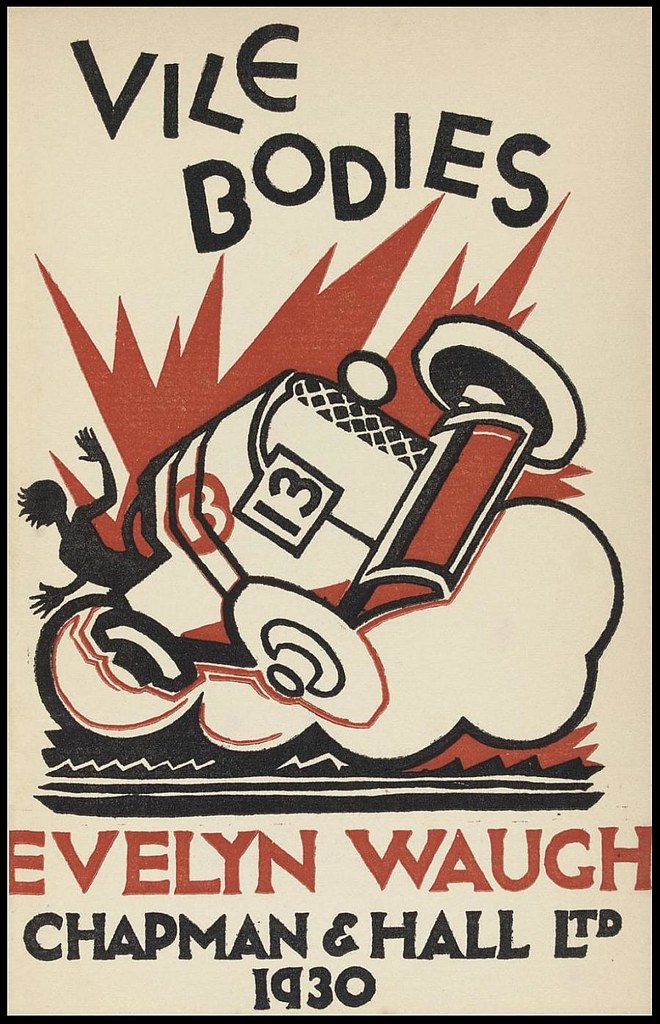
Vile Bodies — The 1930 first edition cover of Evelyn Waugh’s second novel seen at BibliOdyssey.

And last, but not least…

Apples and Oranges — The article about the evolution of Amazon by Adam L. Penenberg, author of the forthcoming Viral Loop: How Social Networks Unleash Revolutionary Business Growth, that launched a great Twitter chat with @FastCompany and yesterday’s ’26 Things…’ list (which could have easily been twice as long). 

Comments closed

Why Not? Or How We Live-Tweeted Fall 09

Why Not?

One the things that really stuck with me from Michael Tamblyn’s 6 Projects That Could Change Publishing For Ever presentation at the BookNet Tech Forum in March was the idea that publishers have to “place lots of little bets quickly.”

It tied into another idea that’s been kicking around recently about reframing ‘Why?’ questions into ‘Why Not?’ questions. That is to say, whenever we — publishers, book distributors et al — ask “why would we do this?” we should flip the question on it head and ask “why wouldn’t we?”.

This doesn’t mean we should pursue every idea that someone puts forward. Sometimes there will be good reasons not to try something — “it costs too much” and “it’s illegal and/or evil” are perfectly valid reasons that spring to mind to nix something (and no doubt there are  plenty more). But, in my experience, reframing the ‘why?’ question encourages people (me included) to think creatively and be more positive about ideas/projects we might otherwise dismiss out of hand.

#rainfall09

This is all a roundabout way of explaining how I ended up twittering from the  Raincoast Books Fall 09 Sales Conference last week.

Before we got under way on the first morning, a few of the early birds were laughing about using Raincoast’s Twitter account to micro-blog the presentations as they happened. Although it started as a joke, the near-inevitable “why would we?” and “who cares?” questions came up, and that raised the stakes. I turned the questions around and couldn’t actually think of any good reasons why we shouldn’t ‘live tweet’ the conference. I had my laptop, wireless access and a power source, so it seemed easy enough to do. And I figured people would tell me pretty quickly if they were bored and I should stop.

Decision made.

We quickly adopted #rainfall09 (an identifying reference tag for twitter posts or ‘tweets’ which was accidentally shortened to #rainfall on more than one occasion) and,  with some help from my colleague Siobhan, I covered all 3 days of the conference in a series of posts of 140 characters or less.

To people who live their lives online and are accustomed to social media rather than the slightly conservative book publishing world, the response to all this is probably a very sarcastic “big whup”. But sales conferences are not usually open and inclusive, and, needless to say, there was a degree of skepticism and resistance to overcome. Certainly it was experiment for us, if not, admittedly, a very large one. And  we were, as far as I’m aware (and someone please correct me if I am wrong), the first publisher/book distributor to Twitter their entire conference.

20/20

With the benefit of hindsight, the drawbacks were predictable. It was very intensive and time-consuming and I found it was difficult — at least initially —  to interact with the people actually in the room and tweet. I’m sure I missed a lot of nuance and I passed on more than few book samples with the barest of glances. We probably over-tweeted and lost a few followers as a consequence.

That all said, the positive outcomes vastly outweighed the problems. The feedback was overwhelmingly positive. We learnt as we went along — becoming better organized and tweeting less — and we gained far, far more followers than we lost over the 3-day period. Our posts were re-tweeted. Followers asked questions and made requests. We raised awareness of Raincoast, the publishers we work with, and the books we distribute. And we were able to connect with reviewers and bloggers we weren’t previously aware of.

I would do some things differently next time for sure. But, ultimately, it was definitely worth doing.

If you are thinking about live-tweeting your conference, here are my 5 Tips:

  1. Be Prepared — Whilst Twitter is great for spontaneity,  making sure you can set-up  your laptop with internet access, and a power source is essential (our conference days were 10 hours straight). And knowing the books (at least a little) in advance, definitely helps — I was often scrambling to find additional information on particular titles and bookmarking a few pages in my browser in advance would have been a plus.
  2. Be selective — Raincoast Books is primarily a distributor. We have something like a thousand titles a season from a variety of publishers. It is impossible to tweet about all of them, and it became quickly apparent it isn’t desirable to try. Our followers just wanted the highlights.
  3. Link — Readers also wanted links to more details if a title caught their eye. I had publisher websites and google open in separate tabs at all times. Even so, linking wasn’t always possible. Put your marketing materials online early and encourage your authors to update their sites (and join Twitter!).
  4. Be creative — If you can’t get your marketing material for your key titles online before conference, or something comes out of left-field, use the resources you do have to find an interesting work-around. When we had some very immediate reader interest in a book called The Quotable Douchebag and there was no information available online, the publisher Quirk Books quickly threw up a blog post with details.
  5. Tool-Up — Twitter management tools like TweetDeck and HootSuite are always useful for professional Twittering, but being able to quickly monitor replies, retweets, and references, not to mention conveniently shorten URLs was essential during conference.

Did you follow @RaincoastBooks or #rainfall09 last week? If so, how did you think it went? What could we do better next time? Leave a comment below or email me.

Note: This is my personal blog, and this post is my personal opinion. Neither reflect the opinion or official policy of Raincoast Books.

Illustrations from the Inspired Magazine Social Bird Icon Set (From the top: Chimero’s Birdie by Frank Chimero, Burdy by Tad Carpenter, and Jacque by Jessica Gonacha).

2 Comments

1/3 Alligator: The Book Cover Archive Q & A

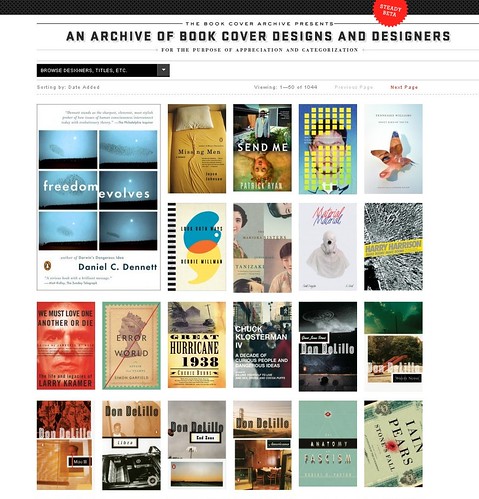
Lauded and linked to by everyone from The Guardian newspaper to the New Yorker blog (not to mention the really important folks like Drawn!Kottke, We Made This,  and Veer)  the dazzling The Book Cover Archive is — as the name suggests — a hand-picked archive of book cover designs and designers, collected “for the purpose of appreciation and categorization.”

Edited and maintained by frequent collaborators Ben Pieratt of General Projects and Eric Jacobsen of Whisky Van Gogh Go, it’s an indexed database of credited book covers sortable and searchable by title, author, designer, art director, photographer, illustrator, genre, publication date, publisher, and even typeface.

Earlier this month, I emailed Ben and Eric with a series of questions about the project.

What was the impetus behind BCA?

Ben: In all honesty, the Book Cover Archive is meant to serve as a passive teaching tool for people like me who suck at book cover design but want to get better.

Do you see BCA as expansion on Covers, the book cover design project you created for Fwis?

Ben: The two sites provide different services. The Fwis Covers blog serves as a platform from which to comment and critique. You can’t post a cover on Covers without commenting on it. Whereas the Archive is passive in its function and editorial voice. The only curatorial decision is the binary It’s In Or It’s Not.

R. Mutt ReadyMech

You’re getting quite well known—notorious even—for online not-for-profit ventures like Covers, ReadyMech, Schtock, and now BCA. How do you get started on these projects?

Ben: For every launched project there’s 10 failed ones that never got off the ground. It’s really just a matter of having ideas for projects that you know no one is ever going to pay you for and then running with it anyway because its fun as hell.

How did you become interested in book cover design?

Ben: Senior year of college I was struggling with my thesis project. I think I had been doing a study of “bad taste” and was just having a hell of a time with it. At around the same time my former business partner, Chris, told me to read Ender’s Game, a Sci Fi classic. I hadn’t read any sci-fi growing up because my dad kept feeding me non-fiction stuff. I loved the book but was embarrassed to carry it around because the cover was so incredibly bad. So I changed my thesis project to redesigning the book covers of science fiction classics. I’ve been mildly obsessed with both sci-fi and book covers ever since.

How do you select which covers to include in the archive?

Ben: I’m picky as hell.

Are there particular designers you look out for?

Ben: I’d like to think that I judge each cover on its merits alone, but there’s no question that I’m super biased. If its American and it’s coming out of New York then I’m probably going to love it.

Eternal Light by Paul J. McAuley, designed by Sanda Zahirovic

Do you have any recent favourites?

Eric: I’m very excited about the new promotional work that Gollancz/Orion has been putting out, the Future Classics and Totally Space Opera series. Besides being surprisingly conceptual and classy takes on genre fiction, I think they point at a trend toward collectible and fetishable books as a revenue stream for authors and publishers. I hope we’ll be seeing more of these kinds of editions soon. More on this in a below.

You’re actually designer yourself. How do you go about designing a new book cover?

Ben: I don’t think I’ve designed anything decent enough to merit being asked this question, honestly. I have no tricks beyond embracing the power of utter panic.

What do think makes a good cover design?

Ben: one-half concept, one-quarter contextual appropriateness, one-half design, one-half je nais se quois, one-third alligator.

And, I have to ask, what makes for a bad one?

Ben: I’m starting to come to realize that the biggest difference between a good design and a mediocre one is the typography. Most covers have a decent, if not passable, concept. Everyone has concepts. It’s really the typography that sets the best apart from the rest. That’s my current thought anyway, subject to change.

Which book would you like to redesign?

Ben: I really dislike the covers of Malcolm Gladwell’s books. They’re completely decent, but they rub me the wrong way. They take a visual from his books and find a piece of related stock art and slap it together. I think he’s earned better. I’d also love to standardize Stephen Hawking’s catalog into some kind of glorious uber-nerd package with a lo-fi sci-fi aesthetic.

Have you ever seen a cover and thought “I wish I’d thought of that”?

Ben: Jamie Keenan’s design for Faster makes me want to give up on life. Jon Gray’s cover for Steinbeck’s Murder makes me feel inadequate in any number of ways. Rodrigo Corral’s design for Invisible Monsters makes me question my sense of self. Most recently Helen Yentus’ cover for The Way Through Doors leaves me questioning if I should pack it all up and become a plumber.

Have you ever bought a book just for the cover design?

Eric: Lots, particularly from McSweeneys. I also re-buy a lot of books I already own when newer, nicer editions come out.

The Americanization of Benjamin Franklin by Gordon Wood, designed by Evan Gaffney

Ben: I was looking for a good book on Ben Franklin recently and bought the Evan Gaffney-designed The Americanization of Benjamin Franklin specifically because I hated all the other covers. Great book, by the way.

With the growing popularity of e-books, are you concerned that book cover design may soon be a lost art (hence the need to archive it)?

Eric: Nope. See next question.

Ben: The only thing I’m worried about is animated covers. You know that shit is coming.

Are we finally seeing “The End of Print”? What’s next for books?

Ben: I have no idea. I don’t think I’m qualified to have an opinion on the issue. I certainly don’t think so. The tactility of the technology is going to have to improve significantly before people are willing and ready to abandoned their hard[cover]ware for hardware (sorry, I had to). As far as books are concerned, I assume the industry will go through the same pains as the music industry. The number of independent publishers and self-publishers will increase dramatically as technology allows them to bypass the major booksellers altogether.

Eric: I think that due to the nature of reading and readers, adoption of e-books will be much slower than that of digital music (a similar paradigm shift), so even if e-books herald an ‘End of Print,’ it’s at least a decade off.

Will it even happen at all? I think so. I hope so. When I read about objections to e-books, it’s usually a lot of hemming and hawing about tactility and comfort and even the smell of pages; these complaints rarely touch on such trivialities as book availability and overall readership, which e-books would certainly expand.

E-book detractors have of a strange idea of what most books are. Those beautiful dusty old encyclopedias, that rare first-edition of Ulysses, even your fancy new Vintage paperback? That is not most books. The Grisham and Grafton paperbacks at the airport, Chicken Soup for the Spirit, college textbooks — that’s most books. Does anyone really care if the next Janet Evanovich thriller has no corporeal form? Wouldn’t that be an improvement?

Those who fear e-books should have a discussion with audiophiles. While CD sales have been steadily declining all decade, vinyl — the choice of music lovers everywhere — has gone up. iTunes downloads didn’t destroy the serious album market; it got more people listening to more artists, at the expense of bulk CDs (which “real” music fans sneered at to begin with) by one-hit-wonders. Listen to audiophiles talk about the “warmth of sound,” fidelity and tactility of vinyl, and compare their words to those of bibliophiles talking about the scent of pages; these are kindred spirits.

Here’s a possible future scenario: e-books become wildly successful, at the expense of  “airport paperbacks” and the bestseller list. Big Box bookstores go the way of Virgin Records. Readership and literacy grows (this is already happening), leading to more bibliophiles and Serious Book Lovers. As the market of crappy, badly designed books diminishes, the demand for beautifully crafted, fetishable books grows (sparking an unexpected return of the Independent Bookstore). There will ultimately be fewer books “in print,” but more awesome, well-designed books than ever.

Thanks Ben and Eric!

Link.

5 Comments

Midweek Miscellany, Jan 28th 2009


John Updike (pictured) has died at 76The Guardian and the New York Times look back at his life and career in pictures. Designer Observer points to ‘Deceptively Conceptual’ Updike’s astute 2005 essay on book covers for the New Yorker:

Publishing forms a minor branch of the entertainment industry, and book design is increasingly a matter of fashion—that is, of attention-getting. In the visual clamor of a bookstore, the important thing is to be different; a whisper becomes a shout, and the ugly becomes beautiful if it attracts attention. Yet an utter flaunting of conventional expectations may baffle and repel the public; when the title and the author’s name are left off the front of the book… it sends a subliminal message of contempt for the written word, the product being packaged.

Batman as jazz– Brad Mackay wins top prize for funniest headline of the week for his look at the reinvention of the Dark Knight and the genius of BatManga! in the Globe and Mail.

“Content is Free… But Curation is Sacred” — Peter Collingridge at Times Emit considers the implications of the Google settlement and what happens if/when we are flooded with unmediated free “stuff”:

[A]s the amount of content we are exposed to increases, without any discernible gauge of quality, it is the trusted curators of that content to whom we will choose to give our attention, time or money, rather then trying to filter it all out personally… the curator may be the bloke in the record shop who knows my music collection and recommends something new, the staff in my local wine merchant, or a particularly good blog I follow, my newspaper – anything. However, it is not Amazon’s recommendation algorithm; it is decidedly human, and, over time, a relationship of trust is built up. If it works, that trust leads to action, purchase, attention, refinement and more trust.

See the Web Site, Buy the Book: J. Courtney Sullivan looks at author web sites and book trailers for the New York Times.

Sara Nelson, editor in chief of Publisher Weekly has been fired is “leaving as part of a companywide restructuring”. The indefatigable Sarah Weiman has a extensive round-up of the reactions in the blogosphere.

The fabulous Book Cover Archive have recently add a couple of lovely minimalist cover designs by Gabriele Wilson (pictured above). Nice.

Comments closed