Skip to content

Category: Comics

Jeet Heer on Jack Kirby

At the New Republic, Jeet Heer looks back at the work of Jack Kirby, the cartoonist who shaped the Marvel Universe and remade popular culture: 

The superhero stories Kirby created or inspired have dominated American comic books for nearly 75 years and now hold almost oppressive sway over Hollywood. Kirby’s creations are front and center in the Marvel Cinematic Universe, but his fingerprints are all over the DC Cinematic Universe too, where the master plot he created—the cosmic villain Darkseid invading earth—still looms large. It was Kirby who took the superhero genre away from its roots in 1930s vigilante stories and turned it into a canvas for galaxy-spanning space operas, a shift that not only changed comics but also prepared the way for the likes of the Star Wars franchise. Outside of comics, hints of Kirby pop up in unexpected places, such as the narrative approaches of Guillermo del Toro, Michael Chabon, and Jonathan Lethem.

If you walk down any city street, it’s hard to get more than fifty feet without coming across images that were created by Kirby or inflected by his work. Yet if you were to ask anyone in that same stretch if they had ever heard of Kirby, they’d probably say, “Who?” A century after his birth, he remains the unknown king.

Comments closed

At Least She’s Reading

Another back to school appropriate comic, this time by J.A.K. (AKA Jason Adam Katzenstein) for The New Yorker

Comments closed

A Cocoon Over There!

‘A Cocoon Over There!’ is a lovely cartoon about going back to school by Argentinian cartoonist Liniers for the New York Times Book Review:

Liniers has a new kids book out this fall from Toon Books called Goodnight, Planet.

1 Comment

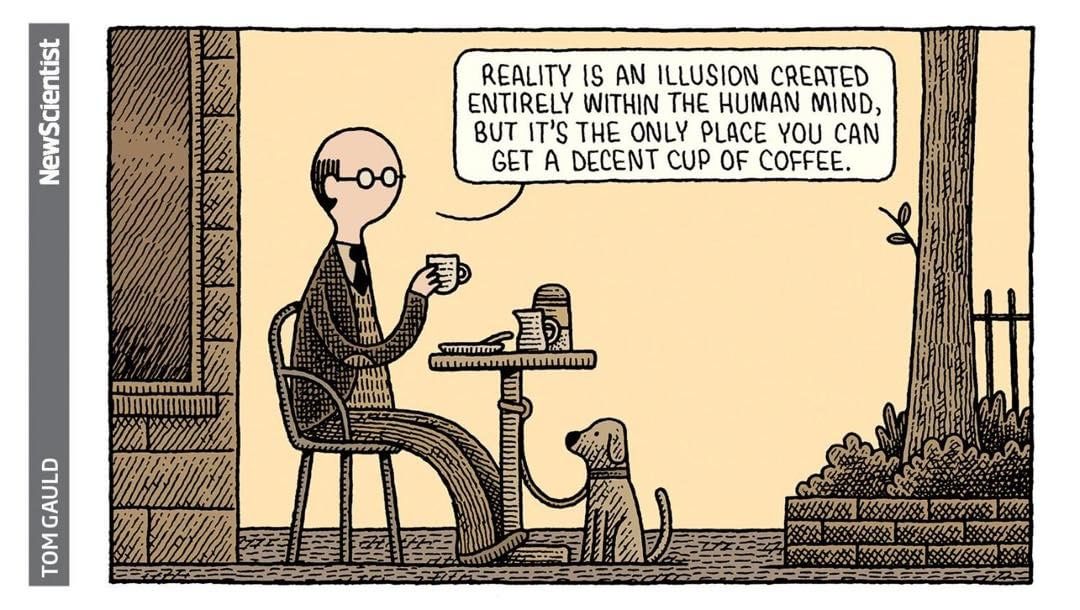
The Only Place You Can Get a Decent Cup of Coffee

Tom Gauld for New Scientist

Comments closed

The Appointment

Tom Gauld takes a look at editing process for The Guardian

Tom’s recent comic ‘Editor’s Letter’ for the New York Times Magazine‘s ‘New York Stories‘ comic strip issue is also great: 

Tom illustrated a story by Andy Newman called View Finder, and provided other incidental illustrations and lettering for the magazine, but the cover was illustrated by Bill Bragg who also, you may remember, illustrated the cover of Welcome to Lagos by Chibundu Onuzo, published by Faber earlier this year.  

You can read more about the issue at Creative Review and It’s Nice That.

Comments closed

Poets with Cellphones

Stephen Collins for The Guardian

Comments closed

Put Your Faith in Comics

At The New Yorker, Jia Tolentino profiles G. Willow Wilson, the writer behind Ms. Marvel, a superhero who is (in her current incarnation) a teenage Muslim from Jersey City:

The première of “Ms. Marvel” sold more copies digitally than it did in print—a company first. Marvel doesn’t release digital-sales numbers, but piecemeal statistics have shown female characters performing especially well in digital formats. Traditionally, comic books are purchased in single, floppy issues at dedicated brick-and-mortar shops, but these can be intimidating spaces for novices: when I walked into Forbidden Planet in Manhattan, I found myself wishing for the ability to act like I belonged. Some readers may simply opt to buy collected issues in paperbacks at regular bookstores or, increasingly, to download e-books. There are now, Wilson suggested, two audiences for comic books, and many people in the industry “are loath to recognize that these two audiences might want two very different things out of the same series. They don’t shop in the same places, they don’t socially overlap, and their tastes might not overlap.”

The relationship between this divided landscape and the most recent Presidential election is not lost on her. At the coffee shop, as a barista cleared our plates, we talked about how the stakes of every identity-politics debate feel heightened since November—and also about new alliances that seem to be forming in the election’s wake. Wilson spoke with some astonishment about the fact that she could include a gay secondary character in “Ms. Marvel”—the blond, popular Zoe—and still have mothers and daughters show up to her readings in hijabs. “It’s funny. Those right-wing bloggers who said my work was part of some socialist-Muslim-homosexual attack on American values, they really created the thing they feared. There wasn’t a socialist-Muslim-homosexual alliance before, but there sure as fuck is one now, and I love it.”

I don’t read a lot of comics from Marvel (or DC for that matter) these days, but Ms. Marvel is truly a joy. 

Comments closed

Dystopia

Tom Gauld for The Guardian.

Comments closed

Talking Coffee

I related to Twisted Doodles comics about talking coffee a little too much… 

Comments closed

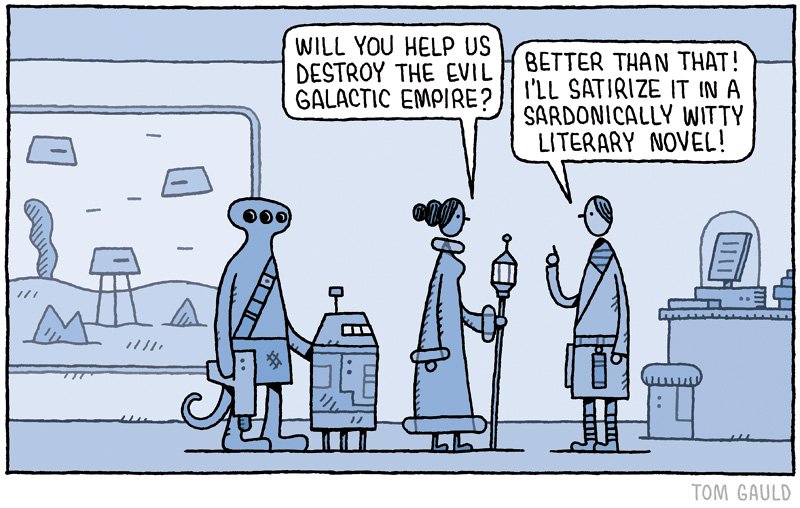
Will You Help Us Destroy the Evil Galactic Empire?

Tom Gauld for The Guardian.

(I’m working on my sardonically witty literary novel as we speak.)

Comments closed

Will Eisner Centenary

On the centenary of his birth, The Society of Illustrators in New York is celebrating the life of cartoonist Will Eisner with an exhibition of his work, including original artwork from his graphic novels A Contract with God (1978) and Life on Another Planet (1983), and over 40 pages of originals from The Spirit (1940–1952) newspaper section.

At the Village Voice R.C. Baker looks back at Eisner’s career:

Humanity leavened with contradiction, pathos, and humor describes the cast of characters Eisner (1917–2005) created in his trailblazing career, most notably in the adventures of a heavy-fisted, lighthearted crime-buster, the Spirit.

The Spirit has been called the Citizen Kane of comics, and it would be accurate to say that Eisner and Orson Welles — the actor/writer/director who brought Charles Foster Kane to life in that 1941 masterpiece — sprouted from the same loam of pulp magazines and cliff-hanging radio serials. Welles then apprenticed in classical theater, while Eisner studied narratives almost as psychologically complex (and more innately American): reams of newspaper strips and Sunday funnies. Both auteurs expanded their mediums in ways we still reckon with today.

Similarly, at Forbes, Rob Salkowitz looks at Eisner’s enduring legacy:

In 1941, comics were not considered high art; they were barely considered art at all. But to a 23 year-old cartoonist named Will Eisner who was just about to debut a new feature called “The Spirit,” comics possessed limitless storytelling potential. “Eventually and inevitably, [comics] will be a legitimate medium for the best of writers and artists,” said the young creator.

Over the next 75 years, Eisner was proved right, due in large part to his own output through the course of a remarkable career that saw him invent significant chunks of the comics’ storytelling vocabulary, pioneer the use of comics for education and training, establish a critical method for teaching and analyzing visual storytelling and virtually invent the long-form comics format known as the graphic novel. A large part of the $1 billion annual publishing enterprise and the multi-billion dollar entertainment, events, media and licensing industries that derive from it, are attributable directly to Eisner’s efforts and innovations.

The Guardian has republished a version of Neil Gaiman’s essay on Eisner from his collection of odds and ends The View from the Cheap Seats1:

Will’s life is, in miniature, a history of American comics. He was one of the very first people to run a studio making commercial comic books, but while his contemporaries dreamed of getting out of that ghetto and into more lucrative and respectable places – advertising, perhaps, or illustration, or even fine art – Will had no desire to escape. He was trying to create an artform.

In seven pages – normally less than 60 panels – he could build a short story worthy of O Henry; funny or tragic, sentimental or hardbitten, or simply odd. The work was uniquely comics, existing in the place where the words and the pictures come together, commenting on each other, reinforcing each other. Eisner’s stories were influenced by film, by theatre, by radio, but were ultimately their own medium, created by a man who thought that comics was an artform, and who was proved right.

And Print has reposted Michael Dooley essay, originally for written AIGA, on Eisner’s best known work, The Spirit:  

The field was already becoming glutted with simplistic adolescent power fantasies, but The Spirit had the texture of real life. He was decidedly not a costumed super-hero but simply a plainclothes sleuth who was prone to frequent noir-like pummelings from two-bit goons. He also displayed an ironic, smart aleck-y sense of humor, highly unique for this genre.

The strip, at seven or eight pages, reimagined itself every time. One week the format might be a fairy tale, another week a seven-page poem. Sometimes the Spirit would be shoved off to the sidelines or shunted altogether if Eisner felt so inclined. A Gerhard Shnobble episode – Eisner’s personal favorite – is a philosophical contemplation of man’s place in the universe disguised as a cops-and-criminals yarn. The Spirit was the first major milestone in his lifetime goal to explore and elevate comics as a mature literary form.

I first came across Will Eisner and The Spirit in The Penguin Book of Comics by George Perry and Alan Aldridge (previously mentioned here). It was a tease — little more than a page of artwork and a couple of short paragraphs on Eisner’s genius. I didn’t actually read a complete strip until years later when I came across a series of reprints from Kitchen Sink Press in a comics shop in London. I could only afford to buy one issue — which collected 3 or 4 stories I think — but it was enough to get me hooked.

Critics tend to focus on the later strips where the Spirit is often peripheral to the stories. These are surely more inventive than Eisner’s early comics. But I miss the Spirit when he is not central to story. He is like Raymond Chandler’s Marlowe — forever getting knocked on the head, and forever waking up in the arms of women who look like Ava Gardner or Lauren Bacall. It doesn’t sound like much, but Eisner imbued even these simple stories with a charm and sophistication that makes them a pleasure to read. 

Will Eisner: The Centennial Celebration 1917–2017 is at The Society of Illustrators, March 1–June 3 2017.

Comments closed

40 Years of 2000AD

The Guardian looks back on 40 years of British weekly SF comic 2000AD:

Forty years ago on 26 February, something extraordinary happened to British comics. Newsagents’ shelves were suddenly stuffed with a brand new title, its masthead garish red and yellow, with an enticing plastic “Space Spinner” taped to the front. “In orbit every Saturday,” the front proclaimed, “for a low price: 8p Earth Money.” 2000AD had landed.

It’s not, strictly, correct to say the world had seen nothing like 2000AD before. A few months earlier, in October 1976, a title put out by the same publishers, IPC, had died an ignominious death. Action was stuffed to the gills with anti-authoritarianism, ultraviolence and gore. Hugely popular with kids, especially boys, it proved too unpalatable for the nation’s moral guardians. Questions were asked in the House, tabloids fulminated against its bloody violence.

The final issue of Action was pulped before it made it to the newsagents. But its successor was already in the works, from the writer/editor who had created Action: Pat Mills.

In Action, Mills had freely taken inspiration from 1970s popular culture, riffing on Muhammad Ali, Jaws and football hooligans. The new wave of science-fiction blockbusters – Star Wars and Close Encounters of the Third Kind – gave him a brainwave.

“I felt, in a way, that science fiction could escape the heavy flak we had got with Action,” says Mills, who now lives in Spain. “With Action, the message was loud and clear because most of it was set in what was the present time. With 2000AD, we could do the same sort of thing but if anyone complained we could say, ‘Look, it’s just some robots in the future.’”

For better or worse, 2000AD was pretty formative for me growing up, although probably less for its best known character Judge Dredd, than for things like Pat Mills and Kevin O’Neill’s bonkers Nemesis the Warlock, Halo Jones and Dr. and Quinch (also bonkers) scripted by Alan Moore, and artist Simon Bisley’s (bonkers) Heavy-Metalesque run on Pat Mill’s Celtic barbarian fantasy Sláine, which were all dark, violent, complicated and, needless to say, extraordinary for a weekly ‘kids’ comic. I don’t know how many of those stories hold up now. At the time they felt subversive, even a little illicit. But then they do say the Golden Age of science fiction is 12.   

I’m not quite old enough to remember Action, 2000AD‘s direct predecessor, but The Guardian also published a piece last year on its 40th anniversary: 

One remarkable thing about Action was that it was tacitly aimed at working-class children.

“The only time we saw working-class characters they were sidekicks, like Digby in Dan Dare, or they were figures of fun,” [Pat] Mills says. “Even Alf Tupper, the Tough of the Track, was presented as this odd character who trained for his races in his pit boots and ate fish and chips as soon as he crossed the finishing line.

“Kids got what we were trying to do immediately. There was this whole culture of punk, of James Herbert books such as The Rats, of Richard Allen’s Skinhead novels … It was all edgy and different, and Action was definitely a part of that.”

Despite that, says Mills, the team putting together Action always had “a definite moral compass”. He says: “We weren’t saying, ‘Go and pick a fight on the terraces’, but we were showing that sort of thing happened, as kids already knew.”

1 Comment