Mister Miracle by Tom King and Mitch Gerads was unexpectedly one of my favourite comics this year. I hadn’t previously read any books set in the ‘Fourth World’ despite it’s massive influence on comics and films. I’ve always found Jack Kirby’s grandiose, dialed up to 11, vision of the New Gods to be a little too much, even for Jack Kirby.1 But the constant overwhelming ridiculousness of it all is one of the themes of Mister Miracle. How do you stay sane, let alone have a normal life with a family, when you are constantly ground down by the world you find yourself in, and confronted daily with situations that are tragic, absurd, and just so much bigger than you?
At the Daily Beast, Entertainment Editor Melissa Leon talks to author Tom King about how his experiences as a CIA counterintelligence officer and his personal struggles with stress and anxiety shaped the book.
“The book started when I had one of those first-episode-of-the-Sopranos panic attacks and I ended up in the hospital,” he says. “It was one of those things where you ask the doctor, ‘Am I dying or am I crazy?’ And they tell you you’re crazy and you’re like, woo-hoo! Oh, wait a second.” He laughs. “I thought I was a pretty tough guy. I’d been to war twice, I’d had three kids. In my own little nerdy corner of the world I was pretty successful. But there was something brittle inside of me.”
Mister Miracle was his chance to write about those brittle parts—and about the creeping suspicion in the age of Trump that reality is fundamentally, metaphysically even, coming undone… Unremarkable events [unfold] in heightened, surreal circumstances; sometimes touching, funny, or grim. The juxtapositions are essential to King, who likens the scenes to the memory of debriefing a source in Iraq in 120-degree weather. “We were both sweating and talking about a guy getting his head chopped off. It was horrible,” he remembers. “But it was my wife’s birthday.” He recalls shuffling into a corner, calling his wife, and singing “Happy Birthday” in half-hushed tones. “That’s what life is, right? The mundane lives right next to the crazy.” …
It sounds all very grim, but somehow it isn’t. At least not completely. There is a lot of humour and affection in it too, which is why I think it works. Somehow King finds a way to be (just about) life-affirming in the end.
Gerads layered artwork is also extraordinary and, at times, beautiful. Laid out on the page in a metronomic 9 panel grid, the glitches, blurs, and repetition add to the sense of dislocation and detachment from reality, like life is being filtered and replayed through a screen.
Part of Mister Miracle’s ambition is to capture a feeling many know intimately, but which can be hard to put into words. King and Gerads articulate that dread succinctly, often with a single phrase: “Darkseid Is.” Panels black out without warning, flashing the phrase in typewriter lettering. It interrupts moments of loneliness or disassociation. But it can also be a punchline, or a shrug: When Big Barda says it, for example, she could just as well say “shit happens.”
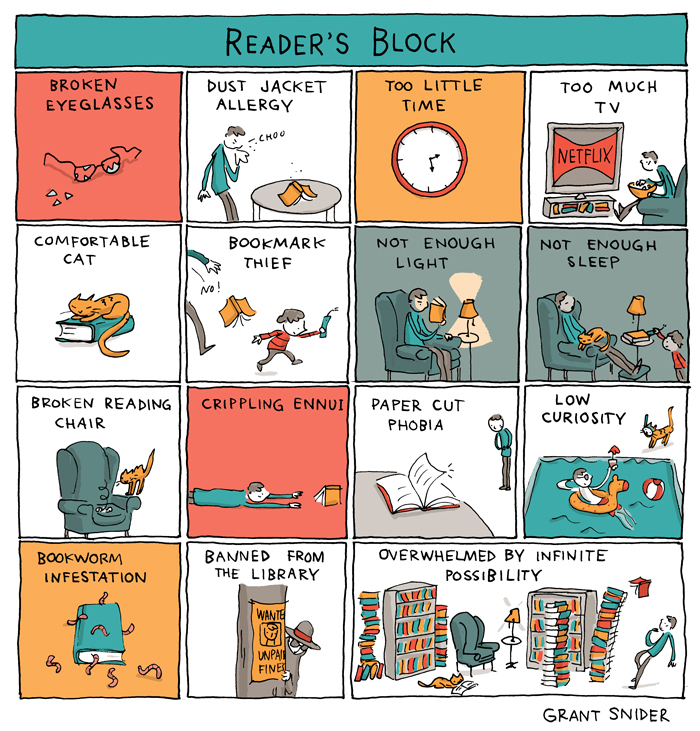
I’ve been in a bit of reading slump of late so I can relate to this recent cartoon by Grant Snider for the New York Times Books Review (although, thankfully, I’ve not been banned from the library!).
The Guardian has an essay by American cartoonist Art Spiegelman on the events that shaped the original ‘golden age’ superheroes and their creators, and why these characters still resonate with readers and movie-goers:
The young Jewish creators of the first superheroes conjured up mythic – almost god-like – secular saviours to deal with the threatening economic dislocations that surrounded them in the great depression and gave shape to their premonitions of impending global war. Comics allowed readers to escape into fantasy by projecting themselves on to invulnerable heroes.
Auschwitz and Hiroshima make more sense as dark comic book cataclysms than as events in our real world. In today’s all too real world, Captain America’s most nefarious villain, the Red Skull, is alive on screen and an Orange Skull haunts America. International fascism again looms large (how quickly we humans forget – study these golden age comics hard, boys and girls!) and the dislocations that have followed the global economic meltdown of 2008 helped bring us to a point where the planet itself seems likely to melt down. Armageddon seems somehow plausible and we’re all turned into helpless children scared of forces grander than we can imagine, looking for respite and answers in superheroes flying across screens in our chapel of dreams.
Apparently a version of this essay was originally intended to serve as the introduction to a Folio Society collection called Marvel: The Golden Age 1939–1949, but was rejected for not being ‘apolitical’.
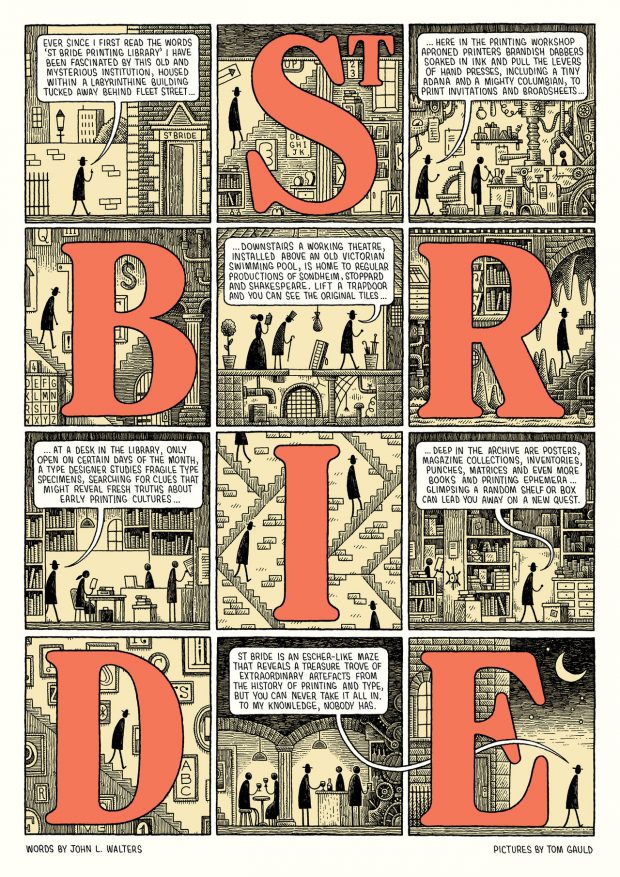
Tom Gauld has collaborated with John L Walters, editor of Eye magazine, to make this lovely poster celebrating the St. Bride Library in London — the largest print and publishing library in the world.
Produced in a limited edition of 80, you can get one from the library store for £15.
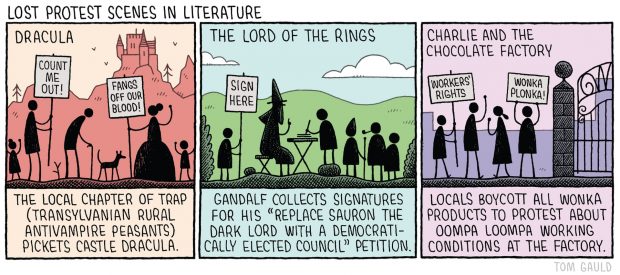
(I feel like this is a variation on a gag that has been going around independent bookstores for a while now, but it gets more accurate by the day. I guess we have to laugh or we will cry, right?)