Skip to content

Category: Comics

Flying Eye Books

The folks behind the amazing  Nobrow Press have just launched a childrens imprint called Flying Eye Books. Their first book is Welcome To Your Awesome Robot by Viviane Schwarz.

This short film created for the launch of the imprint was storyboarded and animated by Jambonbon (James D Wilson), using the original illustrations of Ben Newman. The music was composed by Lloyd Evans.


Comments closed

Nancy and the Messy Shelves

Who doesn’t like tidy shelves?

I do have a strange and peculiar love of Ernie Bushmiller’s ‘Nancy’ comic strips, especially when odd panels are taken out of context, but Fantagraphics are doing a great job of collecting them properly into books (designed by Jacob Covey). Two volumes — Nancy is Happy and Nancy Likes Christmas — are currently available, with surely more to come (?).

(via Nancy Is Happy)

Comments closed

Libraries of the Future

You’re All Just Jealous of My Jetpack, which collects many of Tom Gauld’s cartoons for The Guardian, is out in April.

Comments closed

Midweek Miscellany

The Importance of the Unimportant — Dwight Garner interviews Clive James for The New Republic:

I was the first person to take unserious television seriously. There were plenty of people who were writing profoundly about profound stuff. I was first to spot the importance of stuff that was unimportant: the stuff in between the shows, the link material, the sports commentators, the trivia. I started writing about that. It was illustrative, and you could be funny about it. You start describing a culture by taking that approach. That was my contribution.

Savage Satire — Samuel Carlisle considers whether American Psycho would be better without the violence, at The Believer:

Ellis… had trouble with American Psycho’s violence while writing it: the murder scenes remained unwritten until the rest of the book was completed, at which point Ellis read FBI criminology textbooks detailing actual serial killings and returned to insert the scenes that would be most unsettling to author, reader, and public alike. “I didn’t really want to write them,” he told an interviewer later, “but I knew they had to be there.”

What this leaves us with is violence that is mostly self-contained in a handful of brief chapters. To remove that violence would more or less be a clean excision, leaving the rest of the savagely insouciant satire intact.

And on a related note: The LA Times theatre critice Charles McNulty on depictions of violence on stage:

What is the line between acceptable and unacceptable violence in art? If gruesomeness is the criterion, much of Jacobean drama would have to be banned, including Shakespeare’s “King Lear,” with its graphic scene of Gloucester’s eyes being mercilessly plucked out. Some may believe they can identify pornography at a glance, but violence places keener demands on our sensibilities. Its artistic validity isn’t a function of how many liters of blood are spilled or how many limbs are dismembered. The question is one of gratuitousness. Or to put it another way: How does the brutality fit into a work’s larger vision?

And finally…

Ahab — New research suggests that Fredric Wertham misrepresented his research and falsified his results for his controversial book on the corrupting influence of comic books The Seduction of the Innocent, published in 1954:

Michael Chabon, who researched the early history of comics for his Pulitzer Prize-winning novel, “The Amazing Adventures of Kavalier & Clay,” said that while Wertham had been viewed as “this almost McCarthyite witch hunter,” he was actually “an extremely well-intentioned liberal, progressive man in many ways,” providing mental health services to minorities and the poor.

But of “Seduction of the Innocent,” Mr. Chabon said: “You read the book, it just smells wrong. It’s clear he got completely carried away with his obsession, in an almost Ahab-like way.”

(pictured above: The Phantom Lady drawn by Matt Baker was one the comics cited in Seduction of the Innocent. A reappraisal of Baker, one of the earliest African American comic book artists, has just been published by TwoMorrows Publishing.)

Comments closed

The Tale of Mister Rakete Rinnzekete

‘Excerpts from Beatrix Potter’s Little-Known Experimental Storybook’, a  recent comic strip by Tom Gauld:

The text is from Kurt Schwitters’ poem Ursonate.

A collection of Tom’s short strips, You’re All Just Jealous of My Jetpack is out in April.

Comments closed

Something for the Weekend

Snowstorm…something, something… Snowstorm… Hmm, what? Oh right. Here we go…

Pick Up a Pearson — A profile of book designer David Pearson in the New York Times:

 The chillingly eloquent jacket of “Nineteen Eighty-Four” is the work of the British graphic designer David Pearson He is responsible for the design of four more books that have been reissued by Penguin in the Great Orwell series of paperbacks. From the horror movie typography on “Animal Farm” to the Vorticist-inspired illustration that Mr. Pearson commissioned from Paul Catherall for “Down and Out in Paris and London,” each of the covers exhibits the wit, thoughtfulness and ingenuity that have come to distinguish his work.

“David manages to combine respect for tradition with playfulness and a light touch,” said the graphic design historian Emily King. “He also has a brilliant understanding of the book as a physical object.”

Kvelling — Gerald Howard on the 50th anniversary of the New York Review of Books, at Salon:

Last week, my colleague at Doubleday came by my office with an austere-looking 11-by-15-inch broadsheet. Good God! It was a facsimile edition of the first issue of the New York Review of Books, Feb. 1, 1963. The advertising director and I sat there kvelling over this wondrously manifested printed object from another universe, with its Murderers Row of reviewers weighing in on many books that all these years later still matter, its old-school book ads with their quaint frontal appeals to the reader’s higher cultural aspirations…

The Literaries — A great essay Eddie Campbell about comics criticism at The Comics Journal:

Moving sideways at this point takes me to another recurring argument that falls within the jurisdiction of the present rant. I refer to the incessant debate over who authored Marvel Comics, was it Stan Lee or was it Jack Kirby?… The literaries are inclined to debate whether the furnishing of a plot is enough of a claim to authorship, or whether the real writer in this case was the artist. Once the argument gets started it can go in any direction, and is just as likely to deny that a plot was ever given in the first place, because it is obligatory that everybody who wasn’t there have an opinion and take sides. None of that has ever mattered, as far as I’m concerned, though I acknowledge that the ownership of successful movie franchises could make a difference to this party or that. But the movies do not interest me and I do not care. None of them have ever captured the thing that made Marvel comics exciting to me in 1965 when I discovered them for myself.

And finally…

Amazon Unpacked — A long, must-read piece at the FT on Amazon’s warehouse in the former mining -town of Rugeley, Staffordshire:

As online shopping explodes in Britain, helping to push traditional retailers such as HMV out of business, more and more jobs are moving from high-street shops into warehouses like this one. Under pressure from politicians and the public over its tax arrangements, Amazon has tried to stress how many jobs it is creating across the country at a time of economic malaise. The undisputed behemoth of the online retail world has invested more than £1bn in its UK operations and announced last year that it would open another three warehouses over the next two years and create 2,000 more permanent jobs. Amazon even had a quote from David Cameron, the prime minister, in its September press release. “This is great news, not only for those individuals who will find work, but for the UK economy,” he said.

People in Rugeley, Staffordshire, felt exactly the same way in the summer of 2011 when they heard Amazon was going to occupy the empty blue warehouse on the site of the old coal mine. It seemed like this was the town’s chance to reinvent itself after decades of economic decline. But as they have had a taste of its “jobs of the future”, their excitement has died down…

You can probably guess where it goes from there (but you should still read it)…

Comments closed

Hooray for Christmas

Happy holidays!

Nancy Likes Christmas has just been published by Fantagraphics.

(via the awesome Nancy is Happy).

Comments closed

Charles Burns on Bookworm

Cartoonist Charles Burns discusses his new book The Hive with Michael Silverblatt on KCRW show Bookworm:

KCRW Bookworm: Charles Burns THE HIVE mp3


Comments closed

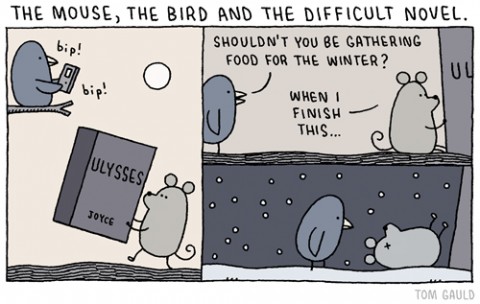
The Mouse, The Bird and the Difficult Novel

I do love Tom Gauld.

Comments closed

Something for the Weekend

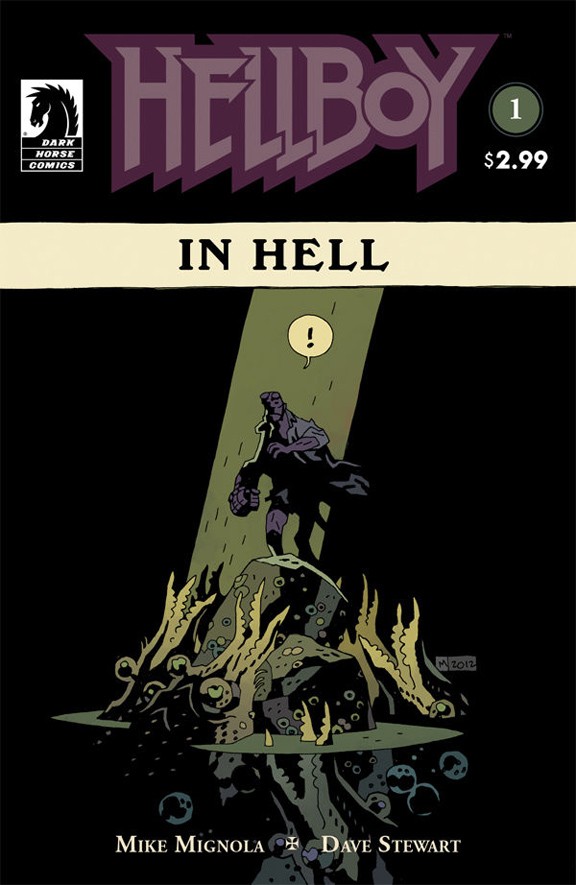
Folklore — Mike Mignola talks about drawing Hellboy again, at ComicsAlliance:

I do have a library. Very little of it is leather-bound. The folklore and mythology library, which is in my studio, is pretty tacky looking since it’s all picked out of used bookstores. I am a book guy but more and more I do use a computer to do certain research things. But there are 30-40, 50, maybe 100 books of folklore in there, most of which haven’t been read. I’ll look at a table of contents and go, “Wow there’s 30 to 40 different Hellboy stories in there.” It’s very comforting to know there’s a million stories to tell that I can pluck off the shelf for those days where it’s like, “Well, I got nothing!”

Suicide Watch — Steve Almond reluctantly reviews Building Stories by Chris Ware for The New Republic:

Ware is essentially a poet of solitude. He uses language and images to capture the private torments of unfulfilled lives. His characters drift in a sea of self-recrimination and unmet desire (not unlike the rest of us). They rarely find love, or resolution.

This bleak approach does yield a curious dividend, though. The occasional moments of grace explode off the page. At one point, we see his heroine cavorting with her daughter on their front lawn. “I remember Lucy landing on top of me, laughing…with the sun shining behind her suddenly life came into perfect focus,” she muses. “This was what it was all about … this very moment … the joyful reality of my daughter.” The girl’s lovely face, nearly life-size, beams at us from the middle of the page.

Of course, this idyll is shattered by the news that one of her friends has committed suicide. If Ware has one flaw, it’s his obvious discomfort with the notion that people—at least his people—might ever find an enduring happiness.

And, while were on the subject of comics…

Hannah Berry, author of the enjoyable Britten & Brülightly, writes about the independent comics scene in the Britain at the New Statesman. Berry’s second graphic novel Adamtine was published earlier this year in the UK by Jonathan Cape.

Also at the New Statesman, Hayley Campbell on the current state of British comics.

Meanwhile, back in the world of big grown-up publishing…

The Telegraph profiles Liz Mohn, “the woman behind media giant Bertelsmann” and, therefore, the monster that is Penguin Random House.

And finally…

Lubricated — Hunter Oatman-Stanford (how’s that for a moniker?) examines the nautical past of popular tattoos at Collectors Weekly:

“Many sailors are extremely superstitious,” says [C.W] Eldridge [founder of the Tattoo Archive], “so they would get specific tattoos to relieve this anxiety over their beliefs. There are stories of guys in the old, wooden-ship days who would get Christ’s head tattooed on their backs so if they got into trouble and had to take lashes, the person wielding the lash would be more sympathetic.”

The variety of designs matched each and every danger aboard a ship. “Sailors would get things like a pig and rooster on their feet to keep them from drowning,” Eldridge says. “They would have ‘Hold Fast’ tattooed on their knuckles so that when they were in the riggings, their hands would stay strong. They would get hinges on their elbows to keep them from having rheumatism and arthritis, and sometimes they would even get a little oil can tattooed above the hinge so that the hinges would stay lubricated.”

Comments closed

Chris Ware on Bookworm

Cartoonist Chris Ware discusses Building Stories with Michael Silverblatt on KCRW’s Bookworm:

KCRW BOOKWORM: Chris Ware Building Stories mp3

Ware will be at the Brooklyn Comics and Graphics Festival tomorrow (November 10) and the Librairie D+Q fifth anniversary party with Charles Burns and Adrian Tomine in Montreal on Sunday (November 11).

Comments closed

Jamie Hewlett

A beautifully shot interview with British illustrator Jamie Hewlett:

It would be lovely to see Hewlett — co-creator of Tank Girl and Gorillaz (if you must) — draw some new full-length comics again.

(via Coudal)

Comments closed