Skip to content

Category: Comics

“I don’t care any more.”


Tom Gauld on the mystery of Dan Brown.


Comments closed

Grant Snider ‘Who Needs Art?’


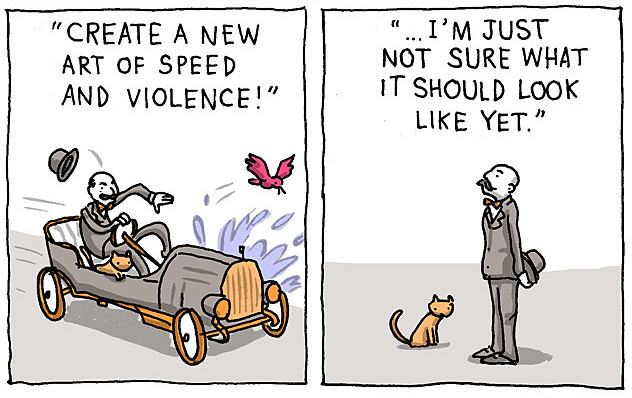
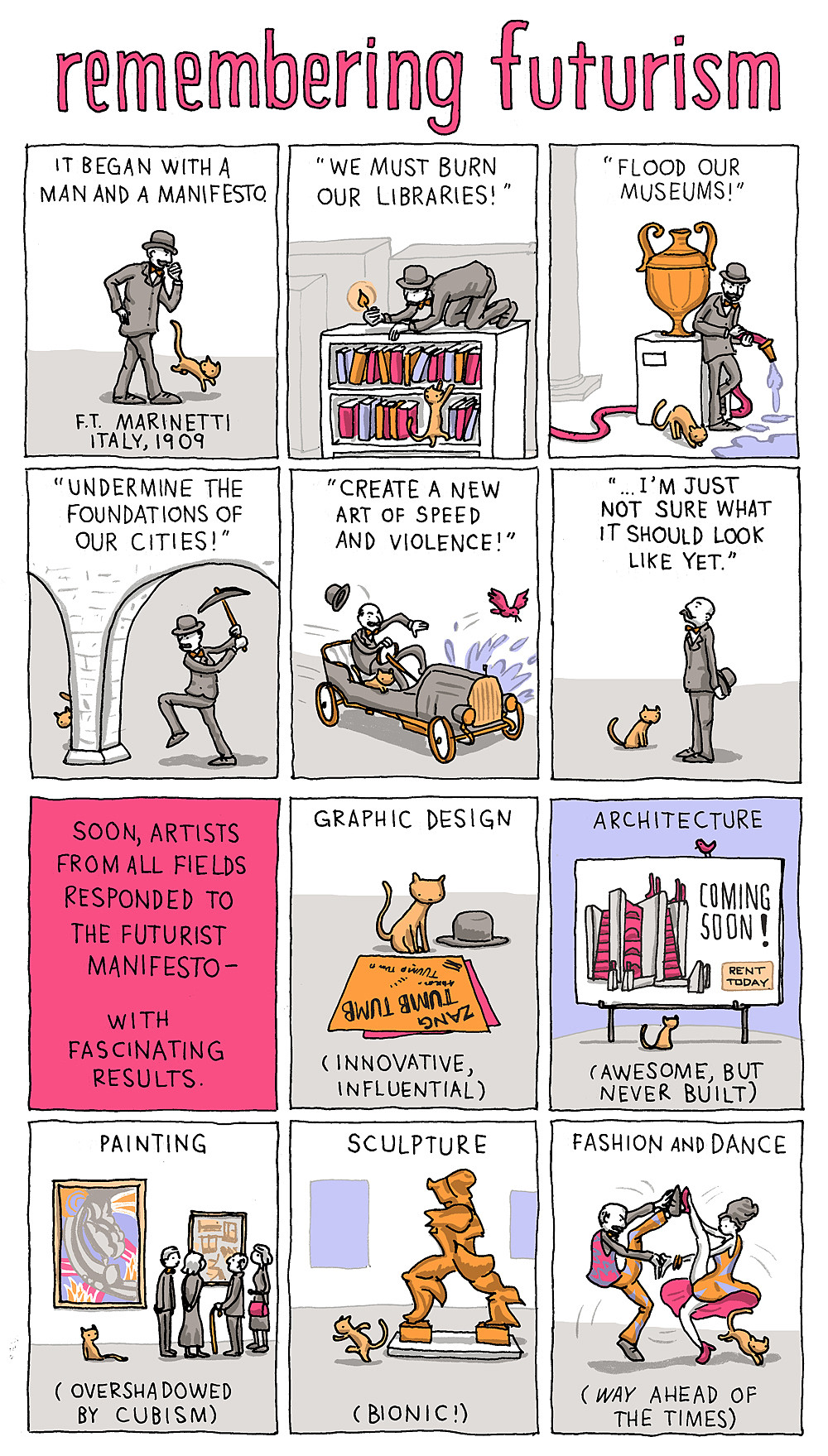
Incidental Comics cartoonist Grant Snider has started a new comic series for Medium.com called ‘Who Needs Art?’ about movements and concepts in art and design.

His first piece, Remembering Futurism, is about Filippo Tommaso Marinetti and Italian Futurist movement.

Read the whole comic here.

Comments closed

Françoise Mouly: In the Service of What the Artist is Saying

In a follow up to his short Q & A with Françoise Mouly and her partner Art Spiegelman for the National Post, David Balzer has a fascinating full-length interview with Mouly, publisher of Toon Books and art editor of the New Yorker, at Hazlitt:

I think that if you set out with a scripted outcome, you don’t succeed. I’m acting out things that work on me. I spent most of my terribly unhappy childhood years immersed in books. I found early on that it was a great way to escape any kind of arguments with my parents or emotional upheaval. I loved reading and being lost in a book. I trained as an architect. As an architect you’re part of a team and no architect can build a house by themselves. But a bookmaker can make a book all by themselves. And an author: look at my husband’s book, or Marjane Satrapi’s Persepolis—she manages to convey a very rich world, and her personality is very well expressed in a book that shows her handwriting, that has a sense of her.

In a way I got a very classical education growing up in France in the sixties, and learning Latin, Greek, French and English. But I’m well versed in the technological part of the 21st century. The common denominator for me is stories, narrative structure. That’s how I understand things. I find them, books, the right recipient for something that is both complex and nourishing. I watch movies and enjoy them; I watch, you know, The Wire and TV shows, but still, the stories I read in books inhabit my brain in a special way. Those characters are very present in my thinking. And children’s books are a very real part of how I think. So I find it a privilege to actually be in communication, to leave a trace of something that’s actually going to be read.

Hazlitt

Comments closed

Paul Pope: In Your Space


In an interview for BookExpo, cartoonist and artist Paul Pope talks about his work, influences, and, yes, his studio space:


Pope’s new book Battling Boy is out in the fall from First Second (and, for the sake of disclosure, distributed in Canada by my employer Raincoast Books). He will be at BookExpo signing galleys on May 30th.

Comments closed

Something for the Weekend

They Call it Madness — Jess Nevins  reviews the H.P. Lovecraft collection The Classic Horror Stories for the L.A. Review of Books:

Lovecraft was not the best of his era in any of the genres he wrote in. Clark Ashton Smith was a better stylist. Algernon Blackwood wrote better horror. Olaf Stapledon wrote better science fiction. Yet it is Lovecraft who has been canonized with a Library of America edition, who has provided the source material for academic writings, comic books, and even game shows like Jeopardy, and who has been assimilated by capitalist culture to the point that there are plushies made of his characters.

One would never have guessed this fate for Lovecraft at the time of his death in 1937…

Nevins has been heroically annotating all of The League of Extraordinary Gentlemen series by Alan Moore and Kevin O’Neill and, most recently, compiled notes to the very Lovecraftian Nemo: Heart of Ice (pictured above). But before you get sucked in, be warned: the annotations have a kind of Borgesian horror all of their own.

(And while were on the subject of Lovecraft and comics, you could do worse than picking up I. N. J. Culbard’s adaptations of The Mountains of Madness and The Case of Charles Dexter Ward published by SelfMadeHero)

Also at the LA Review of Books, Michael Nordine on enigmatic filmmaker Terrence Malick:

Malick has the rare distinction of becoming a celebrity — at least in part — for rejecting the notion of celebrity. At a time when we’re given a direct line into our favorite stars’ streams of consciousness via the social media avenue of our choosing, the 69-year-old continues to let his films speak for themselves. When he was nominated for Best Director at the 1998 Academy Awards, the picture that appeared onscreen was of a chair with his name on it; at last year’s ceremony, a different on-set photo from the same production was used. Each new project of Malick’s is said to come with a contractual stipulation that no photos of him may be used in the film’s promotional materials. No matter: people have repeatedly proven able and willing to create an image of their own. That this picture is incomplete at best and may well be wholly inaccurate matters little. Now more than ever, it seems we still can’t conceive of a famous person who doesn’t want to be famous, and even caricatures are more satisfying than a note reading “not pictured” in the celebrity yearbook.

And finally…

David Berry in conversation Art Spiegelman and Françoise Mouly at the National Post. Here’s Mouly’s take on RAW:

Basically, there were no venues for comics, and I just thought, “Well, I can do it myself.” The idea was to show people what actually could be done … that it wasn’t so much a style that was one answer to where comics should go, but was more that each person had their own voice.

Comments closed

Day Jobs of Poets by Grant Snider


The new comic from Grant Snider, ‘The Day Jobs of Poets’, comes with the following disclaimer:

“there’s no evidence that Emily Dickinson liked cats, but her sister Lavinia was cat-obsessed. So Emily must have been forced to cat-sit occasionally.”

The comic is available as a poster from Grant’s shop.

Comments closed

The Art of Harvey Kurtzman

A short film about artist and writer Harvey Kurtzman, the creator of MAD Magazine, featuring interviews with artists Al Jaffee and Robert Grossman:

The Society of Illustrators in New York is hosting a retrospective exhibition on Harvey Kurtzman until May 11, 2013, and the book The Art of Harvey Kurtzman: The Mad Genius of Comics by Denis Kitchen and Paul Buhle, published by Abrams, is available now.

(via Boing Boing)

Comments closed

Midweek Miscellany

Keeping it Simple — Gilbert Hernandez who has two new books out, Julio’s Day and Marble Season, talks about his work at the LA Times Hero Complex blog:

“What I’m really trying to do is streamline my work, to make it an easier read,” he said. “I’ve always admired newspaper comic strips that are very simple and direct, don’t have a lot of dialogue, don’t have a lot of exposition. When I look back at a lot of the comics that are overwritten, like the beloved old Marvel comics, I edit them in my head, to see how modern readers might become more interested in following them. When I look at my old stuff, like ‘Poison River’ and the early ‘Palomar’ stuff, I sometimes think it’s too dense to enjoy. For me, anyway.”

Mechanics — Tom Whipple on algorithms for Intelligent Life:

What has changed is what algorithms are doing. The first algorithm was created in the ninth century by the Arabic scholar Al Khwarizami—from whose name the word is a corruption. Ever since, they have been mechanistic, rational procedures that interact with mechanistic, rational systems. Today, though, they are beginning to interact with humans. The advantage is obvious. Drawing in more data than any human ever could, they spot correlations that no human would… Their strength is that they can take in that information in ways we cannot quickly understand. But the fact that we cannot understand it is also a weakness.

Cardboard Boxes — At The New York Times, Dwight Garner on packing up his family’s favourite picture books:

In the past, when I’ve had to pack my personal library, what I’ve boxed are talismans of intense yet essentially private experience. Picture books aren’t like this. When you’re putting away these square, dog-eared, popcorn-butter-stained things, you’re confronting an entire cosmos of collective memory… They occupy places in our family’s shared consciousness as indelibly as do summer vacations, trips to the hospital or injured birds cared for in cardboard boxes.

And finally (but most importantly)…

A profile of Kim Gordon at Elle Magazine:

Sonic Youth is not just revered within the indie rock world; it’s an indelible part of American pop-cultural history, a sort of byword for tasteful and progressive art that’s also popular. “She was a forerunner, musically,” says Kathleen Hanna, of the riot grrrl band Bikini Kill and later the dance-rock group Le Tigre. “Just knowing a woman was in a band trading lead vocals, playing bass, and being a visual artist at the same time made me feel less alone.” Hanna met Gordon when she came to a Bikini Kill show in the early ’90s. “She invited my band to stay at her and Thurston’s apartment,” Hanna says. “As a radical feminist singer, I wasn’t particularly 
well liked. I was in a punk underground scene dominated by hardcore dudes who yelled mean shit at me every night, and journalists routinely called my voice shrill, unlistenable. Kim made me feel accepted in a way I hadn’t before. Fucking Kim Gordon thought I was on the right track, haters be damned. It made the bullshit easier to take, knowing she was in my corner.”

(Tasteful is not a word I would necessarily use in association with Sonic Youth, but hey… )

3 Comments

Let’s Design a Book Cover!

Tom Gauld’s collection of cartoons, You’re All Just Jealous of My Jetpackhas just been released in US and Canada.

* For the sake of full disclosure, Tom’s new book is published by Drawn & Quarterly and distributed by my employer Raincoast Books.

Comments closed

Books Are Amazing, Guys


Books. Will. Never. Be. Cool.

The latest Supermutant Magic Academy webcomic by Jillian Tamaki.

Between this, Richard Nash, Evan Hughes, and Mike Shatkin, books have been having a rough time this week. (But I’m still keeping the faith).

Comments closed

Webcomics on Off Book

The latest episode of PBS Off Book on webcomics features interviews with Nick Gurewitch (The Perry Bible Fellowship), the fabulous Lucy Knisley (Stop Paying Attention pictured above), and others:

Comments closed

Midweek Miscellany

‘The Art of Harvey Kurtzman’ curated by Monte Beauchamp and Denis Kitchen opens at the Museum of American Illustration in New York on March 6th. Boing Boing has more (via Drawger).

On a related note: Steven Heller on Al Capp at The Atlantic:

[Denis] Kitchen…loved Capp’s unpredictable plots, his sexy women, and his uncouth, often grotesque cast. But as a college student, Kitchen told me, he witnessed Capp’s transformation “from a progressive figure to a student-hating, pro-Vietnam War pal of Richard Nixon and Spiro Agnew. And not long afterward saw sex scandal headlines gut his fame. Almost overnight he lost everything.” This intense love-hate feeling toward Capp and his work is what led Kitchen to want to understand the man better.

And: Kitchen talks to Michael Dooley about the new book Al Capp: A Life to the Contrary, at Imprint:

“I thought Al Capp was a flat-out genius. That said, I had also known for many years that he had quite a dark side. I’d been collecting every article and scrap for years and interviewing any associate I could find, so I fully expected our biography to depict a deeply flawed and even tortured man…  The ‘monster’ we discussed earlier was also a devoted son and father, an often generous man with assistants and strangers, a man capable of great charity, a man who wouldn’t tolerate a racist or homophobic joke.”

(To be honest, Capp still sounds kind of irredeemable.)

Every day. Onwards. — A. L. Kennedy on writing for love (and money), at The Guardian:

The first novel was treated gently and coddled probably more than it deserved to be. This wouldn’t happen now. The short story anthology as a first book is rarer than unicorn pie. (May contain traces of horse.) The hope of making even 50% of your income as a published author any more in the UK has probably also gone – unless you are lucky enough to produce a bestseller, preferably involving porn. This may change when UK publishers discover that the production of ebooks reduces overheads as well as cover prices. Who knows – it does tend to take a while for UK publishers to notice most things. I worry in case, for example, their offices catch fire and they all burn to death over a period of weeks, coming and going, sadly unable to realise that their coffees are boiling away to nothing in their melting cups. And this is, of course, a hard time for all industries, from the sprightly to the moribund.

Kennedy’s new book On Writing has just been published in the UK by Jonathan Cape.

See also: a short interview with Kennedy in Metro.

Comments closed