
Another gem for the New York Times Book Review by Grant Snider. Love the Unreliable Narrator.
Published July 12, 2013
Books, Design and Culture
Another gem for the New York Times Book Review by Grant Snider. Love the Unreliable Narrator.

photo: Leo Williams
Alan Moore discusses his short films, crowd-funding, the Occupy movement, The Prisoner, and zombies (amongst other things) at Salon:
While the revolution will be certainly televised, it strikes me that there is a strong possibility that the revolution will also be crowd-funded. If Kickstarter and other enterprises are giving projects like Occupy Comics a chance, then it does suggest there are imaginative ideas out there with incredible use and application across the board. Not just in the arts, but in the sciences as well. It’s an exciting concept, and I look forward to seeing what emerges from it.

Moore talks more about his Lynchian short film Jimmy’s End — created with Mitch Jenkins — in this short ‘behind-the-scenes’ documentary for Motherboard TV (worth watching just for the interior of the actual Jimmy’s End Working Men’s Club around the 10 minute mark):
He also discusses crowd-funding and ‘The Jimmy’s End Cycle’ of films — the last of which, Heavy Heart, you can still support on Kickstarter — in an interview with Bleeding Cool from earlier this month.
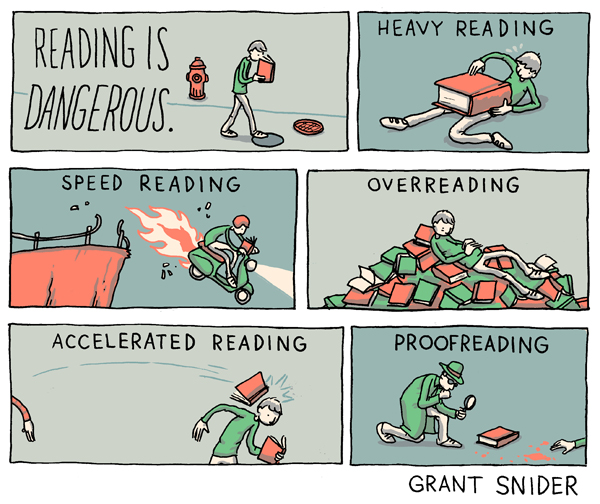
Comments closedAnother charming comic by Grant Snider for the New York Times Book Review, ‘Reading is Dangerous’ illustrates ‘Clunkers‘, James McWilliams’ essay about books as weapons:

Yes, it’s a TED Talk (sorry), but this seems apropos after yesterday’s post about Ivan Brunetti — The New Yorker‘s longstanding cartoon editor Bob Mankoff discussing humour and the magazine’s “idea drawings”:
(And if you’re a cynic, it might also help explain why you don’t think a lot of The New Yorker‘s cartoons are funny!)
At the TED Blog Mankoff selects his favourite New Yorker cartoons.
1 Comment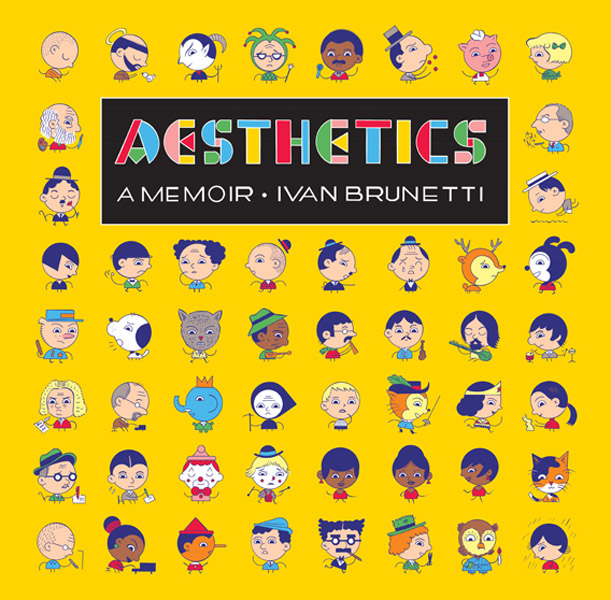
I’m a little late in the game on this (as usual), but teacher and cartoonist Ivan Brunetti has a new book out this month from Yale University Press. An illustrated autobiography of sorts, Aesthetics: A Memoir is a retrospective of Brunetti’s work to date, including previously unpublished drawings, personal photographs, and handmade objects:
There is a short excerpt from the book at the Paris Review Daily, and a lengthy review at The Comics Journal.
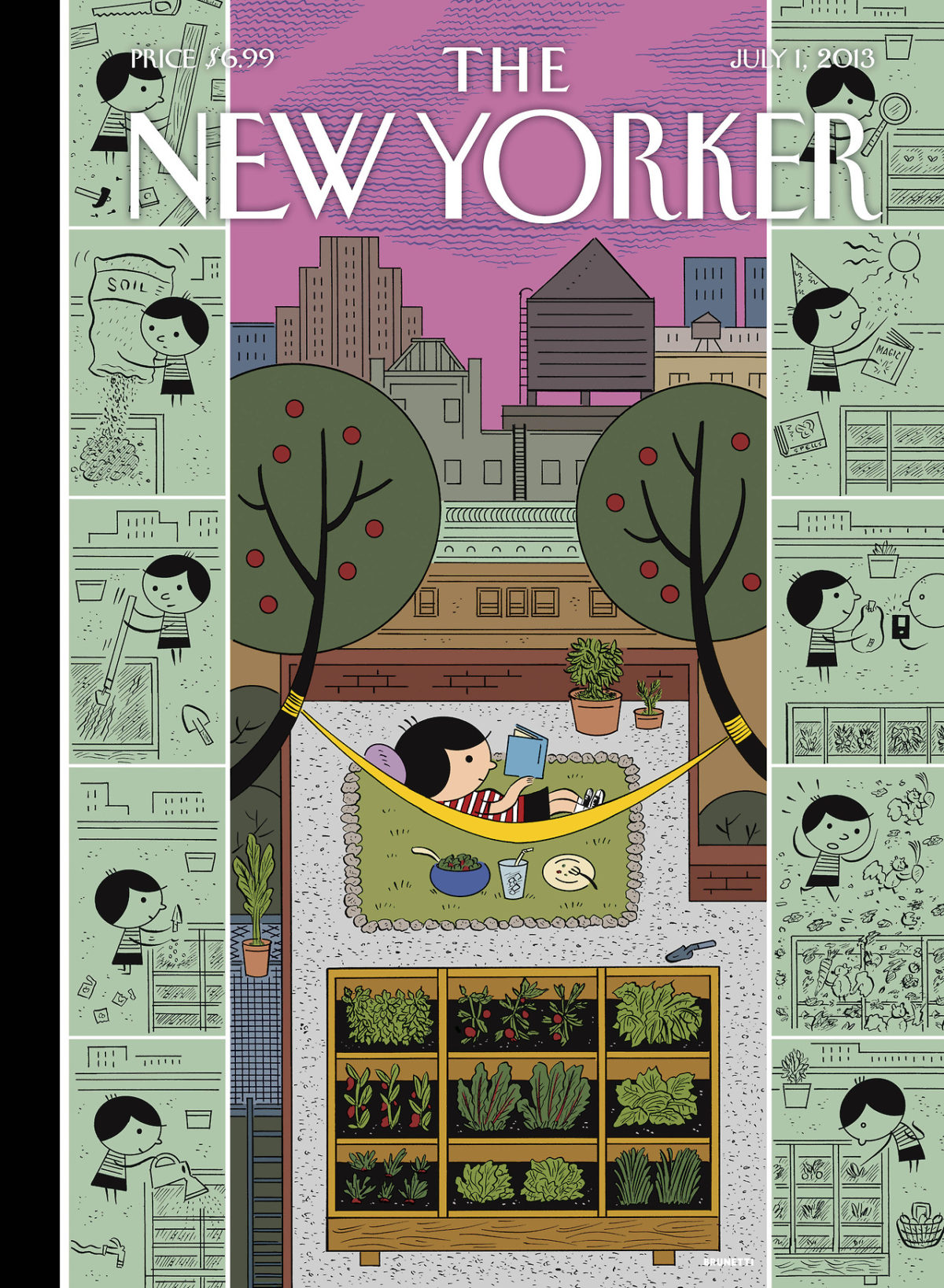
Coincidentally, Brunetti is also the cover artist for latest edition of The New Yorker:
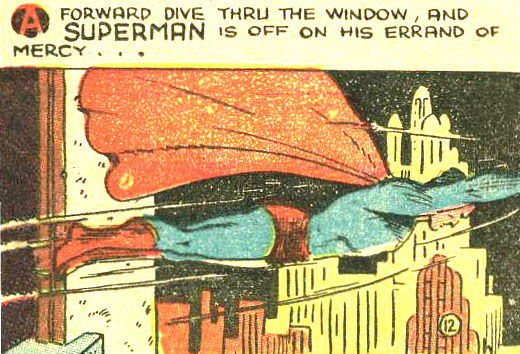
At the Smithsonian Design Decoded blog, Jimmy Stamp provides a brief history of The Daily Planet building in Superman comics:
Whenever disaster strikes Superman’s Metropolis, it seems that the first building damaged in the comic book city is the Daily Planet – home to mild-mannered reporter Clark Kent, his best buddy Jimmy Olsen, and his gal pal and sometimes rival Lois Lane. The enormous globe atop the Daily Planet building is unmistakable on the Metropolis skyline and might as well be a bulls-eye for super villains bent on destroying the city. But pedestrians know that when it falls–and inevitably, it falls–Superman will swoop in at the last minute and save them all (The globe, however, isn’t always so lucky. The sculpture budget for that building must be absolutely astronomical).
There is also a follow-up post on the history of The Daily Planet in film and television.
And if you can’t get enough of this kind of stuff, Stamp has previously written about the architecture of Batman and Gotham City.
Comments closed
Following a group of aspiring indie cartoonists struggling through two gruelling years at the Center for Cartoon Studies in White River Junction, Vermont, and featuring candid interviews with the likes Chris Ware, Scott McCloud, Lynda Barry, Charles Burns, Françoise Mouly, Art Spiegelman and Jules Feiffer, Cartoon College looks like a fascinating documentary about “one of the world’s most tedious artistic disciplines:”
The film was released on iTunes this week, with the DVD available in July.
Comments closed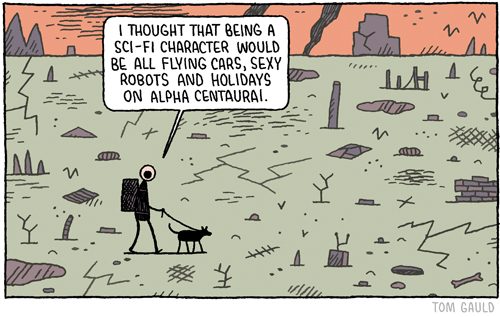
Didn’t we all… (Tom’s new collection of comics, You’re All Just Jealous of My Jetpack, is out now.)

The exhibition of cartoonist Daniel Clowes’ art work that first appeared at the Oakland Museum of California last year, is travelling to the Museum of Contemporary Art in Chicago. Opening at the end of June, Portuguese TV channel Canal180 has (weirdly / not weirdly?) posted a short (English-language) video about the show:
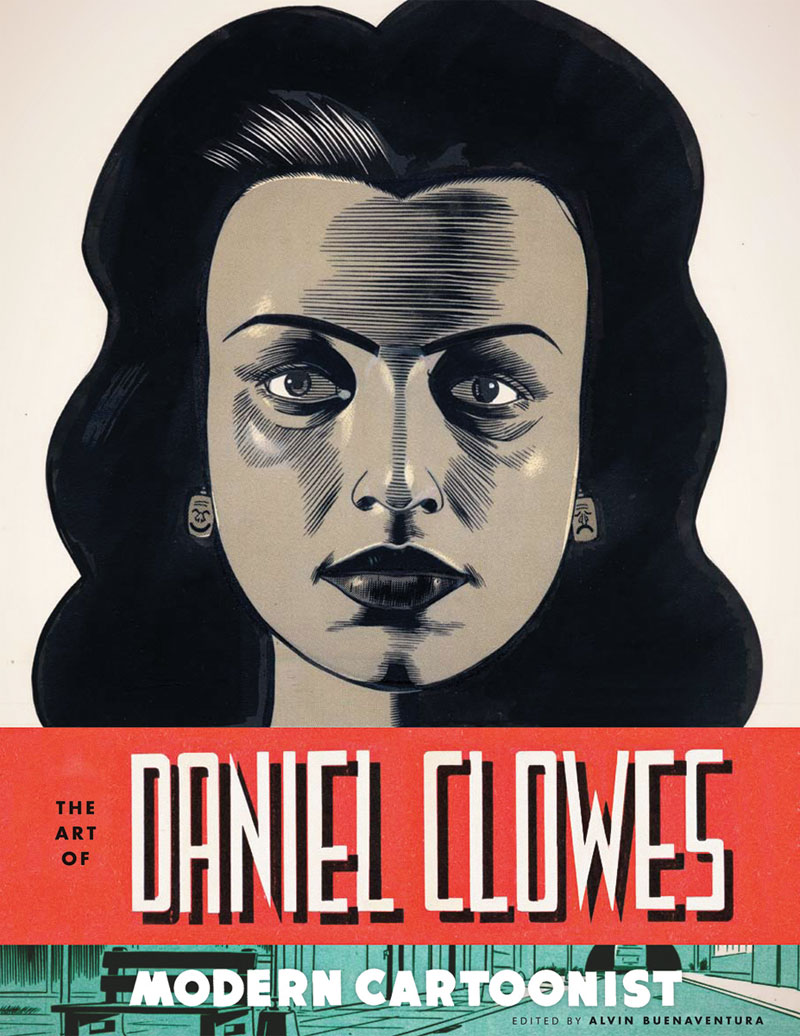
The show is accompanied by the book Modern Cartoonist: The Art of Daniel Clowes published by Abrams.
Comments closed
Gilbert Hernandez talks to The Telegraph about his latest book, Marble Season, and making a comic his daughter could read:
“I thought: what kind of book can I do that’s authentic to what I do, but that my daughter can read?” Hernandez’s daughter is 12, a little young for the zombie splatter of his Fatima: The Blood Spinners or the sexually omnivorous pornography of Birdland. “I thought I’d put myself into Marble Season,” Hernandez says, “but it wasn’t going to have all those things that my daughter can’t look at, or I don’t want her to look at. I wanted to live up to a lot of the good response I’ve had in the past, but put that effort into something that’s, let’s say, clean. For want of a better word…”
Although Marble Season seems a radical departure, Hernandez sees balance and change as essential to his creative process. “My personality is all in my comics, and my personality is all over the place,” he explains. “I’m not a trained technical artist. It’s all visceral and it just comes up – it’s where my brain is that morning when I get up.” It is this desire to experiment – he has complained in the past about being expected to be “a do-gooder cartoonist” – that led to his other ongoing project, the noirish, over-the-top Fritz books.
“In those, I’m thinking about how far the underground cartoonists had gone,” he says, “in particular S Clay Wilson and Robert Crumb. Wilson was criticised as a crazy person in his day, but now he’s one of the grand old artists of the underground. I haven’t even gone as far as Crumb, and yet he’s an American icon. I want to push myself, in a way, so my imagination goes crazy with inventive horror.”


At The Believer magazine, Peter Bebergal, author of Too Much to Dream: A Psychedelic American Boyhood, talks to Alan Moore about his epic work-in-progress Jerusalem, magic, art, gods, and demons:
Magic and art tend to share a lot of the same language. They both talk about evocation, invocation, and conjuring. If you’re trying to conjure a character, then maybe you should treat that with the respect that you would if you were trying to conjure a demon. Because if an image of a god is a god, then in some sense the image of a demon is a demon. I’m thinking of people like Malcolm Lowry, the exquisite author of Under the Volcano.There are kabbalistic demons that are lurking all the way through Under the Volcano, and I assume they were probably similar forces to the ones that eventually overwhelmed Lowry’s life, such as the drinking and the madness. When I hear alcoholics talk about having their demons, I think that they’re probably absolutely literally correct.
Thankfully, they also talk a little bit about comics as well:
Superheroes are the copyrighted property of big corporations. They are purely commercial entities; they are purely about making a buck. That’s not to say that there haven’t been some wonderful creations in the course of the history of the superhero comic, but to compare them with gods is fairly pointless. Yes, you can make obvious comparisons by saying the golden-age Flash looks a bit like Hermes, as he’s got wings on his helmet, or the golden-age Hawkman looks a bit like Horus because he’s got a hawk head. But this is just to say that comics creators through the decades have taken their inspiration where they can find it.
The accompanying illustration of Moore is, of course, by American cartoonist Charles Burns (Black Hole / X’ed Out / The Hive ).
An exhibition of Burns‘ portraits for The Believer is running at the Adam Baumgold Gallery in New York until July 26, 2013.
Comments closed
“It’s the weird stuff… The stuff that makes you different.”
The New York Times interviews Karen Berger, the former executive editor of Vertigo, whose departure from DC Comics has raised questions about the imprint’s future:
Comments closedWhen Ms. Berger joined DC straight out of Brooklyn College in 1979, she was simply “another English major looking for a job” and admittedly no fan of superheroes. “I just fell into the company, fell into the business and fell in love with comics,” she said.
Inspired by the publisher’s more offbeat anthology series, like “House of Mystery” and “Weird War Tales,” Ms. Berger cultivated stories that were sometimes more human and sometimes decidedly not of this earth.
After becoming the editor of the “Watchmen” author Alan Moore, she gathered a lineup of young British writers who were eager to break into American comics and who found Ms. Berger receptive to their ideas.
“She was our generation, and not only that, she was offering us what we wanted,” said [Grant] Morrison, who gave new lives, full of angst and existential uncertainty, to discarded DC characters like Animal Man and the Doom Patrol. “It was a perfect storm for a bunch of creative punks from Britain who were suddenly being taken very seriously.”