Skip to content

Category: Comics

Q & A with Luke Pearson

I’ve been a fan of Luke Pearson‘s work since picking up a copy of Hilda and the Midnight Giant from Nobrow Press a year or so ago. The beautiful illustrations, quality printing and oversize format gave it the exotic feel of the comics albums British school kids used to sneak back from vacations in France (and maybe still do?). Despite my immediate sense of nostalgia, the comic itself was fresh, different and delightfully free of cynicism. I read it over and over with my kids, and then savoured it on my own after they were asleep.

Happy to find a kids comic that adults could also love, I quickly went back and found a copy of Hildafolk (recently reissued in hardcover as Hilda and the Troll) and bought Hilda and the Bird Parade as soon as it was published. While seemingly drawing inspiration from Northern European stories and Tove Jansson’s magical Moomin books, Hilda’s world has it’s own, unique mythology — a strange wood man, truculent elves, troll rocks, sea spirits, salt lions, flying furballs, and lonely, ancient giants. The wide-eyed and blue-haired child and her mother are a curious and reassuring modern presence in this old and magical world. The fantastical is everyday to them — something to be fitted around work and school. Their problems are the problems of the real world — where to live, how to make friends with the neighbours, how to do the right thing…

This juxtaposition of the modern and the magical is also evident in Luke’s comics for adults. But where the Hilda comics are unabashedly bright and joyful, the adult comics are filled with melancholy and sadness. Like Kevin Huizenga‘s Glenn Ganges comics, the fantastical in Luke’s adult comics is shadowy, nightmarish, and all the more unsettling for its appearance in mundane, familiar settings. The monsters and ghosts in stories like like You Mustn’t Be Afraid (included in the anthology Nobrow 7: Brave New Worlds), and the full-length graphic novel Everything We Missare the personal demons (sometimes scary, sometimes familiar) of the world weary, not the new friends of a child in unexplored territory. But for all their apparent differences, at their heart the Hilda stories and Luke’s adult comics are fundamentally about the same things: people, relationships, and about understanding one’s place in the world.

I recently spoke to Luke for the Raincoast Blog about ‘The Boy Who Drew Cats,’ his wonderful contribution to the newly published kids anthology Fairy Tale Comics. Here, we talk about his influences, his comics and his book cover illustrations. We corresponded by email.

When did you first start drawing comics?

When I was very young. I think I probably started drawing speech bubbles as soon as I figured out how to draw people. I used to draw comics about a character called Super Rabbit and show it to my grandparents.

Did you always want to be a professional cartoonist?

I probably did at some point when I was a child. It was obviously something I always thought about, but I was only really familiar with the smallest selection of comics and was entirely ignorant to how the industry worked, so it seemed like a crazy, unachievable dream to ever expect to get to that point. I eventually wound up going to university to study illustration and going into that I was prepared to basically just try and be an illustrator and it was only through the process of that that I remembered that comics were something that I still liked doing and that it was actually weird that I wouldn’t be doing them.

What was the inspiration for the Hilda books?

I draw really heavily on Scandinavian folklore (particularly Icelandic and Norwegian) for the Hilda comics. I got hooked on that initially from researching Icelandic folktales for a map project we were set at university. I really liked how strange and low-key they were. Not much happens and then the weirdest thing will happen, but it’s described really plainly and matter-of-factly and then it will end really abruptly. I tried to fuse some of the stuff I’d read for that with memories from an earlier family holiday to Norway which had a big effect on me and set a bunch of ideas in motion that for a long time I had nothing to do with.

The series has drawn comparisons to Tove Jansson beloved Moomin stories. Has Jansson been an influence on your work?

The 1990 tv series was my first exposure and I always felt like it was key in the shaping of my psyche somehow. I came relatively late to discovering the full breadth of what she did. If I had to choose to have an idol, I guess she would be it, maybe. So obviously she is a big influence on me, as a cartoonist, illustrator and a writer. I always feel a bit weird about any comparison though, because I can’t tell if it’s meant kindly or if it’s more like ‘I can see where you steal your ideas’. Hilda was designed very self consciously, at least initially, to resemble a kinder Little My.

Your contribution to Fairy Tale Comics, ‘The Boy Who Drew Cats’, has a similar magical quality to Hilda. What attracted you to the story?

It was actually one of a couple of stories suggested to me by Chris Duffy, who edited the book. I liked how far removed it felt from the kind of Brothers Grimm stories that I generally think of when I think ‘fairytales’. It’s more like a horror story with a lot of weird details that seemed fun to me. I liked the Japanese setting. I was also completely unfamiliar with it so I didn’t have to feel the weight of past interpretations on me as I adapted it.

I love that the child at the centre of ‘The Boy Who Drew Cats’ looks a lot like Harold from ‘Harold and the Purple’ Crayon. Has Crockett Johnson been an influence on your work?

Actually no! I’m not super familiar with Crockett Johnson’s work at all. He actually started off as Charlie Brown and then I pulled his features around a bit.

Do you approach your comics for kids differently from your adult comics?

I think this is the only kids comic I’ve done that isn’t a Hilda comic. Usually I’d point out that I draw my kids comics (Hilda) in a different style to how I tend to draw my adult stuff. I guess really I’m just talking eyes here. Hilda is full colour with big eyes and my other comics tend to be limited colour with dot eyes. This is full colour with dot eyes so I guess it sits in the middle. Less superficially, I’d say I try to be really clear in regards to storytelling and try and wrap things up neatly with my children’s work.

Briefly, could you describe your working process?

I generally draw and ink on paper, scan, colour in photoshop. I switch between brush pens, brushes, fineliners and dip pens. I don’t have any particular paper that I always use. I’m starting to enjoy occasionally inking in photoshop now, which I’m just using a wacom tablet for.

How is illustrating a book cover different from drawing comics?

Other than involving the same technical skills, it’s different in every way. I guess you are kind of trying to ‘tell a story’ with a cover, but really you just want to create an image that’s striking, intriguing, aesthetically pleasing and somehow captures the tone of the book. I’d say it feels a lot easier than a comics page, because you can just spend all your time fine tuning and perfecting this one thing until it’s ready, rather than having to worry about fifteen different images and making sure they all look good and all fit on the page and make sense when read one after the other. That said, it’s a totally different thing and requires different skills.

Are there any books you would love to illustrate?

Watership Down or something by Franz Kafka. I wouldn’t want to do them in the style I draw my comics though. My taste in book covers is not quite in sync with the ones I’ve actually drawn.

What have you read recently?

I just finished reading Tenth of December by George Saunders. I just bought a couple of collections of Michael Dougan comics which I really like.

How did you get involved with Adventure Time?

I got an email asking if I wanted to take a storyboard test, which I took and I guess they liked it. There’s no interesting story there really. I’ve boarded on two episodes so far, ‘Candy Streets’ and ‘Frost & Fire’ and should be doing some more some time soon.

Where do you look for inspiration, and who are some of your cartooning heroes?

I try to just pay attention to things and take everything in as inspiration in some way or another. But you know, I also just look at tumblr and stuff like every one else does. Some of my heroes are Tove Jansson, Chris Ware, Osamu Tezuka, Gene Deitch and Philippa Rice.

Who else do you think is doing interesting work right now?

Loads of people, but the more I list the more I feel like I’m missing out. My favourite cartoonist right now is Anatola Howard.

Have you thought about creating web-comics?

Yes, but I can’t see myself ever having a dedicated site for a specific regularly updated comic. I usually put my shorter comics online if I can and I wish I could do that more often. I can definitely see myself doing a regularly updated thing for a limited period of time at some point.

Do you worry about the future of books and print?

I can’t say it’s ever kept me up at night.

Thanks Luke!

2 Comments

Jonathan Franzen Says No

So good, Tom… So, so good.

4 Comments

Remembering Kim Thompson

Kim Thompson, co-publisher of Fantagraphics, passed away on June 19th at the age of 56. Even though I briefly worked with the folks from Fantagraphics 5 or 6 years ago, I am sad to say that I never had the opportunity to meet him in person. I’m sure I would have learned a lot.

I recently linked to Seattle Weekly article about the future of Fantagraphics after Kim’s death, and so I also wanted to link to Robert Boyd‘s remembrances of Thompson in The Stranger:

I realize that readers might not understand why Kim Thompson was an important person—not just to me, but to art… [Fantagraphics] published Gilbert and Jaime Hernandez, Daniel Clowes, Chris Ware, Peter Bagge, Ivan Brunetti, Carol Tyler, and so many other great cartoonists, and are still doing it today. When you compare the publishing achievements of the underground comics generation (a brief brilliant flame) to Fantagraphics (and its peers, like Drawn & Quarterly), it’s hardly a contest. Fantagraphics is one of the greatest publishers of comics in any language of all time and one of the strongest promulgators of the art of comics in existence. And Kim Thompson was crucial to that 30-plus years of artistic success.

Sometime ago, the indefatigable Tom Spurgeon posted a long and comprehensive obituary of Thompson at The Comics Reporter that also serves as a potted history of Fantagraphics if you are interested in this particular corner of comics culture. There is a somewhat shorter obituary at The Comics Journal.


Ben Schwartz also posted about Thompson and the importance of The Comics Journal at the Los Angeles Review of Books:

Kim Thompson was born in 1956 to American citizens living abroad in Denmark, and arrived here in the US in 1977. That same year, Kim joined Gary Groth to help put out The Comics Journal, begun in 1976. The Comics Journal was the first forum for nothing but discussion, criticism, and journalism about comics to rise above the level of the zine (not to discount those incredibly vital fan networks). There would be no comics section here at the Los Angeles Review of Books, or anywhere else, without The Comics Journal. They were not the only comics-oriented publication, but they were the only one with actual journalistic standards that hired writers of depth and knowledge… Critical magazines have a way of stimulating creativity. From the heated, hyper-talkative culture of the 1940s and 50s Partisan Review, a Saul Bellow emerged to embody its aesthetic. From Cahiers du Cinema and its attempt to create a new critical language for film, the French New Wave filmmakers appeared. In a similar way, from the Comics Journal intelligentsia, a literary comics… movement began.

Finally, Tom Spurgeon posted (re-posted?) this 2008 interview with Thompson, again at The Comics Reporter. It is striking how much he still believed there was to be done:

“The industry has changed far more radically, and for the better, than I ever could have imagined, in terms of the respect accorded to comics, the level of work being produced, comics’ place in the market, the whole ball of wax. (You have to bear in mind that when we started cartoonists were literally wondering whether Americans would ever be willing to read comic books that ran beyond the length of an issue of Giant-Size Fantastic Four.)

The weird thing is that the idea of “graphic novels” and comics for adults has had so very little penetration into the general literate populace. Most regular people are, in my experience, still utterly stunned and confused at the very idea, New York Times Book Review reviews notwithstanding. There is a weird disconnect between the press’s enthusiastic embrace and promotion of the medium and its effect on actual “mainstream” readers… It remains an uphill battle, and if I’d known how much of an uphill battle it would continue to be, even with all of these victories, I might have become an advertising copywriter circa 1979″

He will surely be missed.

(pictured above: a portrait of Kim Thompson by Jim Blanchard; Eric Reynolds, Gary Groth, and Kim Thompson by Daniel Clowes commissioned for the (as yet) unpublished Comics As Art)

1 Comment

Françoise Mouly: In Love With Art

Jeet Heer discusses the work Françoise Mouly and his new book, In Love With Art: Françoise Mouly’s Adventures in Comics with Art Spiegelmanwith Dave Berry at The National Post:

She’s open to the wider world in a way that was very rare for North American comics, which was a very provincial scene. But combined with that is not just the European comics themselves, but the European fine art tradition, which she had been educated in and made her very responsive to certain types of art. That’s very distinct from North America, even in the undergrounds, which were much more rooted in satire and lowbrow comedy and pulpishness. The other thing that she brought to the table is a sense of design, which is very rare in comics to that point. There was no one designing magazines and books in that format. Even people who believed in mature comics, they didn’t have that. Fantagraphics, their comics in the ’80s, even though the content is great, when they put it together in a book, they have no idea how to design that kind of product.

In a lot of ways, that sense of design really made the whole idea of the graphic novel possible. The distinguishing thing of the graphic novel isn’t just the length, but that it’s conceived of as a book. In the ’70s and ’80s, people thought that if you had a 64-page Hulk story, that’s a graphic novel – better paper, but all the same design elements as the regular comic… what made Maus and the other books that she did seem like bookstore material, library material was her book design sensibility. Everybody who’s doing interesting comics since then has learned from that.

Earlier this week, The Atlantic ran an excerpt from the book about the now iconic 9/11 New Yorker cover created by Mouly and Spiegelman:

It was a true example of collaborative art. Many of the hallmarks of Mouly’s tenure as New Yorker art editor can be seen in the 9/11 cover, including a direct engagement with current events—an enormous tonal shift in New Yorker cover history. But the cover doesn’t deal with this tragedy in the didactic manner of, say, a political cartoon, but rather through artful means: using subtlety and ambiguity, strong design, a compelling use of color (or in this case, a memorable absence of color) and the distillation of experience (rather than ideas or ideologies) into an iconic image. The dialogue between Mouly and Spiegelman was also typical of the strongly collaborative way she always has worked with, and continues to work with, her artists.

In Love With Art: Françoise Mouly’s Adventures in Comics with Art Spiegelman is published by Toronto’s Coach House Press, and if you are in Toronto this evening, Françoise Mouly and Sean Rogers will be in conversation Jeet Heer at Revival on College Street, starting at 7:30pm

Comments closed

Forward, Fantagraphics!


Seattle Weekly profiles local independent publisher Fantagraphics:

Fantagraphics was founded in 1976 to launch The Comics Journal, a very opinionated annal of the trade that made Groth and Thompson high-profile critics of their industry. As both editors and writers for the Journal, the two young men had an outsize impact on a moribund business, often disrespecting their elders and picking up many enemies along the way.

Then in 1981, Fantagraphics joined the industry it so often criticized. The gadflies became insiders. How did that happen? “It was partly happenstance, partly a logical progression,” says Groth. “The Comics Journal was championing a vague but real aesthetic direction for comics, and we slowly realized we could put those theories into practice. The Hernandez brothers’ self-published Love & Rockets was a revelation because it suggested what I had envisioned, in my mind’s eye, the kind of comics I wanted to see. Little did I know that they would mature and in short order create work that was almost the embodiment of what I had hoped to see.”

(The cover is by local artist and Fantagraphics stalwart Peter Bagge of course)

Comments closed

Art Spiegelman: Mixing Words and Pictures

Cartoonist Art Spiegelman interviewed at NEA Arts Magazine:

It never occurred to me that comics were anything other than worthy. They were in fact among the most worthy endeavors I could imagine. They were how culture got introduced to me, more than through other media…. I always assumed they were a container big enough to hold whatever I could hold.   

Spiegelman’s somewhat delayed book Co-Mix: A Retrospective of Comics, Graphics, and Scraps will finally be widely available in September. (Full disclosure: Co-Mix is published by Drawn + Quarterly and distributed in Canada by my employers Raincoast Books)

Comments closed

Chris Ware: An Everyday Genius


The September/October issue of Intelligent Life includes an extensive profile of cartoonist Chris Ware by Simon Willis:

As he worked on “Building Stories”, [Ware] decided he needed a form that allowed the past and the present to co-exist in a jumble, as in our own heads. “Like something you’d see in a dream.” A book wouldn’t do. The answer came to him: lots of little books, in a box.

Ware is not the first artist to use a box to explore memory. The writer B.S. Johnson, “the great lost British novelist of the 1960s” in Jonathan Coe’s view, published a novel, “The Unfortunates”, in 27 fragments of prose about the memories that assail a sports reporter at a football match. But the biggest influence on Ware was the American artist Joseph Cornell, who made artworks out of found objects arranged in small cabinets. Ware fell in love with his work in 1989, and when he got to Chicago he discovered the Bergman collection at the Art Institute, which has several of Cornell’s boxes. One of them, “Ann— In Memory” (1954), contains a few faded photographs and ads for hotels. The box is a physical and metaphorical container. “It’s certainly a good image of the way we recall things,” Ware says. “It has an organisation to it, but also a sort of chaos.”

Comments closed

Inside The Daniel Clowes Reader


At The Comics Reporter, Tom Spurgeon talks to the editor of The Daniel Clowes Reader Kevin Parille about compiling the book. The interview will be too esoteric for some, but it’s great to see Parille draw attention to the work of the book ‘s designer Alvin Buenaventura, and place Clowes work in a wider cultural context than just comics:

[It] was crucial that the book alternate between comics and critical materials, and that within the essays, text and images would be carefully integrated — and Alvin’s design does that. I also wanted a diversity of secondary materials: full interviews; interview expects; a piece on Clowes’s children’s literature precursors; a short feature on Clowes’s revisions of character faces (how he changes them from comic to graphic novel); full lyrics to songs that Enid listens to and sings; excerpts from a zine mentioned in Ghost World; and more. When I couldn’t find an essay on a topic I thought should be included, I asked someone to write it. I also thought it would be helpful if Ghost World, a comic more visually and thematically dense than some might recognize, had an index; so I created one with entries for key themes, words, phrases, and objects.

Since Clowes’s comics come from so many different artistic and social perspectives, I include essays that employ distinct critical approaches: personal narrative, literary theory, close reading, historical context, psychoanalytic, etc. In order to addresses a wide readership, I selected writers who are smart and write accessible prose. In unexpected ways, many recurring issues tie the essays together: gender, adolescence, music, punk, grunge/gen x/the ’90s, Clowes’s aesthetics, urban environments, etc. . . . The essays present readers with an expanded sense of what Clowes is about and offer new ways to appreciate his work.

Comments closed

The Life and Times of Daniel Clowes

The NEA Arts Magazine has a really great interview with cartoonist Daniel Clowes:

I always had this senseand I was very confident about thisthat I knew something that other people didn’t. I knew that this form had great potential, and I knew that great things had been done that people were wilfully ignoring in their dismissal of the entire medium. So I felt like I had it all to myself. Or, you know, me and the ten other people that were thinking of it this way. It was exciting to know that people who were regarded as experts, [like] my teachers and people in the art world, were wrong and I was right. I knew that as well as I knew anything.

Comments closed

Joost Swarte: Tumult in the Book World


This wonderful illustration by Dutch cartoonist Joost Swarte accompanied a discussion on traditional bookstores in the digital marketplace in last Sunday’s New York Times.

4 Comments

Tom Gauld Totes


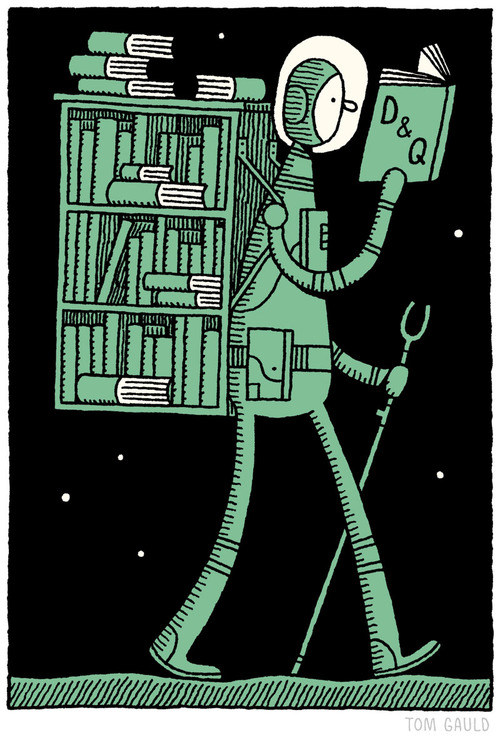
Tom Gauld drew this bookish astronaut to go on tote bags for his Canadian publisher Drawn & Quarterly. I’m reliably informed that the bags are available from D+Q at conventions and from their store in Montreal.

Comments closed

Nimona by Noelle Stevenson

I’m ever so late to this, but Noelle Stevenson‘s Harvey nominated webcomic Nimona really is terrific:

The series will be published by HarperCollins in 2015.

(via Waxy)

Comments closed