Skip to content

Category: Comics

Gene Luen Yang: The In-Between World of the Graphic Novelist

The New Yorker‘s book blog Page-Turner have posted a wonderful interview with cartoonist Gene Yang:

I grew up reading comics, and I just have this deep attachment to the medium. I think a lot of the things in my life that I become most passionate about, and most excited about, are all from comics…  In traditional Asian arts, the word and the picture always sit next to each other. I have an aunt, a Chinese brush painter, who told me that when you do a Chinese brush painting, you have to pair the image up with some poetry. A complete work is not masterful unless both of those elements are masterful. So maybe there’s some sort of attachment there—the idea of words and pictures working together is part of my family history.

You can read my interview with Gene, posted yesterday, here.

1 Comment

Q & A with Gene Luen Yang

I wouldn’t be surprised if you were feeling a little disillusioned with comics right now — frictionless superhero movies that deliver ever-diminishing emotional returns; ham-fisted editorial decisions; disputes over rights, compensation and artwork; violence; stupidity; institutional misogyny and racism; and generic blandness will do that.

Beyond the multiplexes and controversies, however, it is actually a quite an exciting time to be reading comics.

There are signs — Brian K. Vaughan and Fiona Staples‘ space opera Saga, Hawkeye by Matt Fraction, David Aja and Javier Pulido, and Scott Snyder and Greg Capullo‘s horror-driven Batman spring to mind — that genre comics may still have some life in them.

Classic series and newspaper strips are being properly curated and are more available than before. Under-appreciated artists are being rediscovered.

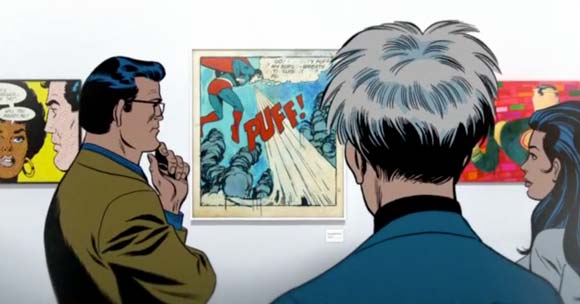
Alternative cartoonists such as Peter Bagge, Alison Bechdel, Chester Brown, Jaime and Gilbert Hernandez, Rutu Modan, and Chris Ware are producing some of the best work of their careers. The art of Daniel Clowes and Art Spiegelman is being recognised with gallery exhibitions.

And sitting somewhere between in the alt. auteurs and the superheroes, cartoonists like Emily Carroll, Becky Cloonan, Tom Gauld, Faith Erin Hicks, Hope Larson, Bryan Lee O’Malley, Luke Pearson, Noelle Stevenson — artists who have absorbed a diverse range of influences — are carving out niches for themselves, often combining and subverting genres and styles to produce uniquely personal visions.

It’s in this last, loose group of cartoonists1 — the one between the experimental and the mainstream — that I’d put artist and writer Gene Luen Yang.

Best known for his work on the Avatar: The Last Airbender graphic novels, and the critically acclaimed American Born Chinese, Gene’s most recent work is Boxers & Saints, an ambitious two-volume historical graphical novel telling parallel stories of two young on the opposite sides of the Boxer Rebellion. Already shortlisted for the National Book Award for Young People’s Literature and listed amongst Publishers Weekly‘s best books of the year — it is a remarkably mature, compassionate, and accomplished work that is at times funny, at times tragic, but always very human.

I recently met Gene while he was in Toronto to promote Boxers & Saints. I was impressed by his thoughts on being a cartoonist and on the medium itself, and we spent a good couple of hours talking books, comics, and movies. We have since corresponded by email for this Q & A.

American Born Chinese and Boxers & Saints are distributed in Canada by my employer Raincoast Books, and parts of this interview have appeared previously on the Raincoast blog.

  1. These are, admittedly, all very arbitrary, untidy and personal lists and categorizations — nobody who’s interesting fits exactly.
2 Comments

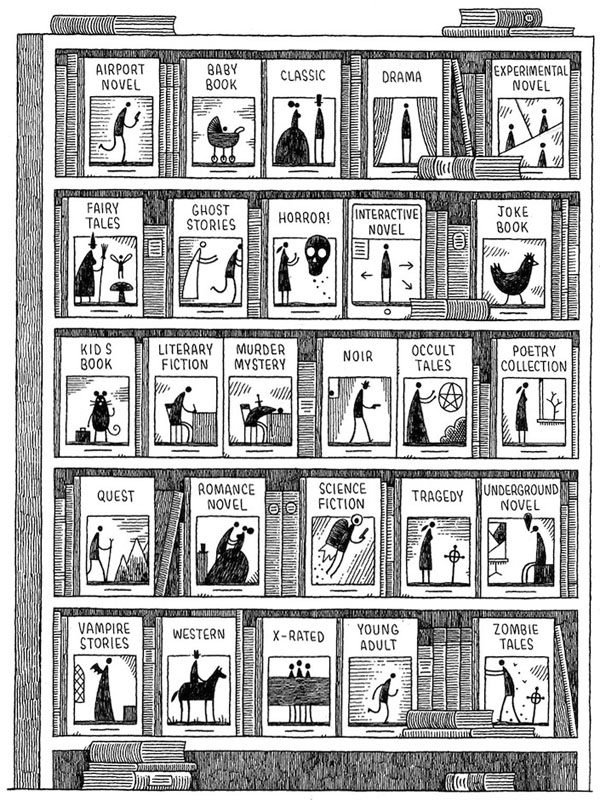
An Alphabet of Books by Tom Gauld

Tom currently also has a new ‘A Noisy Alphabet‘ print for sale.

Comments closed

Jeet Heer: In Love With Art and The Superhero Reader


At the Comics Reporter, Jeet Heer discusses his two recent books on comics, The Superhero Reader edited with Charles Hatfield and Kent Worcester, and In Love With Art: Françoise Mouly’s Adventures in Comics with Art Spiegelman, with Tom Spurgeon: 

Strange to say, when I work on a biographical essay, I’m also often writing a type of disguised autobiography. The introduction to the first volume of the Walt and Skeezix books deals with father/son relationships. I wrote it not long after my father died. The introduction of first volume of the Orphan Annie series touches on the fact that Harold Gray never had kids and examines the theme of infertility in the strip. It was written while my partner and I were struggling with our own fertility problems. In the case of Mouly, yes, it’s true that she, like me, learned English as a second language, aided by comics. And in general, Mouly’s experiences as an immigrant speak to my own history (and perhaps even more, the lives of my parents). Mouly’s cultural interests are another commonality. One of the nicest compliments I’ve received is from Mouly herself, who told my publisher that she was happy that I wrote this book because I was someone who not only knew about comics but had a wider cultural frame of reference. One of the attractive things about Mouly is that she understands comics but has a horizon that is wider than comics culture. It might be a form of pernicious self-flattery, but I like to think the same is true of me.

The fact that Mouly is such an anomalous figure in comics makes her story interesting to me since I also feel like I’m an odd duck in the comics world. Even when I was a kid first reading comics, I paid attention to the credits to see if there were other outsiders in the field. I got a secret thrill whenever I saw Ben Oda (hey, he doesn’t sound like he’s white!) listed as letterer. And I took note of the few women in comics as well, not just Mouly but also Marie Severin, or Glynis Wein. Even as a kid, I noticed that the few women in comics were almost invariably colorists. I often wondered why. I wasn’t a particularly politically astute kid but I did notice a few things.

3 Comments

Out of Skin by Emily Carroll


Just in time for Halloween and clocks going back, Canadian artist Emily Carroll has posted a chilling new webcomic called Out of Skin. Although it can be read a standalone story,  Carroll says on her blog that she considers it “part of a trilogy in terms of setting & theme” with her earlier comics His Face All Red and Margot’s Room, both of which are well worth reading if you haven’t doesn’t already.

Happy Halloween!

Comments closed

Horror Story by Grant Snider

Grant Snider’s new Halloween horror story will chill the hearts of writers everywhere: 


Comments closed

Chip Kidd: Obsessed with Batman


In this interview from the AGI Open in London earlier this year, Chip Kidd talks about his work designing books covers, his involvement with comics and, of course, his obsession with Batman:


You can read recent interviews with Chip discussing his new book Go: A Kidd’s Guide to Graphic Design at Publishers Weekly and The New York Times.

Comments closed

Superman 75th Anniversary Animated Short


Superman through the years in two minutes:

There’s a list of annotations on the DC Comics blog.

Comments closed

Graphic Horrors

I missed this during Banned Books Week, but with Halloween and Bonfire Night around the corner, it still seems somewhat timely…

At Print magazine Michael Dooley looks back at the comic books featured in Fredric Wertham’s infamous 1954 book The Seduction of the Innocent: The Influence of Comic Books on Today’s Youth.

Part one deals with “subliminal nudity, women’s ‘headlights,’ and the fascism and homosexuality of DC superheroes.” Part two, as Dooley gleefully notes, delivers “pages of eye injuries, Nazi vampires and teenage dope fiends.”

Dooley makes it clear he wants to “bury Dr. Fredric Wertham,” so don’t expect a lot of context (if you want more to read more about it, pick up The Ten Cent Plague by David Hadju), but hell, it’s fun anyway.

‘An Uncensored Look at Banned Comics’, a full-length story on banned comics, will appear in Print‘s February 2014 issue.

Comments closed

The Joy of Reading by Grant Snider

After illustrating the special sex issue of the New York Times Book Review last week, cartoonist Grant Snider has turned his cover illustration and two unused sketches into a series of posters titled The Joy of Reading. The posters are available from Grant’s shop.

Comments closed

Dear Mr. Watterson


Dear Mr. Watterson is a documentary film about the impact of  Bill Watterson’s beloved comic strip Calvin & Hobbes:

The film was funded by Kickstarter, and will be in theatres and available ‘on demand’ on November 15th, 2013.

(via Coudal)

Comments closed

Chris Ware: The Magic of Comics

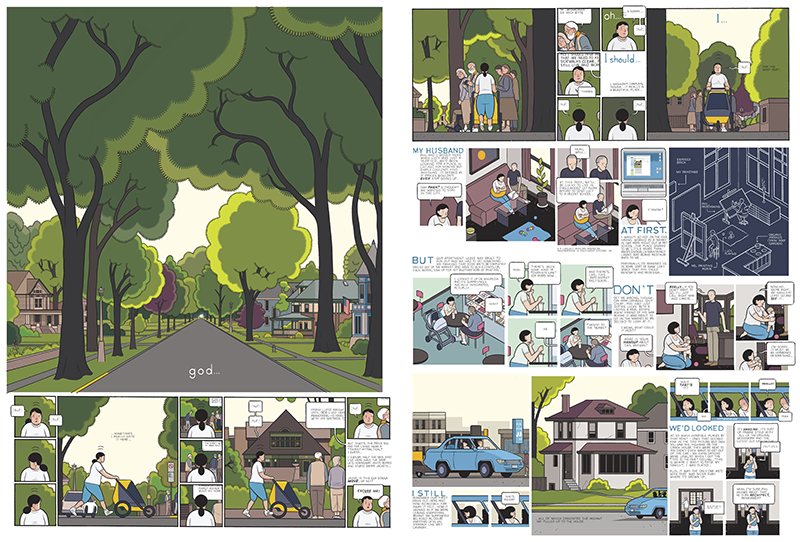
Following his appearance at the Edinburgh international book fair, Cartoonist Chris Ware spoke with Stuart Kelly of The Guardian about his recent work Building Stories:

“As soon as a screen can produce something that can move, it becomes a passive medium, whereas I feel that comics are a very active medium. The appeal is they masquerade as a passive medium, but they’re not at all. It takes a lot of effort to read comics, even though it seems like they’re easy. It seems like they need to be fixed on paper to have a certain power – my wife always tells me never to use the word magic, but I can’t help it, there is no other word: there is a magic when you read an image that you know doesn’t move but you have a sense that something is moving, if not on the page then in your mind.”

Read the whole interview.

Comments closed