Skip to content

Category: Comics

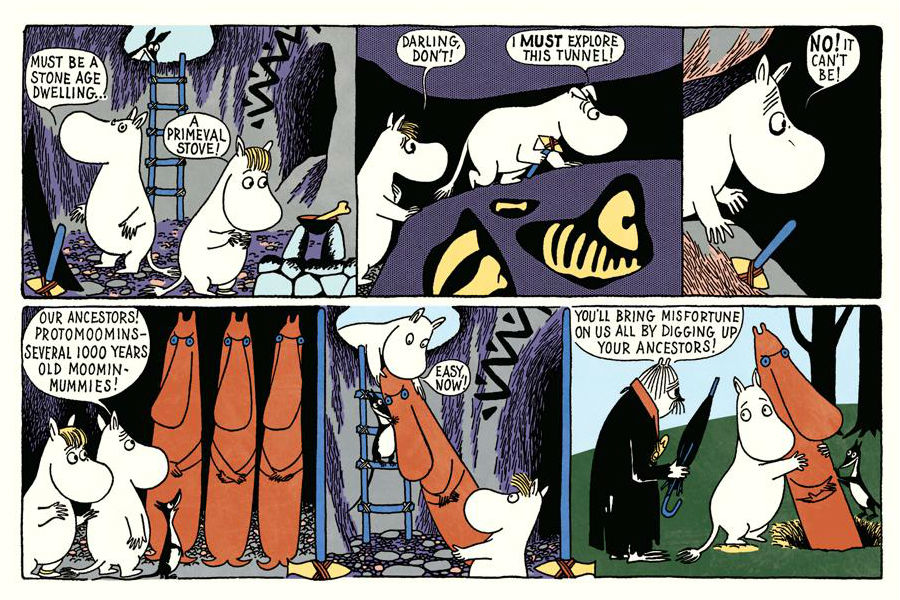
Tove Jansson: The Hand That Made the Moomins

9781770461345
At The New Yorker, James Guida reviews Tove Jansson: Life, Art, Words: The Authorized Biography by Boel Westin, and Jansson’s memoir of childhood Sculptor’s Daughter (both published by Sort of Books):

Writing the Moomins afforded an escape at war’s end. After a quiet start, the series took off in the fifties, bringing welcome financial stability—but the success also represented a kind of detour. Jansson’s ambitions for painting never left her. Now free time was scarce, thanks to an unceasing flow of fan mail, the minutiae of merchandising, processions of visitors, and, until Lars, one of her brothers, took over, the arduous demands of the comic strip. For a while, there was no pleasure to be found in working. Thankfully, social media didn’t exist yet: “I could vomit over Moomintroll,” she wrote. “I shall never again be able to write about those happy idiots who forgive one another and never realize they’re being fooled.”

As with someone like Kafka, it is hard to know how literally to take Jansson’s obstacles. To some degree, her entrapment was avoidable: to be so involved in the products, to answer every letter, seem Moominish ideas—either that or, for a person who so prized being left free and alone, they’re plain masochistic. Were an analogous scenario to occur in the books, the hassles would be washed away by flood, to be followed by a celebratory picnic. As it was, Jansson believed that her nature didn’t give her a choice.
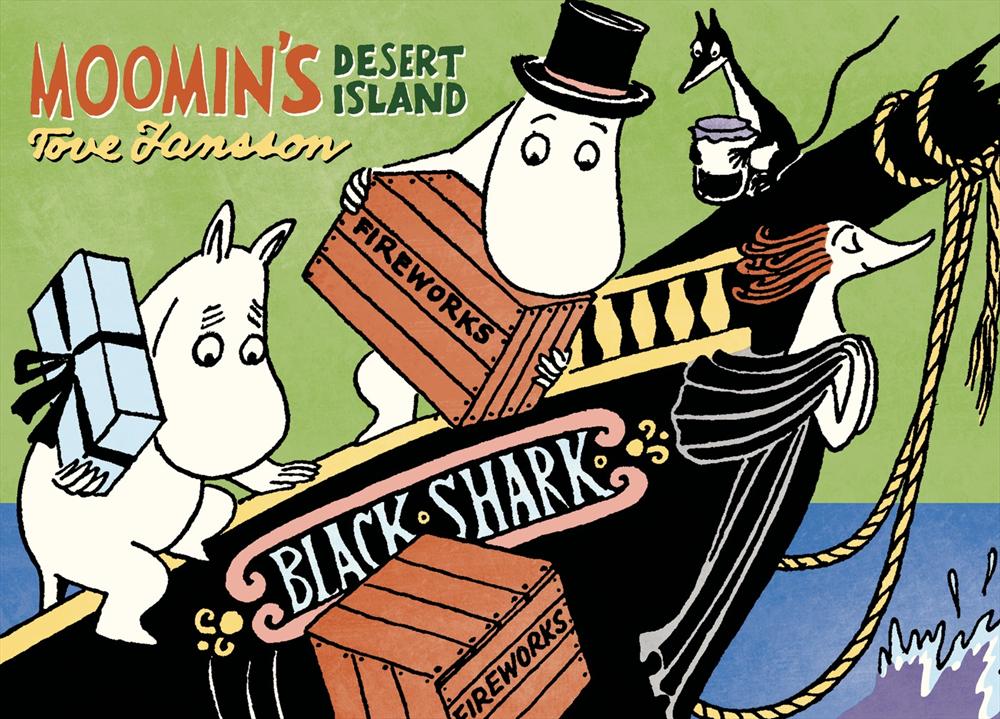
moomins-desert-island
On related note, Montreal’s Drawn Quarterly have just published two new paperback books in their lovely series of classic Moomin comic strips reworked in full colour, Moomin and the Golden Tail and Moomin’s Desert Island (pictured above).

(NB: the Moomin storybooks, published by FSG, and the Moomin comic books, published by D+Q, are distributed by my employer Raincoast Books. Sorry I seem to be doing this so much lately!)

Comments closed
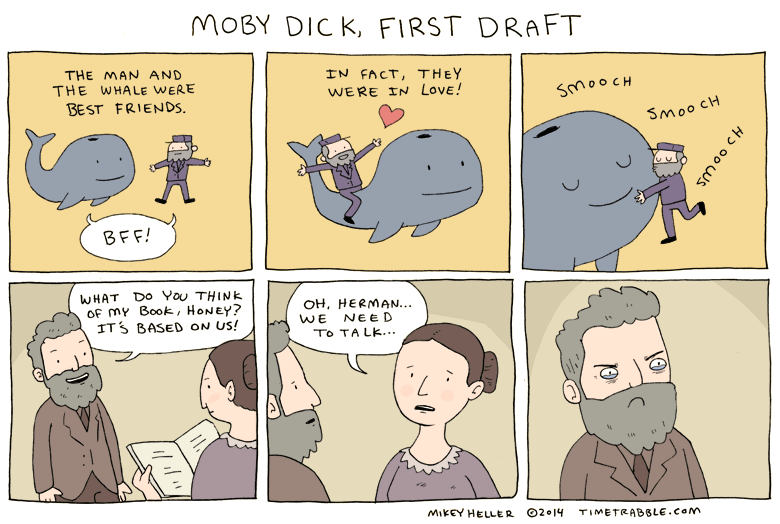
Moby Dick, First Draft

2014-01-20-Moby-Dick,-First-Draft
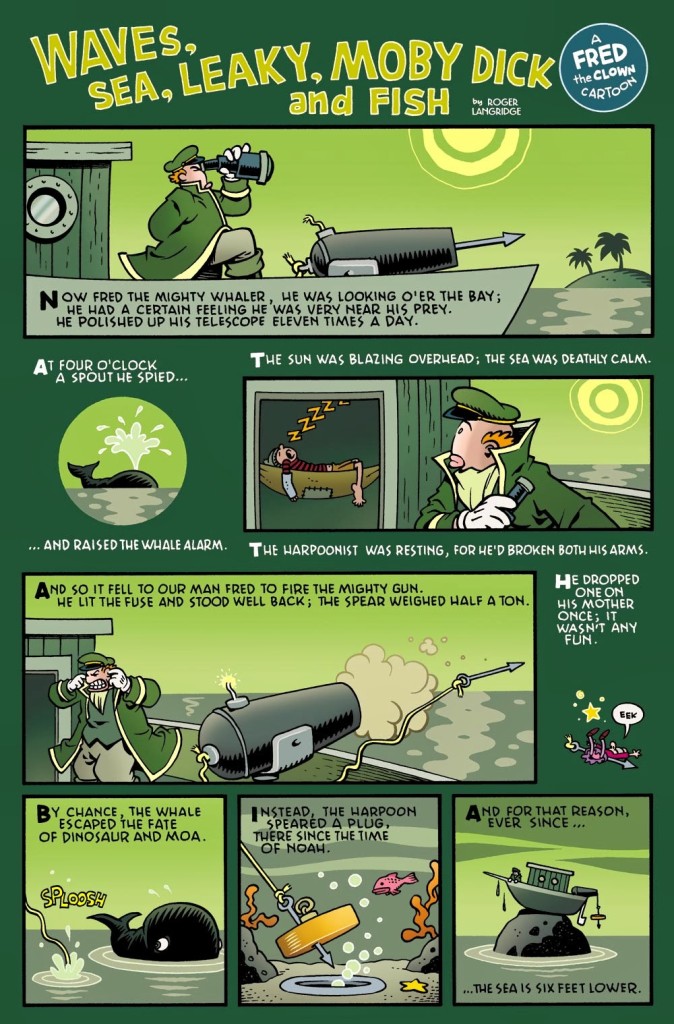
By some strange coincidence, Mikey Heller’s Time Trabble strip is the second comic about Moby Dick I’ve seen recently. Here’s Roger Langridge’s version featuring Fred the Clown:

Waves,_Sea,_Leaky,_Moby_Dick_and_Fish

(Thanks Michel)

Comments closed

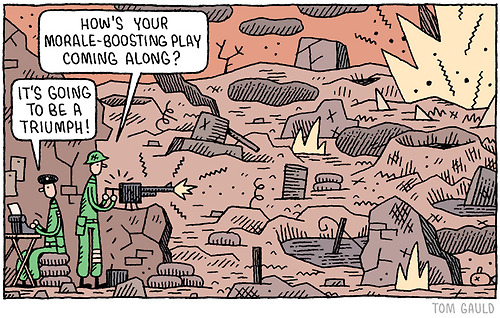
Morale

morale
In light of my previous post about how awful being a writer is, Tom Gauld‘s latest cartoon for The Guardian seems strangely appropriate…

Comments closed

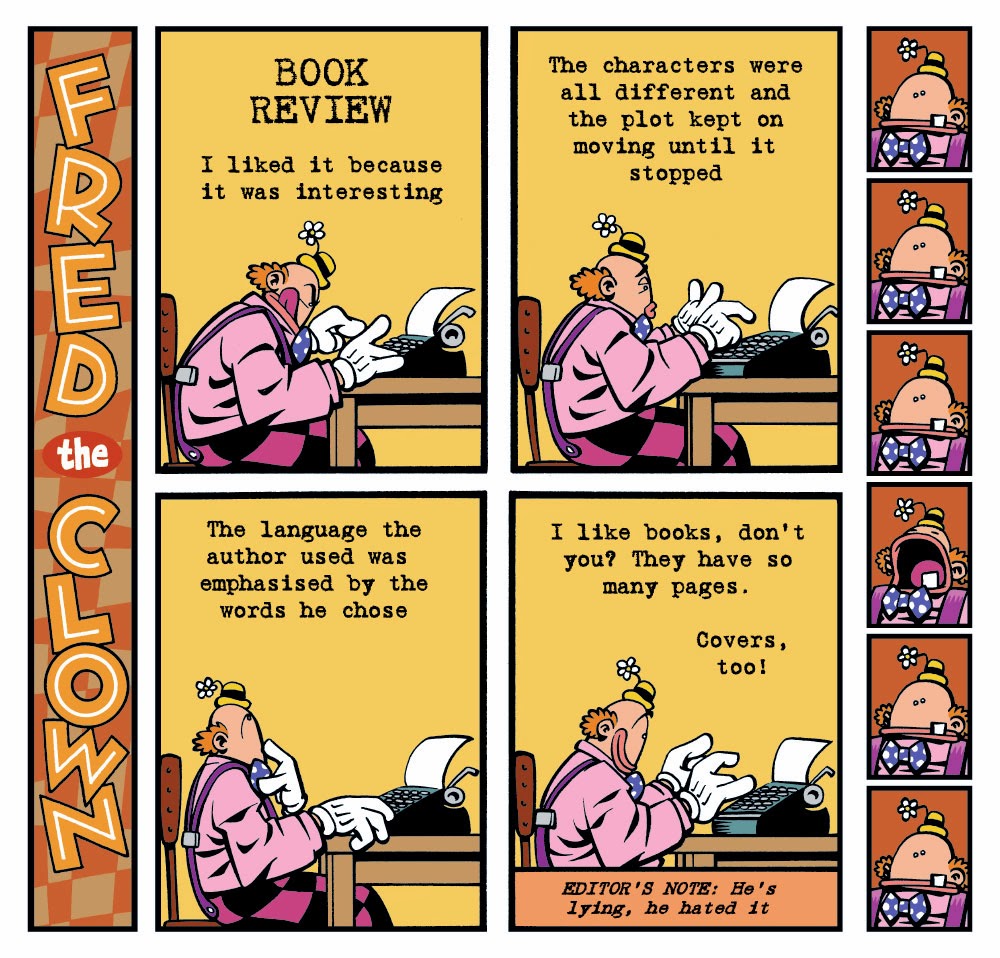
Fred the Clown: Book Review

fred_079-Book-Review
By Roger Langridge. I’ve read reviews like this (except the bit about liking books usually comes at the beginning).

Comments closed

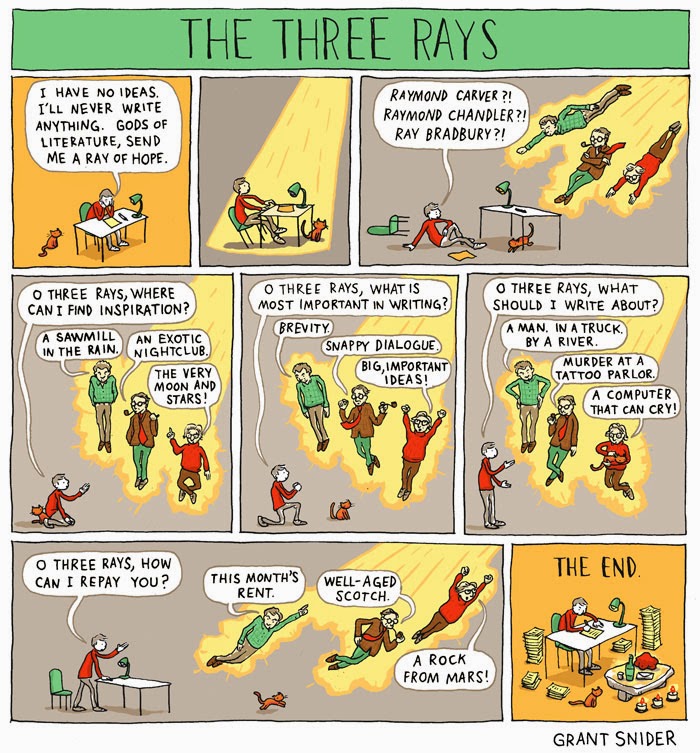
The Three Rays by Grant Snider

threerays-blog

Grant Snider’s latest comic for the New York Times Book Review.

Comments closed

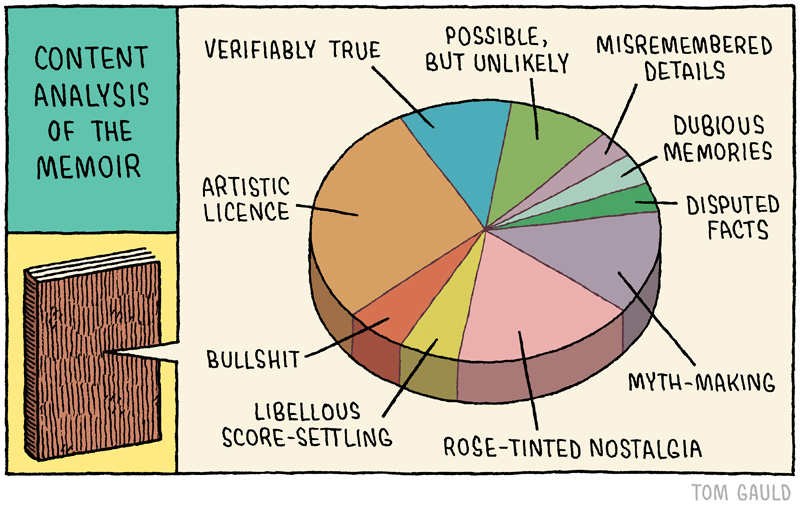
Content Analysis of the Memoir by Tom Gauld

memoir-tom-gauld
Tom Gauld

(My memoir will be largely myth-making, dubious memories, and bullshit. Maybe some artistic license too… )

Comments closed

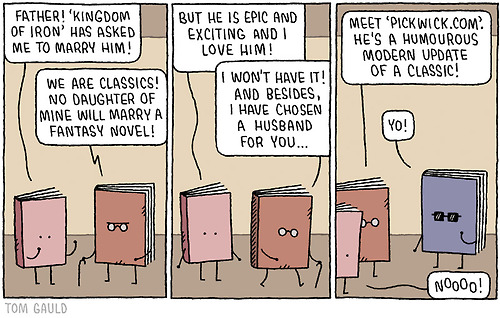
“No Daughter of Mine Will Marry a Fantasy Novel!”

Tom Gauld

Comments closed

Fahrenheit 351 by Grant Snider


Mmm… toasty.

Comments closed

Homo Sapiens Solitarius by Tom Gauld


Tom Gauld.

Comments closed

Child’s Play: Blockbuster Movies, Comics and Superheroes

At RogerEbert.com, Alexander Hul has an interesting piece on self-indulgent movie directors and the degeneration of blockbusters:

Artists certainly are allowed to make films that only satisfy their own creative pursuits. But blockbusters—more than any other kind of film—are conceived of as a way to entertain and satisfy audiences (so they can make money). Modern spectacles feel like they’re built to entertain and satisfy their filmmakers instead. They’re not considering who their destruction is actually for anymore. They’re just doing it. Or, as Vulture wrote, when it comes to destruction porn, “No one necessarily asks for it; it just kind of happens.” Bless his honesty, but [Damon] Lindelof’s assessment of the climactic destruction he penned for “Star Trek Into Darkness” only reinforces how embedded and unconscious this has all become for the moviemakers: “Did ‘Star Trek Into Darkness’ need to have a gigantic starship crashing into San Francisco? I’ll never know. But it sure felt like it did.” All of this makes me recall “Jurassic Park”‘s Ian Malcolm sentiment when he lectures Hammond for blindly realizing his dinosaur fantasies with the technology he has access to. Filmmakers are now so preoccupied with how much they can (and are encouraged to) destroy digitally, they don’t stop to think if they really should. They don’t stop to ask “Who is this really for?”

On a related note, Toronto-based writer Mike Doherty asks comic-store owners have blockbuster movies been good for comics?:

“I hate to say it… but after waiting so long for really good superhero movies—all my life, almost—and now they’re here, I’m almost getting bored of them. There are so many now. And they’re always basically the same story, which is not much story: bad guy versus good guy, good guy wins in the end.”

Almost getting bored of them? I think I’m already well passed that point. And much as it pains me, I’m beginning to think Alan Moore may have a point:

[Superheroes] don’t mean what they used to mean. They were originally in the hands of writers who would actively expand the imagination of their nine- to 13-year-old audience. That was completely what they were meant to do and they were doing it excellently. These days, superhero comics think the audience is certainly not nine to 13, it’s nothing to do with them. It’s an audience largely of 30-, 40-, 50-, 60-year old men, usually men. Someone came up with the term graphic novel. These readers latched on to it; they were simply interested in a way that could validate their continued love of Green Lantern or Spider-Man without appearing in some way emotionally subnormal. This is a significant rump of the superhero-addicted, mainstream-addicted audience. I don’t think the superhero stands for anything good. I think it’s a rather alarming sign if we’ve got audiences of adults going to see the Avengers movie and delighting in concepts and characters meant to entertain the 12-year-old boys of the 1950s.”

Sigh.

Comments closed

2001: When Two Sorts of Genius Collide

At The Dissolve, Noel Murray considers Jack Kirby’s comic book adaptation of the movie 2001: A Space Odyssey directed by Stanley Kubrick:

It’s not essential to know how Kubrick’s fascinations with avant-garde film and music influenced 2001, or to focus on how a mid-1960s conception of computers and technology affected the character of HAL, who’s like an elaborate version of one of those early chess-playing robots. But it does recontextualize 2001 to think of it as the product of an individual, working in concert with other individuals, none of them delivering messages from on high. And for all the angry letters Marvel received (and, to its credit, published) from 2001 fans who felt Kirby was besmirching their favorite film, it helps to remember the pressures that Kirby was under at the time, internally and externally, and to see the 10 issues and one tabloid edition of his 2001 as the product of a scatterbrained genius grappling with his own relevance. Kubrick and Kirby—these were both just people, grasping at something just beyond them, while planting guideposts for others to follow.

Comments closed

Society is Nix: The Quotidian Chaos of the Urban Scene

J. Hoberman reviews the oversize comics collection Society is Nix: Gleeful Anarchy at the Dawn of the American Comic Strip, 1895–1915, edited by Peter Maresca and published by Sunday Press Books, for the New York Review of Books:

Society is Nix focuses on the depiction of then-contemporary metropolitan life. In addition to Hogan’s Alley and other metropolitan jungles, the comics reveled in the quotidian chaos of the urban scene: the pushcart madness of “Familiar Sights of a Great City—No. 1, The Cop is Coming” is rendered as a mock-classical frieze. Genuine monuments are regarded with derision; several strips in Society is Nix satirize the rapid transit system then under construction in New York. As the twentieth century approached, cartoonists extrapolated a city of the future, replete with snow-capped office buildings, floating real-estate agents, and colliding single-person dirigibles, or ponder “the possibilities of wireless telegraphy” which, save for predicting communication with Mars, seems much like the Internet…

…In his introduction, Maresca refers to these comic strips as “the birth of modern popular culture”—perhaps “mass media” would be a better term. These strips were not only all over the page, they were in big cities all over the country—the most successful supplements reached hundreds of thousands of readers in New York alone. Yet at the same time, they were wildly experimental… [The] first newspaper comic strips were not so much an extension of vaudeville as precursors of the equally déclassé and temperamentally anti-authoritarian motion picture. The early strips thrived on choreographed violence, including runaway horse carts, baroque streetcar collisions, and a panoply of what Hearst might have termed polychromous explosions.

Comments closed