Skip to content

Category: Reading

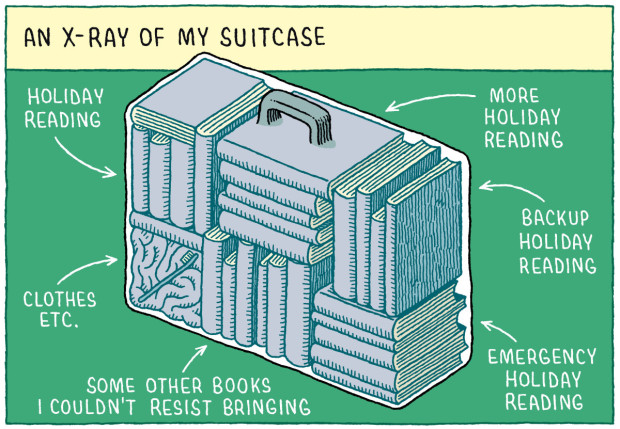
‘To Be Read’ by Tom Gauld

Tom Gauld for The Guardian.

My ‘to be read’ wall feels particularly bad at the moment. I did, however, read an ARC of She’s a Killer by Kirsten McDougall on vacation, which is fun if you like an unreliable narrator who is not quite a genius, but very possibly a sociopath (and has an imaginary friend).

Comments closed

It Can Happen Here

With shadows of authoritarianism rising around the world, Cass R. Sunstein reviews three books on life in Nazi Germany for the New York Review of Books.

The books, They Thought They Were Free by Milton Mayer, Defying Hitler by Sebastian Haffner, and Broken Lives by Konrad Jarausch, do not focus on the well-known historic figures, but explore how ordinary people navigated such a terrible time. The contemporary parallels are chilling:

With evident fatigue, the baker reported, “One had no time to think. There was so much going on.” His account was similar to that of one of Mayer’s colleagues, a German philologist in the country at the time, who emphasized the devastatingly incremental nature of the descent into tyranny and said that “we had no time to think about these dreadful things that were growing, little by little, all around us.” The philologist pointed to a regime bent on diverting its people through endless dramas (often involving real or imagined enemies), and “the gradual habituation of the people, little by little, to being governed by surprise.” In his account, “each step was so small, so inconsequential, so well explained or, on occasion, ‘regretted,’” that people could no more see it “developing from day to day than a farmer in his field sees the corn growing. One day it is over his head.”

(via Kottke)

Comments closed

Books Will Always Matter

“Even though we think of reading as something that we do alone in our rooms by ourselves, we talk about books, and we take the ideas that we learn from books and the stories that we have heard about books, the characters that we have fallen in love with in books, and we bring them to our conversations.

They make us more empathetic. They connect us to one another. They make people who are not like us more human.”

Lisa Lucas, executive director of the National Book Foundation, explains why books will always matter on PBS Newshour

Comments closed

At Least She’s Reading

Another back to school appropriate comic, this time by J.A.K. (AKA Jason Adam Katzenstein) for The New Yorker

Comments closed

The Custodian of Forgotten Books

In a lovely piece for The New YorkerDaniel A. Gross talks to blogger Brad Bigelow, the man behind the Neglected Books, about rediscovering forgotten literature:

Most novels are forgotten. Glance at the names of writers who were famous in the nineteenth century, or who won the Nobel Prize at the beginning of the twentieth, or who were on best-seller lists just a few decades ago, and chances are that most of them won’t even ring a bell. When “The Moonflower Vine” resurfaced and ricocheted around the publishing world, it became an unlikely exception.

What’s strange about the journey of that book—and about our moment in the history of publishing—is that its rediscovery was made possible by an independent blogger, named Brad Bigelow. Bigelow, fifty-eight, is not a professional publisher, author, or critic. He’s a self-appointed custodian of obscurity. For much of his career, he worked as an I.T. adviser for the United States Air Force. At his home, in Brussels, Belgium, he spends nights and weekends scouring old books and magazines for writers worthy of resurrection.

“It can just be a series of almost random things that can make the difference between something being remembered or something being forgotten,” Bigelow told me recently. On his blog, Neglected Books, he has written posts about roughly seven hundred books—impressive numbers for a hobbyist, though they’re modest next to the thousands of books we forget each year. “It’s one little step against entropy,” he said. “Against the breakdown of everything into chaos.”

Comments closed

Tom Gauld’s Suitcase

Gauld-Suitcase

Tom Gauld for The New Yorker.1

Comments closed

E-Books Can’t Burn

Author Tim Parks has an interesting post on the virtues of e-books on the NYRB blog:

The e-book, by eliminating all variations in the appearance and weight of the material object we hold in our hand and by discouraging anything but our focus on where we are in the sequence of words (the page once read disappears, the page to come has yet to appear) would seem to bring us closer than the paper book to the essence of the literary experience. Certainly it offers a more austere, direct engagement with the words appearing before us and disappearing behind us than the traditional paper book offers, giving no fetishistic gratification as we cover our walls with famous names. It is as if one had been freed from everything extraneous and distracting surrounding the text to focus on the pleasure of the words themselves…Add to that the e-book’s ease of transport, its international vocation (could the Iron Curtain have kept out e-books?), its indestructibility (you can’t burn e-books), its promise that all books will be able to remain forever in print and what is more available at reasonable prices, and it becomes harder and harder to see why the literati are not giving the phenomenon a more generous welcome.

It is encouraging to see a writer at the venerable NYRB enthusing about e-books, but two things immediately spring to mind. First, that reading on the screen might present more, not fewer, distractions than reading an unconnected book. And, second, the idea that e-books — which can not only be monitored but endlessly rewritten and immediately deleted across an entire network without a reader’s permission — are some how less vulnerable than paper-ones seems, to put it politely, naive.

2 Comments

There’s More to Life Than Reading…

With library closures threatening in the UK, here’s Tom Gauld’s comic ‘Withdrawn‘ for The Guardian‘s Saturday Review:

Comments closed

Favourite New Books of 2010

Ducking in just under the wire, here is my list of favourite of new books of the year. It’s not meant to represent the “best” of 2010. Rather, it’s a completely unscientific, very subjective list of books (arranged in alphabetical order) that I enjoyed. As I mentioned in my previous post, I found compiling the list a bit of a challenge and yet, for all that, there’s an air of withering predictability about the selections. There are no surprises. But even if this wasn’t a particular stellar year for reading, there were still lots of books I was excited about and that can only be a good thing.

I should also mention, for the sake of disclosure and all that, the top 10 includes one book distributed by Raincoast Books in Canada, and the list of honourable mentions refers to a couple of other titles I have helped promote in some minor capacity. They’re included here because I actually like them, not for any nefarious marketing reasons, but I guess you’ll just have to take my word for that. In any case, all these titles are identified with an asterisk…

And with that out of the way, on to the list!

Born Modern: The Life and Work of Alvin Lustig*
Elaine Cohen Lustig & Steven Heller

Chronicle Books
ISBN 9780811861274
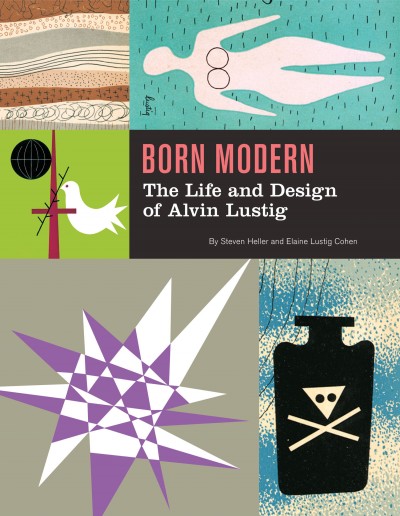
I am a little embarrassed to start this list with a title distributed by Raincoast, but it comes first alphabetically and, I can honestly say tat Born Modern was the book I was most looking forward to this year. And I was not the only person excited about the book. When I tweeted about it from the Raincoast sales conference, the response was immediate. Almost every North American book designer I’ve ever spoken to cites Lustig — who designed covers for New Directions Press in the 1950’s — as an influence. The book designer’s book designer, then… A must-have.

C
Tom McCarthy
Knopf
ISBN 9
780307593337

Tom McCarthy’s C was, as mentioned previously, one of the defining books of the year for me, standing — perhaps unfairly — opposite the ubiquitous Freedom. If I am honest though, I liked it less than McCarthy’s previous novel, the starkly compact Remainder (one of my favourite books of the last 10 years). At times, the sprawling, crawling C felt like it was held together with the sticky-tape of McCarthy’s singular intellect (a thought reaffirmed by seeing him in conversation with Douglas Coupland in Toronto). But somehow, in the end,  it still works in some sort of baffling, gorgeous way.

The book was also perfect excuse to finally talk to Knopf cover designer Peter Mendelsund for the blog. The Q & A with Peter and Tom about C is here.


The City and the City
China Miéville
Del Rey
ISBN 9780345497529

I am cheating a little by including The City and the City because it was first published in 2009. It was, however, published in paperback in 2010, and as that’s how a lot of us still buy our fiction, I’m bending the rules to include it.

The novel itself is essentially a detective story, but what lifts out of the ordinary is the imaginary space in which it takes place. Architecture, geography and maps are clearly important to Miéville, but where, for example, Perdido Street Station creates a fantastically baroque city of ghettos and towering alien architecture, The City and the City is only slightly off-kilter — familiar but unsettling — and the book is even better for it.

Joy Division
Kevin Cummins
Rizzoli

ISBN 9780847834815

This was my Christmas present (thank you Mrs C.O.!) and it is — pretty obviously I would think — for fans only. Still, I’m guessing there’s quite a few out there. In any case, the book is a collection of beautiful black and white photographs of Joy Division and the late Ian Curtis by Manchester-born photographer Kevin Cummins. It includes Cummins’ iconic pictures for the NME of the band standing on a snowy bridge in Hulme, Manchester, as well as photographs of live performances and the band back stage. The book was stylishly designed — with more than a whiff of Peter Saville — by London design agency Farrow.

Just Kids
Patti Smith
Ecco
ISBN 9
780060936228

Other than owing a copy of Horses,  I can’t say that I’m particularly familiar with the work of Patti Smith, or Robert Mapplethorpe for that matter (other than the sort of stuff must people know about his art, and that he was connected to Sam Wagstaff, no relation). But, it doesn’t really matter. Smith’s memoir about her relationship with Mapplethorpe is a touching and self-deprecating look at their early years together in New York and their adventures in the art/music scene of the late 1960’s and early 1970’s.

Memories of the Future
Sigizmund Krzhizhanovsky, translated by Joanne Turnbull
NYRB
ISBN 9781590173190
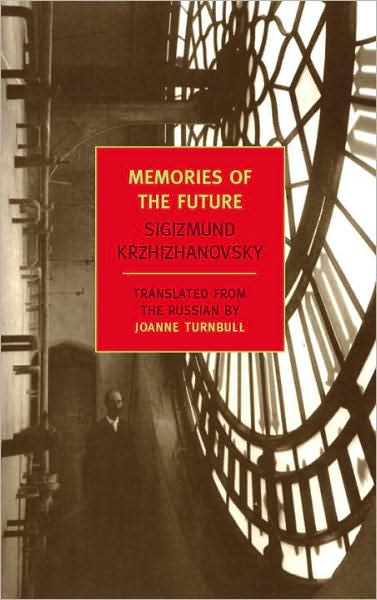
I am definitely cheating by including this in the list as it was published in 2009. That said, it was published late in 2009, I missed it, and it’s too good not to be in this year’s top 10.

The book itself  is a collection of seven short stories written between 1922 and Krzhizhanovsky’s death in 1950,  all of which were suppressed by Soviet censors. The stories are reminiscent of Gogol’s short fiction and Bulgakov’s novellas, and suffice to say, they’re all bonkers. But in a good way. I loved the story Quadraturin about the man who gets lost in his black, ever-expanding apartment, and the strange time travel title story which concludes the book.

Penguin 75: Designers, Authors, Commentary (the Good, the Bad…)
Paul Buckley

Penguin
ISBN 9780143117629

Seeing as I spend so much time talking about cover design, I would be remiss if I didn’t include Penguin 75 in my top 10. Released to celebrate Penguin’s 75th anniversary, it’s a surprisingly diverse and candid look at the recent cover designs from Penguin’s US outpost in New York.  I talked about Penguin 75 with art director Paul Buckley and book designer Christopher Brand here.

Parker: The Outfit
Darwyn Cooke

IDW
ISBN 9781600107627

The previous book in Darwyn Cooke’s Richard Stark adaptations, The Hunter, was on last year’s list, so perhaps it is hardly surprising that the sequel, which I think is better,  is in this year’s top 10 as well. In new book, the formidable Parker — now with a new face — turns the tables on ‘the Outfit’, who quickly wish that they’d let sleeping dogs lie. Cooke seems in more confident form with this adaptation and the result is a stylish and fast-paced noir that looks incredibly cool. My pithier Advent Book Blog pitch for The Outfit is here.

The Shallows
Nicholas Carr
W.W. Norton & Co.
ISBN 9780393072228

I had a frisson of recognition reading Carr’s description of internet affected attention spans and I doubt I was the only one who thought “oh god, that’s happening to me” while reading The Shallows. The book is too long — a shorter book would’ve been even more effective — but it is still compelling. Carr doesn’t say technology is wrong, but reminds us that for all its benefits, we should be mindful of the consequences and what we might be losing.

Werewolves of Montpelier
Jason
Fantagraphics

ISBN
9781606993590

I wrote about my love for Jason’s comics when Werewolves of Montpellier was about to be released earlier this year, and the book itself didn’t disappoint. Ostensibly the book is about a thief called Sven who disguises himself as werewolf to rob people’s apartments and incurs the wrath of the town’s actual werewolves. It is, however, as much about friendship, identity, loneliness, and, ultimately, Sven’s unrequited love for his neighbour Audrey. In a lovely one-page scene, Audrey stands behind Sven, hugging his shoulders.  “Do women come from another planet?” she asks. “Yes, women come from another planet,” Sven replies. The whole book is achingly brief, but Werewolves of Montpellier is possibly my favourite Jason book to date.

Honourable Mentions

American Trademarks edited by Eric Baker and Tyler Blick*
Footnotes In Gaza by Joe Sacco (December 2009)
I.O.U.: Why Everyone Owes Everyone and No One Can Pay by John Lanchester (published in the UK as Whoops!)
KENK by Richard Poplak and Nick Marinkovich*
Large Scale: Fabricating Sculpture in the 1960’s and 1970’s by Jonathan Lippincott*
The Lost Rolling Stones Photographs: The Bob Bonis Archive, 1964-1966 by Larry Marrion
The Rocketeer: The Complete Collection by Dave Stevens (December 2009)
Shirley Craven and Hull Traders: Revolutionary Fabrics and Furniture 1957-1980 by Lesley Jackson (October 2009)

So there you go. If  this hasn’t met your requirements, Largehearted Boy is aggregating every online “best of 2010” book list he can find, and Fimoculous is aggregating all of the lists related to 2010 in categories ranging from ‘Advertising’ through to ‘Words’. That should keep you busy…

Happy New Year!

aggregates all of the lists related to 2010aggregated all of the lists related to 2010)
Comments closed

A Year in Reading 2010

2010 was a year of losing battles and one of the first casualties was time for personal reading. The moments I did have were snatched on the subway and, if I could keep my eyes open, last thing at night. I often found myself unwittingly rereading chapters I had read the previous day, or worse, that very morning. The difficulty this week of compiling a list of my favourite books of the year — and the predictability of that list (to be posted soon) — made it very clear that not only did I read less than previous years, I rarely strayed off the beaten path.

The year was thus defined, for better or worse, by two big novels that were in some senses polar opposites: C by Tom McCarthy and Freedom by Jonathan Franzen. If C was modern experimental novel masquerading as an early 20th century bildungsroman, Freedom was a Victorian drama in modern dress. It felt like “Two Paths for the Novel” all over again.

Someone cleverer than me observed C “was surrounded by the sort of buzz and static which it contained and described.” But while the buzz amplified C to the Booker shortlist, the hype around Freedom and Franzen seemed to diminish the book. It was so ludicrously overpraised, and subsequently criticized and shunned, that it was almost impossible to evaluate fairly.

OTHER FICTION

Like just about everyone else, I started 2010 reading Stieg Larsson, but now, with 2011 just around the corner, The Girl Who Kicked the Hornet’s Nest remains unfinished, my bookmark at Chapter 6.

I loved the architecture and weird psycho-geography at the heart of the mysterious The City and the City (published in paperback this year) and went on to read China Miéville’s earlier, equally architectural, novel Perdido Street Station.

I was also happy to belatedly discover that Phillip Kerr had resurrected his Bernie Gunther Berlin Noir detective series. Better late than never…

Sadly neither The Imperfectionists by Tom Rachman nor Zero History by William Gibson really added up to more than the sum of their (occasionally really quite good) parts.

I simply abandoned Justin Cronin’s clunker The Passage.

Better was Canal, Lee Rourke’s L’Étranger in London. I wasn’t entirely convinced by it, but an off-beat novel about urban ennui and existential violence was a welcome change of pace. Rourke is no doubt an author to watch.

Canal had the added virtue of being short, something of  a rare and undervalued quality these days. In fact almost all of the fiction I enjoyed the most this year — the icily beautiful The True Deceiver by Tove Jansson, the bonkers Memories of the Future by Sigizmund Krzhizhanovsky, and the lyrical The Blue Fox by Sjon — were short. And not actually published in 2010.

Colony by Hugo Wilcken, also short and published in 2007, was unquestionably my favourite novel of the year. Drawing its title from Kafka’s The Penal Colony (and, in turn, Joy Division’s song Colony), the book seemed to me more like a post-modern Conrad, or perhaps Camus trying his hand at a Boy’s Own Adventure. Needless to say, I’m looking forward to Wilcken’s next novel…

NONFICTION

I waited too long to read Patti Smith’s wistful and self-depreciating memoir Just Kids, but I was charmed by it nonetheless. I was less enthralled with Bob Dylan in America by Sean Wilentz. I was not, I suspect, the target audience however…

Jared Lanier’s You Are Not a Gadget: A Manifesto and Nicholas Carr’s The Shallows both raised intelligent concerns about development of the internet. I was less convinced by Lanier’s polemic than Carr’s tweedier defense of long-form reading, but neither were as reactionary as they were sometimes characterized, and both offered interesting insights whether one agreed with them or not.

The subjective magazine-style reportage of War by Sebastian Junger and the gossipy Game Change by John Heilemann and Mark Halperin were both signals of what we can expect from nonfiction in future.  But both were troubling, especially War, which felt both narcissistic and yet, at the same time, voyeuristic and exploitative. Neither book properly addressed the complications of embedded insider journalism.

Both War and Game Change were, at least, entertaining. That cannot be said of Bob Woodward’s less than electrifying Obama’s Wars. There is something to be said for detailing events in chronological order, but that doesn’t make it any more readable. Worse, perhaps, I didn’t gain any greater insight into what had happened.

COMICS

Even though Dan Clowes is the godfather of the miserable asshole, it is now such a common trope in indie comics that despite his undeniable virtuosity I was somewhat disappointed by the uncompromising Wilson. It was, however, unfair of me to expect Clowes to be anyone other than Clowes, and just about everyone whose opinion I respect tells me I am wrong about this book, so don’t take my word for it.

KENK took up a lot of my professional time this year so I was glad to see it get such a positive critical response and I’m hopeful that it will finally see a US release in 2011.

Having a short attention span, I enjoyed the latest installment of Hellboy, and its gothic spin off Sir Edward Grey Witchfinder, but continued to be underwhelmed by Mignola’s plodding BPRD series.

Like just about every other nerd in Toronto I read the 6th and final installment of Bryan Lee O’Malley’s Scott Pilgrim series (now handily available as a box set). I also finally read Jeff Smith’s epic Bone from cover to cover and revisited The Rocketeer stories by the late Dave Stevens, which were collected, at long last, in a slim hardcover edition at the end of last year.

I loved The Outfit, the latest installment of Darwyn Cooke’s adaptations of Richard Stark’s Parker stories (my Advent Book Blog recommendation this year), and Jason’s strange and delightful Werewolves of Montpelier.

Footnotes In Gaza (published late in 2009) left me depressed, but thoroughly in awe of Joe Sacco.

THE ONES I DIDN’T GET TO (BUT MEANT TO)

The list of new books that I had every intention of reading this year but didn’t is far, far, too long. Here, however, are a few of the books (in no particular order) that I intend to get to sooner rather than later: Matterhorn by Karl Marlantes, Our Tragic Universe by Scarlett Thomas, Super Sad True Love Story by Gary Sheyngart, A Visit From the Goon Squad by Jennifer Egan, Every Man Dies Alone by Hans Fallada,  Boxer, Beetle by Ned Beauman, Kraken by China Miéville, What Ever Happened to Modernism? by Gabriel Josipovici, The Hare With Amber Eyes by Edmund Dewaal, A History of the World in 100 Objects by Neil MacGregor, Just My Type: A Book About Fonts by Simon Garfield, Set to Sea by Drew Weing and H.P. Lovecraft’s At the Mountains of Madness adapted by Ian Culbard. There are no doubt many, many more… I would love to hear what you read and enjoyed this year and what I should add to the list of books for 2011…

2 Comments

Images and Words

Photographer Steve McCurry, best known for his iconic National Geographic portrait ‘Afghan Girl’, recently posted two sets of beautiful photographs on his blog of people reading books. Publishing Perspectives spoke to McCurry about the ongoing project:

As a photographer, McCurry is always on the hunt for the “unguarded moment,” that slice of time that reveals something personal and honest. “I have another gallery of people sleeping and of couples interacting. There’s an intimacy people have with a book and its author that is similar,” he says, adding. “We’re all different and we’re all the same. It amuses me that whether you’re fabulously rich and sophisticated or you happen to be someone on the street in the third world or a classroom in some remote area, reading is all the same act. It’s a common link in our shared humanity, a thing we all do that is regardless of where we are economically or socially.”

The first selection of McCurry’s photographs of readers, titled ‘Fusion: The Synergy of Images and Words’, can be seen here. The second set is here.

Comments closed

Father’s Day: Men and Reading

Thriller writer Jason Pinter recently rattled some publishing china by suggesting that a stubborn belief that Men Don’t Read is alienating male readers:

I’m tired of people saying Men Don’t Read. Men LOVE to read… But the more publishing repeats the empty mantra that Men Don’t Read the less they’re going to try to appeal to men, which is where this vicious cycle begins.

Publish more books for men and boys. Trust editors who try to buy these books, and work on the marketing campaigns to hit those audiences. The readers are there, waiting, eager just under the surface… They’ve been alienated for a long time and might need to be roused from their slumber. But as I’ve always said the biggest problems facing the publishing industry are not ebooks, or returns, but the number of people reading. This is a way to bring back a lot of readers who have essentially been forgotten about.

Pinter is right in a sense. The idea that men don’t read books is a glib generalization and publishers really should be worried about literacy and declining readerships. But are men really turning away from reading because the book trade isn’t trying to reach them?

The scandal engulfing former Penguin Canada CEO David Davidar is a prickly reminder that the upper echelon of publishing is still largely a boy’s club. And even if you accept Pinter’s assertion that “that most editorial meetings tend to be dominated by women”, Rebecca Smart, Managing Director at Osprey Publishing, ably demonstrates that women can publish effectively for a predominantly male readership.

And even if you ignore all the books on football mentioned last week (not to mention the endless number of books on baseball and cricket), and the entire output of writers like Cormac McCarthy, George Pelecanos and the late (but still in print) Patrick O’Brian, the New York Times best seller lists reveal more than a few new books have been successfully published for men.

Recent bestsellers have included The Big Short by Michael Lewis, Crisis Economics by Nouriel Roubini and Stephen Mihm, The Pacific by Hugh Ambrose, Operation Mincemeat by Ben Macintyre, Matterhorn by Karl Marlantes, and Sh*t My Dad Says by Justin Halpern.

The perception that publishers are marginalizing men is just as much an illusion as Men Don’t Read. At least if men read the NY Times and like books on economics, war and expletives. (And who doesn’t?)

But this is, of course, completely subjective. The New York Times bestsellers — war, history, politics, and angry (funny) old men — may not be the kind of books Pinter had in mind. I certainly didn’t read the book that caused Pinter so much angst, A Lion’s Tale by pro-wrestler Chris Jericho, but then I don’t read much Roth, Amis, or Coetzee either, though I suppose plenty of men do. Perhaps the real problem is publishing along stereotypical gender lines? Not all men (or women) want to read the same books…

I was thinking about this because of two books I finished recently: War by Sebastian Junger (Twelve 2010) and Colony by Hugo Wilcken (Harper Perennial, 2007). Both are books by men about men — and I enjoyed them both — but otherwise they have almost nothing in common.

Full of piss, vinegar, and shit blowing up, War is a nonfiction account of Junger’s time embedded with the Second Platoon of Battle Company in the Korengal Valley, eastern Afghanistan.

Dexter Filkins, author of the excellent The Forever War, reviewed the book for The New York Times:

At one level, Junger’s book is a chronicle of Second Platoon’s days. He takes us up the mountains, along the valley floor, on helo-lifts, into firefights. We sit with the men in their bunks — infested with fleas and tarantulas — and we listen to their low-grade (and sometimes hilarious) ­philosophizing as they pass the hours… But Junger is aiming for more than just a boots-on-the-ground narrative of the travails of American fighting men. As the book’s grandiose title suggests… “War” strives to offer not just a picture of American fighting men but a discourse on the nature of war itself.

With it’s acronyms, hot military hardware and bunker philosophizing War is, without question, a compelling read. But it is also a deeply troubling book. Junger’s intimate dependence on this closely knit platoon clearly affects his journalistic perspective, and Junger’s narcissism aside, I was left wondering whether there is a psychological condition in embedded journalists similar to Stockholm Syndrome.

Lewis Manalo, a former sapper in 82nd Airborne Division, describes Junger as a “war tourist” in a scathing review of the book for Publishing Perspectives:

[W]hat a fantasy it is. All the thrill of being in combat with none of the responsibility of knowing what to do. He endows the different engagements with the excitement and clarity of a Hollywood action film… As Junger paints them, these fights are where all those big words like “heroism” and “courage” and “sacrifice” come into play, where men achieve amazing things and where they die dramatic deaths. Over and over, Junger and the men he depicts rave about how exciting battle is. In Junger’s world, war is a glorious thing where everyone should want to be.

“Fantasy” is an interesting choice of words. Certainly, the phrase ‘war-porn’ came to mind when I was reading it. Perhaps not surprisingly then, Junger’s experiences in Korengal are also the basis for a feature-length film called Restrepo co-directed with photographer/filmmaker Tim Hetherington:

If War is a dirty nonfiction hypemachine, Colony by Hugo Wilcken is a beautifully constructed — if largely ignored — literary novel.

With echoes of Conrad and Camus, Colony is a sophisticated post-modern adventure story. Sabir — a war veteran and petty criminal — finds himself on a boat to a brutal penal colony in French Guiana. He escapes the camp, but as his plans unravel, the book takes an unexpected tack, throwing the previous narrative into doubt. The past, present, and future mix in memory and imagination.

John Self, who has long championed the novel, had this to say about it:

The book’s sometimes elusive nature seems to be reflected in the references to Poe’s Narrative of Arthur Gordon Pym. But what impresses most is Wilcken’s unwillingness to try to impress the reader: the prose is unfussy, the scenes uncluttered. There is no ‘fine writing’. Instead, there is very fine writing indeed.

The theme of Colony is escape: from captivity to freedom, and vice versa; from reality into dreams and memories; from one identity to another; from life to elsewhere.

Colony is simply an extraordinary book. It also feels like an old-fashioned one, especially compared to War‘s heady multimedia blend of insider reportage and violence stuck together by hasty research and memoir. My sense is that it is War‘s template that will be imitated by publishers trying to capture Pinter’s elusive male reader. But personally it will be Colony that endures, and lives long in my mind.

The  past, present, and future mix in memory and imagination. The prose is simple and uncluttered. Familiar characters become surprising and complex.
7 Comments