3000 (ish) photos of Abigail Uhteg making 35 books over a 2 month period at the Women’s Studio Workshop in Rosendale, NY:
(via Jacket Copy amongst others…)
Comments closedBooks, Design and Culture
3000 (ish) photos of Abigail Uhteg making 35 books over a 2 month period at the Women’s Studio Workshop in Rosendale, NY:
(via Jacket Copy amongst others…)
Comments closed
There is nothing quite like pricing to get book people’s pulses racing and the recent price war in the US — and the American Booksellers Association’s open letter to the Department of Justice — certainly has everyone and their mother all aflutter.
We have plenty of pricing issues of own in Canada. The unique challenges of publishing here (big geography + small population) and the fluctuating US dollar make Canadian pricing particularly fraught. But we haven’t really seen the same kind of problems as the US or the supermarket price wars that have plagued the UK.
As The Toronto Star helpfully points out, Canada is different. But it is not simply a matter of being more polite than Americans (or nicer than the British) — what makes us different is that we are a small book market dominated by a single retailer. Dropping the gloves with Canada’s Chief Booklover hardly seems worth the effort.
Nevertheless, Canadian consumers keep a keen eye on the US and a sustained price war south of the border would inevitably put pressure on bookstores in Canada (including Chapters-Indigo). It would be foolish to ignore what is going on.
The most emotive issue is, of course, the detrimental impact of price wars on already struggling independent bookstores. As HarperStudio’s Bob Miller notes:
The short-term results of this price war are some losses for Wal-Mart and Amazon, and some brisk sales for the publishers whose books have been chosen. But the “road kill” here are the accounts who can’t afford to participate in the race—traditional booksellers.
Clearly though, publishers like Miller are worried too. It has been a particularly difficult 18 months in US publishing, and the thought of additional pressure on prices and discounts is, for many, terrifying. We seem to be lurching from one crisis to the next.
But, is this really anything more than another storm in the tempestuous book industry teacup?
To some extent I agree with Mark and The New Yorker that twitchy book people are exaggerating the effects of this price war. We are, after all, only talking about ten books. This isn’t going to wreck publishing just yet. In the short term it will be good for sales, and as long as Amazon, Wal-Mart and Target are willing to take the losses, the publishers will be laughing all the way to the bank.
But there will clearly be problems down the road if this continues, and I think Michael Hyatt, CEO of Thomas Nelson, is on to something when he suggests that the strategy behind the price war is actually damaging for everyone — publishers, authors, booksellers, mass retailers, and consumers (although Dennis Johnson at Moby Lives isn’t totally convinced by Hyatt’s solutions).
If there are going to be ‘winners’ in this, it is only going to be the big retailers and it will not be long before they demand more books and deeper discounts. Publishers will have to run the risk of crippling returns if the discounted books don’t sell, and will be increasingly reluctant to bet on creative projects. Corners will be cut in the effort to produce cheaper books that are short-term ‘sure things’.
Without over-stating it, I am also troubled that such discounts set the expectation that all books should be less than $10 (and if you’re skeptical about setting expectations with arbitrary numbers, you might want to read Nudge).
In the end, you get what you pay for. Books — good books — take time and they take money, whether they are printed or distributed digitally. If a book costs less than $10, then you can expect publishers — and self-publishers for that matter — to churn out a lot of poorly researched, quickly written, hurriedly edited, badly designed and cheaply produced books. And, as Don Linn, former Senior VP and Publisher at Taunton Books, points out, this will certainly hurt authors first:
When content’s price and value is pushed below a sustainable level for publishers… writers will suffer. They will be forced to make the economic choice to write less to finance their careers. It’s not enough to say glibly that ‘writers have to write so they will’ or that self-publishing will be their salvation. When content’s value drops, self-published content’s value drops as well.
Of course, publishers need to take responsibility here. Too often publishers dump bad books into stores in pursuit of a fast-buck, and they only have themselves to blame when stores demand big discounts up front and readers don’t actually want to pay full price for them.
And I think it is too easy to say that books (paper or digital) need to be cheaper and more ‘timely’. Sure. But I’m willing to bet that readers are also willing to seek out and to pay for books that surprise and delight (and that format isn’t the real issue).
It is difficult for publishers to think about the long-term (especially if shareholders are involved), but if we are seriously worried about pricing, then perhaps the place to start is publish books that are worth the price tag?
2 Comments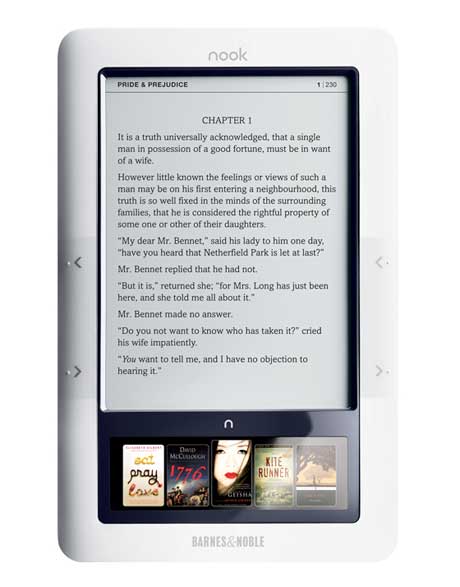
Despite being lumbered with “the worst product name in recorded history”, Barnes & Noble‘s new dual screen e-reader the ‘Nook’ is getting a lot of favourable reviews.
An appallingly kept secret, the Nook was officially unveiled earlier this week and is being widely touted as a ‘Kindle Killer’ (whatever that actually means).
Direct comparisons with Amazon’s e-reader are inevitable of course — especially given the Nook will go on sale for $259, the same price as the Kindle 2. And, if nothing else, US publishers seem relieved that Amazon finally has some serious competition from the country’s largest bookstore chain.
As reported in Publishers Weekly and the New York Times, part of what is attractive to publishers (aside from the simple fact it is not owned by the Amazon) is that the Nook is relatively flexible and supports formats, including ePub. and — perhaps more crucially in the short term — PDFs, that can be read on other devices.
Of course, that B&N has 1,300 stores and already understands books (and the publishers that publish them) doesn’t hurt.
Much is also being made of the Nook’s promising ‘LendMe’ feature, which will let readers share their books (within limits) with others, even though some people aren’t entirely happy about it.
Unsurprisingly, B&N are describing the Nook as “The World’s Most Advanced eBook Reader”, although it is unclear whether the Nook will be available outside the US, which could be problematic in the long run (especially as Amazon and Sony both have global reach). The Guardian Technology Blog does point out, however, that the Nook’s 3G wireless is provided by AT&T, “one of the GSM [Global System for Mobile Communications] providers in the US, so from a technical standpoint, it should be easy to launch the reader internationally.”
But does B&N really have the will or the way to make the Nook available beyond its US home base? And could it do so successfully?
Ultimately perhaps, the real question though is whether there is actually a mass market — either in the US or internationally — for single purpose e-readers. Some smart people clearly think so, but given that non-proprietary formats like ePub can be read on more useful, convenient and competitively priced multi-purpose devices such as laptops and cellphones (and whatever else Apple are currently cooking up), and that books still look like the most robust, simple and elegant format — I’m not so sure…
Comments closed
Poets & Writers magazine have just published the final installment of Jofie Ferrari-Adler’s series of interviews with publishing professionals.
The last interview in this excellent series is with Jonathan Karp, publisher and editor in chief of Hachette‘s remarkably successful Twelve imprint.
Formerly an editor at Random House, Karp founded Twelve with the objective of publishing no more than one book a month. Since their launch, 15 of Twelve’s first 30 books, including Christopher Hitchens’ God Is Not Great and Dave Cullen’s Columbine (pictured above — cover designed by Henry Sene Yee), have been New York Times best-sellers. It’s clearly a successful model, even if it is one that’s hard for start-ups to replicate (how many new imprints could have snapped up the rights to True Compass by Ted Kennedy for example?).
The interview is, of course, well worth reading in full. But here are a few passages about Twelve that stood out for me…
On founding Twelve:
I was thinking, “Okay, I want everything to be the lead title. I want to have at least a month to put it across. And I want to have the best talent. What’s the best way to do that?” It’s to make a promise to the author and to make the promise so explicit that it’s on the spine of the book: Twelve. That’s it. One a month. You get your launch and, although we can’t guarantee that the book’s going to be a best-seller, we can at least guarantee that you will have our full attention, focus, and commitment for a sustained period. We will talk about your book until people will not listen to us anymore.
On acquisitions:
I really am amazed by how often publishers decide to do something because a similar book succeeded. That is flawed reasoning. Books catch on for any number of reasons, and it’s not a mathematical formula that can be reproduced. Even more insidious is the idea that sometimes creeps into acquisition decisions in a really cynical and negative way, where people say, “Well, that nondescript work caught on, so this nondescript work could too.” I just don’t understand why you would want to go down that road. It makes no sense to me. I would think that you would feel as if you were going through your life just imitating other people, doing something you didn’t really believe in. I’m genuinely mystified by that.
On publishing fewer books:
What I do think is that the Twelve model makes a great deal of sense for unknown authors or authors who want to break out. I think that’s true. I think that this is the best way to publish a midlist author or an author who’s on the way up. Let me put it another way: I think it would behoove the major publishing houses to publish fewer books with more focus. I think that everybody would benefit from that. What I don’t know is whether the companies can meet their targets doing it. I’d have to be a CFO to know that, and it would be arrogant of me to say that a major publisher can get by without disposable books. I don’t know the answer to that. What I know is that I’m working for a company that publishes a lot less than the other major publishers with a more concentrated marketing approach and seems to be making a lot of money doing it.
On the “future of publishing”:
I have an idealistic hope that as more and more media becomes disposable, books will be increasingly regarded as the permanent expression of thought and feeling and wisdom. So publishers who can offer definitive material will thrive. Now, as I say, that’s idealistic. Plenty of publishers are going to continue to do well publishing derivative material that they don’t really believe in. But I think it’s going to be harder for them. It’s going to be harder for them to survive. I think there will be some displacement—some houses will shrink and other houses will grow. I could see some pure play digital publishers who aren’t encumbered by the weight of overhead and the history of their business relationships becoming influential factors in the publishing world. So I think it’s a transitional time and a transformative time. But it’s always been that way. I don’t think anything should be regarded as permanent. All we ultimately have is our belief in the particular books. And as long as you have that, you’re fine.
As I say, the whole interview (the whole series in fact) really is worth your time.
3 CommentsAs has been widely, widely reported, Amazon remotely deleted copies of books by George Orwell from their customers’ Kindles last week after a rights issue with the publisher MobileReference.
Even if it was not actually a huge surprise that Amazon had the ability to claw back e-books it had sold (or — to be honest — that someone might publish something that didn’t belong to them on the Kindle), there has been a predictably hysterical reaction, fuelled — at least in part — by antipathy towards DRM and Amazon, and the delicious irony of the particular books involved.
Even Michael Bhaskar, who reignited the online DRM debate last week on The Digitalist by having the audacity to suggest that DRM might not be all bad (twice), is having second thoughts:
When I wrote the piece I was perhaps slightly self consciously swimming against the tide. However all that is made a mockery of when something like this happens – faith in the system is, well, annihilated and the issues of trust that came up are starkly thrown into relief.
Apparently the problem was a rights one and somewhere down the line the wrong books got into the system in the wrong way. Everyone was re-imbursed and the books are widely available. Does this make any difference to the body blow of seeing 1984 automatically deleted from people’s devices?
…Lets just say if this had come out last Monday, I don’t think the blog posts on DRM would have got written.
But — and perhaps I am alone on this — I don’t think this debacle is really about DRM. I actually think it is about a publisher not knowing (or not caring) that Orwell isn’t in the public domain in the Kindle’s primary market, and a vendor — who is unable (or unwilling) to thoroughly vet submissions — making an awful customer service decision and overreacting to rectify an awkward situation (which perhaps they felt they were partially responsible for).
Of course, as Cory Doctorow rightly points out, DRM is a the ‘loaded gun’ that allowed Amazon to kill the books. In the traditional book world this would not have been possible, and it really does bring home some the scariness of ‘remote deletion’. And yet this really came about not because of DRM (the issue could have been resolved without deleting the books) but because of poor judgement (by a publisher and the vendor) and, perhaps, as Paul Biba at Teleread suggests, because Amazon still does not fully understand what they’ve got themselves into.
Comments closedI usually avoid discussions of digital rights management (DRM) as much as possible. It’s a Gordian Knot. We can spend a lot of time and energy painstakingly untangling it, never to find a form of DRM that keeps everyone happy. Or we can end DRM altogether with one bold stroke (“mission accomplished!”) only to discover that cutting the knot takes longer than we expected and is more complicated than we first thought. Either way, my sense is that we will continue to have some kind of hybrid situation — with some e-books ‘protected’ by DRM and some not — as we both cut and untangle all the issues…
And for all that I’m often left wandering if DRM really matters as much as we tend to think it does. Do people outside of our strange intersection of media and technology really care about it as much as we do? Are there other pressing issues that we should direct energy towards? I have this nagging sense that as we agonise over the do-we-don’t-we of DRM, most people just want to read good books.
Nevertheless, the great DRM debate has come to the fore again as a result of Michael Bhaskar’s seemingly mild assertion that DRM Is Not Evil on Pan Macmillan’s The Digitalist blog, which resulted in the (predictable) slew of comments. Michael has now posted a response which has garnered another slew of comments. It’s all worth reading if you can summon the energy and want some insight into the issue (although I don’t think anyone mentions foreign rights, but perhaps some one will get to that yet…)
3 Comments
2009 Penguin Design Award — Peter Adlington’s abstract design for The Secret History by Donna Tart (pictured above) took 1st place. More on the Penguin Blog.
The Good Design Book — Christopher Simmons, graphic designer and principle at the San Francisco-based design firm MINE, records the progress and process of writing and designing his new book on design (via Unbeige). The whole concept reminded me that I should also mention the crowdsourced Smashing Magazine Book.
OK, Go — Kassia Krozser, Kirk Biglione, and Kat Meyer (and an unnamed “veteran of the book industry”), put their money where their collective mouth is, and launch digital publisher Quartet Press (and they’re accepting submissions).
The Debrief — Organizer Hugh McGuire pens his personal thoughts on BookCamp Toronto for Book Oven.
One of the most powerful things about BookCamp, compared with other events I’ve been to, is that this was not just a grassroots group. There was high-level engagement from the publishing industry, with publishers, editors, senior VPs, production managers, marketers, and interns, and everything in between. It was great to see the honest debate and conversation being lead by these insiders, who are truly grappling with the future of their business and their passion.
And VANTAP‘s Sean “Crazy Horse” Cranbury adds his 2 cents on #bcto09 at the Books on The Radio blog, and teases BookCamp Vancouver.
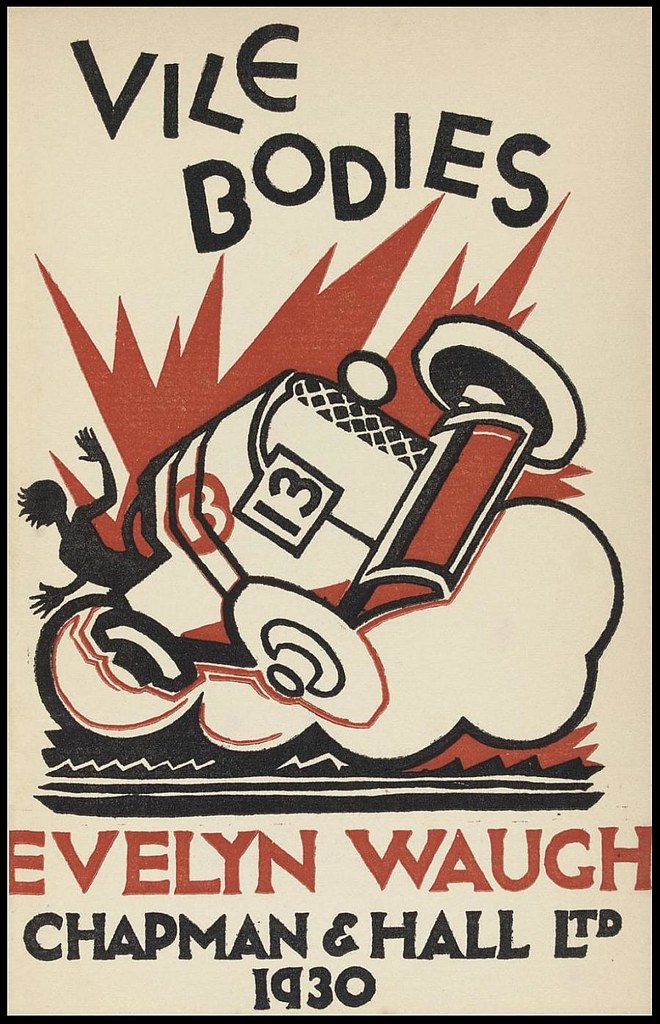
Vile Bodies — The 1930 first edition cover of Evelyn Waugh’s second novel seen at BibliOdyssey.
And last, but not least…
Apples and Oranges — The article about the evolution of Amazon by Adam L. Penenberg, author of the forthcoming Viral Loop: How Social Networks Unleash Revolutionary Business Growth, that launched a great Twitter chat with @FastCompany and yesterday’s ’26 Things…’ list (which could have easily been twice as long).
Oh dear. I’m really not an Amazon-hater. But this morning I inadvisedly took Fast Company magazine to task on Twitter for only writing book industry stories about Amazon and the Kindle.
In their response, Fast Company rightly pointed out that the Fast Talk section of the April edition of the magazine featured technology — aside from the Kindle — that is changing book publishing. It included (short) interviews with Josh Hug, CEO and co-founder of Shelfari (which is in fact owned by Amazon), Julia Cheiffetz, Senior Editor at HarperStudio, the team behind Scholastic’s 39 Clues, Steve Haber developer of the Sony e-reader, and Eileen Gittins, CEO of Blurb.
Funnily enough, I had actually bought April issue of Fast Company and completely forgotten about this (admittedly somewhat forgettable) feature. Suitably chastened, I apologised for my sweeping generalization.
I am grateful (and slightly amazed) that Fast Company took the time to reply to my glib missive and put me straight. However, I do think there is a tendency — not just isolated to Fast Company — to use Amazon as the only frame of reference in stories about the book trade.
With this in mind, I challenged myself to pull together a quick list of current book-related things that I think are exciting that don’t (as far as know) have anything to do with Amazon (yet).
So here is a completely personal, off-the-cuff list of 26 book companies, ideas, projects, blogs, websites and trends that I think are inspiring, interesting, exciting, or worth watching (and are unconnected to Amazon):
(And yes, I realise there is a certain irony in writing a list that’s not about Amazon just to prove not everything has to do with Amazon)
Who or what would be on your list?
*Full disclosure: D+Q are distributed in Canada by Raincoast Books.
3 CommentsAn unforeseen consequence of the “New Think for Old Publishers” debacle at SXSW in earlier this year is that I will be a participant in a session on the role of the publishers in the digital age at Book Camp Toronto on June 6th.
The now infamous SXSW panel was supposed to discuss “what’s going right and what’s going wrong in publishing, assess success of recent forays into marketing digitally, digital publishing, and what books and blogs have to gain from one another.”
As has been well documented elsewhere, things did not go according to plan.
Despite the presence of heavyweight panelists (including the venerable Clay Shirky), new ideas were in short supply. Audience frustration overflowed on to Twitter and an array of 140 character bullets (identified by a #sxswbp hashtag) ripped into the panel, with what was perhaps the kill-shot fired by a writer in the audience:
“If, as an author, I can design it myself, write it myself, publish it myself, why would I bother going to a publisher at all? What purpose do you serve?”*
The old answer to this question was that publishers offered technical expertise and mass distribution.
But, nowadays, digital technology has made it easy for writers to publish, distribute and market their own books independently. And whilst professional editing, design, production, distribution, and marketing may still be valuable and sought-after services, it’s become very apparent that the perceived gap between self-publishing and traditional publishing is narrowing.
The battering that the SXSW panel took inadvertently revealed what we have long-suspected — publishers need to change the way they think about themselves, the decisions they make, and the services they offer, or cease to exist.
One idea that gained some currency in the aftermath of SXSW was that publishers are — or could be — ‘cultural curators’, a role made only more important by the explosion of content created and distributed by digital technology.
In a world where it is impossible to read everything that is emailed, texted, tweeted, posted, uploaded, or printed, there is an opportunity for publishers to become trusted advisers who sift through the vast digital slush-pile and present only the best, most interesting work. Or so the argument goes.
Unfortunately, the truth of the matter is that publishers haven’t proved to be very effective at curating in the past, and it’s precisely this kind of pretension that gets them in trouble at events like SXSW.
A rap sheet of opportunistic publishing, self-indulgence, costly blunders, and generally too much poor product means that publishers (not to mention the mainstream media) have squandered any cultural authority they may once have had, and have been superseded by an informal network of curators connected online.
Furthermore, curation doesn’t really explain what publishers actually do for authors. If it’s just filtering (by set a of cultural criteria I may or may not agree with), why bother going to a publisher at all?
Not long after after SXSW I sat down in Toronto with Book Camp TO organizer Hugh McGuire to discuss these crumbling cultural hierarchies and the implications for publishers.
Expressing my dissatisfaction with the idea of publishers as curators — and trying to take into account Hugh’s reader-centric approach — I suggested that perhaps we’d stand ourselves in better stead if we thought of ourselves more as ‘advocates’.
More proactive than curation, advocacy takes into account that publishers do more than find completed works of art and present them to the public. And it goes at least part way towards explaining what publishers do for authors, whilst offering a model for how they can interact meaningfully (and honestly) with readers.
Perhaps, just as crucially, it also means being able to effectively publish and promote books that we believe in, without making any of the claims of cultural authority or superiority that are attached to curating — the framework of advocacy works whether you are publishing literary fiction or genre, poetry or humour.
Admittedly, there are probably minimal and maximal versions of what ‘publisher as advocate’ means. On the minimal side, publishers promote (and defend if necessary) their books in the public forum. A more maximal version — which is probably where my thinking lies — would not simply limit advocacy to marketing a finished product. It would begin with the commissioning editor championing the work in-house, and continue through the production of the book to the publicist who is pitching it to reviewers, and beyond. It would also mean publishing less and publishing better.
These ideas are not definitive. In fact they’re a rather hurried formation (at the prompting of Sean Cranbury) of a jumble of ideas that I’ve had kicking around my head that need more time, but also more air and more discussion.
The Book Camp Toronto session about the role of publishers is on Saturday June 6th at the University of Toronto’s iSchool. Please come along and share your ideas. If you can’t make it, please feel free to leave your feedback, ideas, and links in the comments section or send me an email or a DM.
Over and Out.
* For the record, this quotation is from panelist Peter Miller‘s account of #sxswbp
1 CommentAmazon launched the new large-screen Kindle DX in the US on Wednesday. The device, apparently aimed at newspaper readers and the textbook market was met with much fanfare in the New York Times (who had leaked the announcement earlier in the week), the Financial Times, Publishers Weekly and elsewhere.
Despite the immediate gadget-lust, the hype was also met with skepticism (and more than certain amount of unlinkable ambivalence). The DX’s $489 price tag, ‘blah’ design, lack of colour and Amazon’s decision to release the new device so soon after launching the Kindle 2 have been common complaints.
But for all these (fixable) flaws, what really nags at me about the Kindle is that whilst I can see what’s in it for Amazon, I just can’t see what’s in it for me the reader. With each launch it seems that readers continue to be secondary to Amazon’s business strategy.
I’m unlikely to buy a Kindle because, all things being equal, I’m always going to choose a paper book over an electronic one. If convenience is the primary concern, then I’m going to read an e-book on the phone I carry in my jacket pocket.
The Kindle DX won’t change my habits either. I already read newspapers on my laptop and I don’t want to carry 2 large devices. If I was a student, I’d want to my textbooks on my laptop too — if only because of the 2 magic words: “copy” and “paste”.
Comments closed