Skip to content

Category: Books

Some Football Literature for the Weekend

Somehow I managed to miss most of the hype leading up to the World Cup, but now that things are about to kick off I’m actually genuinely excited (not least by England vs. The U.S. on Saturday) and have spent the last couple of days catching up. Here are a few literary, typographical, and just plain interesting things that I’ve stumbled across…

Soccer Aid — A typographic poster for the World Cup designed by Treble Seven | 777 in aid of UNICEF.

Simon Kuper, author of Soccernomics, on CBC Radio’s The Current discussing the World Cup.

The very same Simon Kuper reviews four books about the World Cup and African football for The Financial Times:

Great claims are often made for football’s significance. In fact it’s almost always a mirror rather than a gun: it reflects society, rather than changing it. Usually the sport has just one significant effect on real life: it makes people happier. At least, it usually does.

Nation’s Only Soccer Fan Becoming InsufferableThe Onion of course:

According to sources only peripherally aware of the World Cup, Janovich’s infuriating behavior first became apparent during a Super Bowl viewing party last February when he repeatedly used the phrase “American football” to describe the action on the field. In recent weeks, Janovich has also begun referring to the supposed suspense involved in choosing the players for the U.S. “side,” and has struck up several extended but one-sided conversations concerning figures such as “Kaka” and “Ronaldinho,” generally mystifying and alienating everyone he has come into contact with.

Typographic World Cup T-Shirts. Sadly Drogba is already out for the Ivory Coast, but otherwise these are great (via Kottke).

How Did Football Get So Big? — Tim de Lisle at Intelligent Life:

If the hype is extraordinary, so is the ambient presence. The last World Cup was all around us, on billboards, drink cans and cereal packets, on garage forecourts and millions of flag-bearing cars, in the windows of Boots the chemist and McDonald’s the burger joint (“Want tickets? Win tickets! Buy any large meal to play”). The cup-winning captain from 1966, Bobby Moore, was on every KitKat wrapper, despite having died 13 years earlier; his team-mate Geoff Hurst, now Sir Geoff, was appointed director of football for McDonald’s and had columns in two newspapers. The boys of 1966 were bigger in 2006 than they were in 1966.

Footballers as Film Stars — In a related item at the Intelligent Life blog looks at the Nike’s slick World Cup commercial created by Oscar-winning director Alejandro González Iñárritu (Babel):

And finally… A few literary football lists:

And, not to be outdone, here’s a list of 10 football books worth your time (in no particular order) compiled at great haste for The Casual Optimist by my good friend and recovering sportswriter Nick Clifford who is a great source of useless facts about the beautiful game:

  1. Football Against The Enemy by Simon Kuper
  2. Brilliant Orange: The Neurotic Genius of Dutch Football by David Winner
  3. Full Time: The Secret Life of Tony Cascarino by Paul Kimmage
  4. Futebol: The Brazilian Way of Life by Alex Bellos
  5. The Hand of God: The Life of Diego Maradona by Jimmy Burns
  6. Morbo: The Story of Spanish Football by Philip Ball
  7. Calcio: A History of Italian Football by John Foot
  8. Soccer in the Sun and Shadow by Eduardo Galeano
  9. Among the Thugs by Bill Buford
  10. The Ball is Round: A Global History of Soccer by David Goldblatt

(full disclosure: this list has a couple of late additions from me, so if you disagree, it will probably be with my selections — Nick has impeccable taste).

Update: Flavorwire also has a list of 6 books to read during the World Cup.

2 Comments

The Distant Hours

Andersen M Studio, the team behind the amazing stop-frame animation book trailer Going West, have produced another stunning short film using intricate paper cut-outs for Kate Morton‘s new novel The Distant Hours (to be published by Pan Macmillan):

(via Creative Review)

5 Comments

Agents of Change

There’s a great op-ed by Stephen Page, chief executive of Faber & Faber, in today’s Guardian about the iPad and publishing:

It’s clear that publishers must move faster to establish our compelling and useful role in the modern life of reading. While acquiring new expertise, we must assert the best of our traditional strengths; providing capital (in the form of advance payments), offering editorial expertise, and creating a readership by designing, creating, storing, promoting and selling the works of writers. But that’s not enough. Publishers also have to explain what value they are bringing to the relationship between writers and readers, a conversation that is made far more transparent through digital media and digital texts.

Page goes on to list what he sees as guiding principles for publishing going forward. These include retaining print and digital rights, reviewing royalties, flexible pricing, connecting to readers, and excellent metadata. He concludes:

The iPad launch is not the moment, but that’s because the moment has passed. We need to work with authors in new ways, and keep pace with reading’s evolution, or better still become agents of change ourselves.

It’s a must-read. If you work in publishing, send it to your CEO.

1 Comment

Q & A with Peter Mendelsund and Tom McCarthy

In the early days of The Casual Optimist I scribbled out a short list of book designers I wanted to interview. More designers have been added since then, but a few of the original list remain un-interviewed. At the top of the list has been the name I actually wrote down first: Peter Mendelsund.

As Senior Designer at Knopf, Mendelsund’s designs feature here regularly. Much as I love his covers, however, Peter has been interviewed extensively elsewhere. I just haven’t known how to approach his work in a way that he would find interesting.

That was until I saw the shockingly subversive jacket design for Tom McCarthy‘s new novel “C”. The pairing of Mendelsund, the designer who is a musician, and McCarthy, the author who is an artist, was — it seemed to me — inspired.

A perfect opportunity…

What follows is primarily an interview with Peter about that design for “C”. But over the course of a few emails, Peter and I both decided to bring Tom into the conversation. I had met Tom shortly after the release of his debut novel Remainder and Peter had, it transpired, met Tom in New York after Knopf had signed “C”. It made sense to both of us.

It is a long, but absolutely fascinating exchange. Peter kindly answered my questions more fully than I had any right to expect and Tom, who was contributing from Stockholm, was more than gracious in less than ideal circumstances. I’m grateful to them both.

7 Comments

#Failure

It probably hasn’t escaped your notice that following the departure of founder and publisher Bob Miller to Workman Publishing last month, HarperCollins imprint HarperStudio is going to close after just 2 years in business.

As a publisher, HarperStudio garnered a remarkable amount of media attention for offering authors lower advances in exchange for a greater share of profits, their plans to sell book to booksellers on a non-returnable basis, and an early and comprehensive embrace of social media.

There was, however, a general feeling — particularly within the industry itself — that despite (or because of) their marketing-savvy, the imprint didn’t quite live up to the hype (even if not everyone felt quite as strongly about it as Dennis Johnson).

In the end they unable to keep author advances down, or their books non-returnable. Yet, as writer Mark Barrett who blogs at Ditchwalk notes, these problems are hardly unique to HarperStudio and, in a sense, their failure is a collective one for publishing.

Perhaps we simply expected (or hoped for) too much?

Nevertheless, I was disappointed by HarperStudio for the more basic reason that their books always seemed to be less innovative than the company itself. When people talked about HarperStudio it was rarely about what they actually published. The books were — for all their audacious marketing — eminently forgettable. They were kind of things that traditional small-to-medium sized trade publishers have a tendency to churn out with alarming regularity (with perhaps the notable exception of Crush It! for which HarperStudio reputedly paid a rather large advance), and it was never clear to me who their core readership was intended to be. Their innovations seemed to do little to improve the kind of books being the published.

In this sense, HarperStudio’s closure has echoes of Quartet Press.

Like many people, I had unrealistically high expectations for Quartet, and I still admire the fact that the people involved put their money where their mouths were (and mostly still are). But my heart sank when it became clear that for all their innovative plans for e-books, they launched with nothing ready to publish. The eventual announcement that they would be publishing romance fiction meant that, unlike HarperStudio, they at least planned to publish to a recognised (and potentially profitable) niche, but somehow this felt like an afterthought. The digital medium was more important than the message.

I was reminded of all this by Brett Sandusky‘s recent announcement that his project Publishr is soliciting for material to publish:

Publishr is proud to announce a new project: Publishr will bring an eBook, which has yet to be created, to market. We will do this in an atmosphere of complete transparency.

Publishr currently seeks proposals from motivated authors (particularly those with works of unpublished fiction and narrative non-fiction) as well as support from contributors who are interested in innovation and building a superior native-digital eBook product or suite of products that will be sold in the real world.

In many ways this is great idea, and there are definitely lessons to be learnt from this kind of experimentation. But Publishr seems to be following in the footsteps of HarperStudio and Quartet (albeit on a smaller scale). Based on the erroneous belief that there is a large reservoir of quality material that can be easily and quickly tapped, the focus is on revolutionizing how to publish rather than what or who to publish.

There is, of course, wisdom to innovating the process rather than the product. Toyota’s success was built on innovative factories, not innovative and original products (at least until the Prius came along). And yet the Toyota process was geared (again until recently) to producing certain kinds of consistently good, inexpensive cars (which, I would guess, was all the consumer actually cared about).

My point is not that we should not stop experimenting with new author contracts, transparency, formats, trade terms, or marketing — we need to try new things and be allowed to fail. But this should not come at the expense of consistently good, interesting (and inexpensive) books.

Perhaps a model for start-ups is to be found in James Bridle’s modestly immodest print-on-demand publishing effort Bookkake. Although Bookkake is not publishing new material (and who knows whether it is making money), it seems a more sustainable kind of venture, not least because James has published books that he cares about. They have an sense of coherence and quality that one might expect from a successful small press.

Another alternative is demonstrated by Toronto small press ChiZine Publications (CZP) who established a ‘dark genre’ webzine long before they moved into print. Founders Brett Alexander Savory and Sandra Kasturi knew what the kind of stories they liked — “weird, subtle, surreal, disturbing dark fiction and fantasy” — and built a community around it. The books (available in multiple formats) came later.

The CZP story in particular seems to be the polar opposite of HarperStudio, Quartet, and Publishr. CZP was launched because they had stories they wanted to publish, not because they wanted to ‘fix’ the system. I’m not saying that improving the process isn’t important, it’s just that we need to find new, interesting, consistently good content as wellmeaningful stuff that matters (if only to us). If we don’t, the new books will just be glowing versions of the old books (with better PR)… Plus ça change…

8 Comments

Doctorow at Bloomsbury

Whether you agree with him or not, this is an interesting — if scatter-gun — talk by Cory Doctorow on publishing, e-books, pricing, and DRM (and more) at UK publisher Bloomsbury:

There are some additional notes (and a couple of corrections!) at Cory Doctorow’s website.

(via Ted Striphas’ The Late Age of Print)

1 Comment

Educate or “Educate”?

I had an interesting discussion with author Jim Hanas (@jimhanas) on Twitter today about customers and education. It started with Jim’s comment (re-tweeted by Director of Digital Initiatives for Chelsea Green Publishing, Kate Rados / @KateRados):

“When you start trying to ‘educate’ your customers, it’s the beginning of the end for any industry.”

I disagreed, and said so. I believe education informs and liberates. Rarely is it a negative thing in life or business.

But as it turned out, in this context ‘educate’ meant something different to Jim than it did to me. For Jim, it was a sinister euphemism for scold, blame, bully, and punish. ‘Education’ was “code for ‘litigation.'”

If I understood him correctly, Jim was saying that to ‘educate’ our customers would be to repeat the mistakes of the music industry.

Needless to say, I don’t want to see publishers suing school children. For me, though, ‘educate’ means to inform, communicate, and engage — all things  publishers should do and not just with their books. To educate means, for example, an editor talking about a new acquisition, a production manager explaining why they used FSC approved paper, or a designer explaining how to use their tools.

Until now, we have assumed that nobody cared about this stuff. But the web has showed us that it can be endlessly fascinating, and, perhaps more pertinently, that an unwillingness to explain what we do ourselves creates a vacuum that will be filled by others who either have something to gain or who find our lack of transparency and engagement frustrating (looking at you Hugh McGuire!).

Ultimately, then, I don’t think Jim and I were in true disagreement. We just understood a word differently. Perhaps the lesson is that publishers need to educate, not “educate”?

4 Comments

The Discussion That Will Not Die!

Tales from the Crypt Bronte

Now the dust has almost settled on the Amazon-Macmillan dispute, John Sargent, CEO of Macmillan, laid out their new position on availability, pricing and the (much discussed) agency model yesterday:

We will price our e-books at a wide variety of prices. In the ink-on-paper world we publish new books in different formats (hardcover, trade paperback, and mass market paperback) at prices that generally range from $35.00 to $5.99. In the digital world we will price each book individually as we do today… For physical books, the majority of new release hardcovers are published in cheaper paperback versions over time. We will mirror this price reduction in the digital world.

This follows hot on the heels Motoko Rich’s second stab at explaining the issues around pricing for The New York Times (her previous — fairly woeful — attempt is here):

Publishers argue that it would be difficult to sustain a vibrant business on much lower prices. Margins would be squeezed, and it would become more difficult to nurture new authors…“You’re less apt to take a chance on an important first novel if you don’t have the profit margin on the volume of the big books,” said Lindy Hess, director of the Columbia Publishing Course, a program that trains young aspirants for jobs in the publishing industry. “The truth about this business is that, with rare exceptions, nobody makes a great deal of money.”

This echoes similar points made by Lydia Dishman’s in an earlier article, “The Case Against Dirt-Cheap E-Books”, at BNET:

If massive sales are the only aim, content is devalued to the point of creating digital pulp. Maybe no one old enough to remember real pulp fiction (not the Tarantino film) is reading this, but the only thing that lives on from that era are histories of the pulp fiction genre, not the actual books, which by definition were cheaply produced and contained even “cheaper” content. Pulp’s inherently ephemeral — not exactly a stable foundation for a new business model.

Pricing seems to be the issue that just will not go away right now, and none of the points raised here are new. But I guess the upside is that there is now some more informed discussion going on and publishers are beginning to take it seriously. That, and John Sargent giving other CEO’s a free lesson in communications and transparency.

(Image from R. Sikoryak‘s Masterpiece Comics published by Drawn & Quarterly)

2 Comments

The Silver Lining Top 5

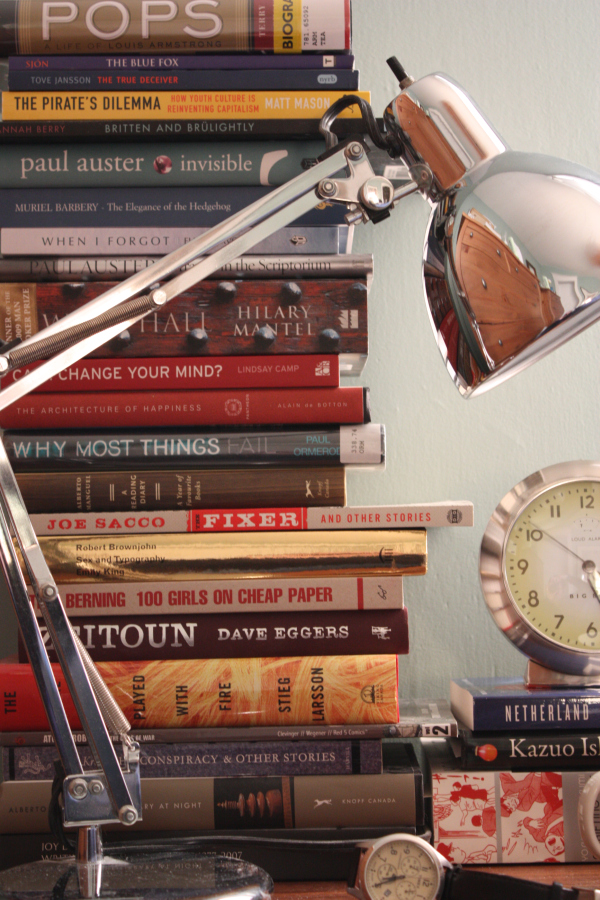
The nice folks at The Silver Lining blog — consistently one of my favourite blogs for vintage design goodness — were kind enough to ask me for a contribution to their ‘Top 5’ feature last month, and so, as of today, the top 5 books beside my bed are online for everyone to see.

The Top 5 are:

  1. Pops: A Life of Louis Armstrong by Terry Teachout
  2. The True Deceiver by Tove Jansson
  3. The Blue Fox by Sjón
  4. Britten and Brülightly by Hannah Berry
  5. The Pirate’s Dilemma: How Youth Culture Reinvented Capitalism by Matt Mason

I actually just finished reading Pops at the weekend, but there is no guarantee that I will read the rest in that order — the list really is just a happy accident of stacking. You you can read more about each of the selections in the post at The Silver Lining.

Comments closed

The Peanut Gallery

Having written a couple of things this week about what publishers should be doing, Don Linn has a timely post at his blog Bait ‘n’ Beer on exactly why such thoughts are usually wide of the mark:

[N]ot all publishers are the same. While there are some commonalities among the hundreds of publishers, there are major differences between trade, academic, educational, reference and other types of publishers and even within those broad categories, there are major differences (even within the same house) between fiction and nonfiction, text and illustrated, genre and general fiction, children’s, YA and adult titles. And I’ve only named a few… The point is it’s dangerous to take individual examples and generalize them to an entire, very diverse industry.

He goes on remind readers that talk is always cheap:

[P]ublishers don’t do everything critics think they should [because] not many publishers are rolling in cash at the moment. I can’t name a single publisher who wouldn’t want to spend more on investments in marketing, quality, workflow improvement and editorial, but the money’s just not there. So we need to temper our expectations with a dose of financial reality.

It’s a great post. And worth reading every time you think a publisher should be doing something they aren’t.

(link)

Comments closed

Workflow Part 2

One of the ‘joys’ of not getting quite enough sleep at night is that you don’t always say things with the kind of nuance that you might intend. Sometimes the coffee speaks for you.

Unfortunately that happened yesterday with my post about production, which was taken in some quarters as a damning indictment of publishers, rather than a post about some of the problems we face creating decent e-books. Coffee 1, Optimist 0.

Anyway, after I published the post, I was chatting with a friend and colleague at one of the big publishers about their production process. She told me that although they have been converting PDF files into e-books, they are moving towards changing their workflow. This can’t happen overnight though, she said. Changing something that complicated takes time, especially when people have to learn new skills.

She also reminded me that we have to put things into context. Publishers are not the hold-outs they are often portrayed as (or at least not all of them are) — e-books are still only a small part of the overall business, and even though we’ve seen a rapid growth in the market, it is not the same for every genre, category, or publisher. New devices (with different standards) are also appearing on the market with alarming regularity.

None of which means that publishers should sit on their hands of course. But — as my friend rightly pointed out — this a process not “a flip a switch situation.”

10 Comments

Workflow in the House

As I’ve mentioned in the past, many publishers have tended to treat e-books as shovelware, and (unsurprisingly) the hasty conversion of files intended for print into e-book editions — with little or no consideration for the medium — has meant the quality of e-books has suffered.

Needless to say, poor quality e-books are becoming something of an embarrassment for publishers trying to convince readers to pay a premium for downloads (as Kassia Kroszer recently pointed out in Publishing Perspectives: it is hard to justify higher e-book prices when the product simply isn’t up to scratch), and clearly it’s an issue publishers need to address sooner rather than later if they want win this argument.

The problem of substandard e-books partially stems from the fact that many publishers currently lack the means and expertise (and, to some extent, the will) to produce high quality e-book editions themselves. Their workflow and production process are set up for print, so the quickest way to create e-book files has been to outsource the job to third parties, inevitably with very little quality control.

This was the subject of an interesting (if somewhat snarky) post this week by Pablo Defendini, producer and blogger at Tor.com, at The New Sleekness:

[B]ig publishers outsource a large part of these services… They’ve found that cutting out expensive production departments and hiring out the services of middlepeople, who also handle distribution and sometimes even retail fulfillment, saves on people power (read: health insurance and pensions), hassle, and extra load on their IT departments. Well, guess what one of the cardinal rules of the digital revolution is: digital production eliminates the need for most middlepeople. Bring this all back in-house, make it a lean operation. Settle on nothing less than a standards-compliant workflow, but please, build it from the ground up, as opposed to tacking it onto your existing production setup as an afterthought.

Pablo is picking a crowd-pleasing soft target in the “big publishers” — many (most even?) small and medium size publishers (the notable exception being O’Reilly of course) are also outsourcing their e-book production — but he does make some really important points about the need to learn new skills, rethink workflow and (ideally) bring e-book production in-house.

The comments are also worth reading but, — if like me — you are just beginning to get your head around this stuff, definitely work your way through the Digital Book World presentation by Liza Daly, of Threepress Consulting, referenced in the article:

25 Comments