
With A.A. Knopf FINALLY publishing his novel The Snowman in the US this May, Norwegian author Jo Nesbø discusses his earlier Harry Hole novel The Redbreast with the BBC World Service Book Club:
1 CommentBooks, Design and Culture
With A.A. Knopf FINALLY publishing his novel The Snowman in the US this May, Norwegian author Jo Nesbø discusses his earlier Harry Hole novel The Redbreast with the BBC World Service Book Club:
1 Comment
The Swedish author Henning Mankell talks to NPR New’s Morning Edition about the 11th and possibly last Wallander novel The Troubled Man:
“Maybe I’m a little old-fashioned. In the times where everyone is talking about how everything is a process, I am keen on dots … you call them a period. I believe in periods. I really thought that now is the ending, to make the final period in the stories of Wallander.”
NPR NEWS MORNING EDITION: HENNING MANKELL
Comments closed
Author Sarah Bakewell talks about How To Live: Or, A Life of Montaigne in One Question and Twenty Attempts at an Answer with Ramona Koval for ABC RN’s The Book Show:
THE BOOK SHOW: HOW TO LIVE, A LIFE OF MONTAIGNE
Comments closed Literary editor Lev Grossman (author of The Magicians) discusses why Time put Jonathan Franzen on the front cover the magazine of with Ramona Koval on ABC Radio National’s The Book Show:
ABC RADIO NATIONAL THE BOOK SHOW: LEV GROSSMAN
Comments closed
Anthony Gottlieb writes on the renewed interest in 16th Century French essayist Michel de Montaigne for The New York Times:
Like Socrates, Montaigne claims that what he knows best is the fact that he does not know anything much. To undermine common beliefs and attitudes, Montaigne draws on tales of other times and places, on his own observations and on a barrage of arguments in the ancient Pyrrhonian skeptical tradition, which encouraged the suspension of judgment as a middle way between dogmatic assertion and equally dogmatic denial. Montaigne does often state his considered view, but rarely without suggesting, explicitly or otherwise, that maybe he is wrong. In this regard, his writing is far removed from that of the most popular bloggers and columnists, who are usually sure that they are right.
And, funnily enough, Sarah Bakewell author of How To Live: Or, A Life of Montaigne in One Question and Twenty Attempts at an Answer — one of the books mentioned by Gottlieb — recently spoke to Eleanor Wachtel about Montaigne for CBC Radio’s Writers & Company:
CBC RADIO WRITERS & Co. WITH SARAH BAKEWELL
The cover of the US edition of How To Live, published by Other Press, is by Mr. John Gall (pictured above). But you knew that already of course….
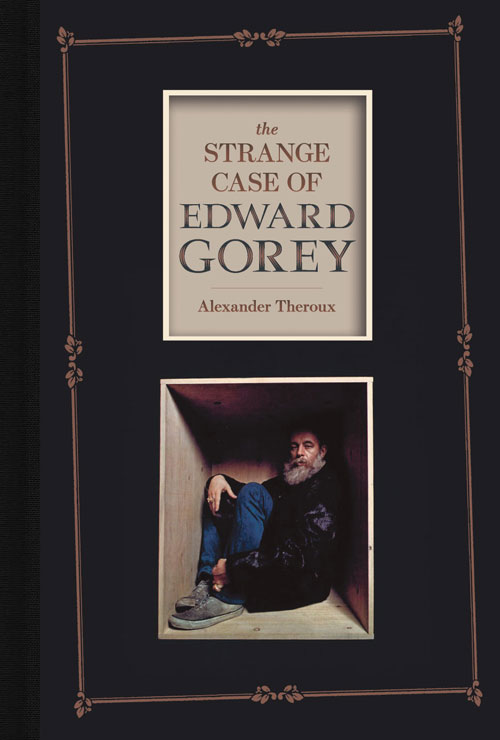
Alexander Theroux, author of The Strange Case of Edward Gorey (recently revised and republished by Fantagraphics), talks to NPR’s Weekend Edition Sunday about the writer and illustrator Edward Gorey, who would have been 86 years old today:
Violence is the essential Gorey ingredient. It is used in his books with such off-hand wit and inevitability that, having become his signature, if it were suddenly missing, you would begin to worry or at least feel you are being fobbed off by work not of the master’s hand.
NPR THE WEEKEND EDITION: THE LIFE OF EDWARD GOREY
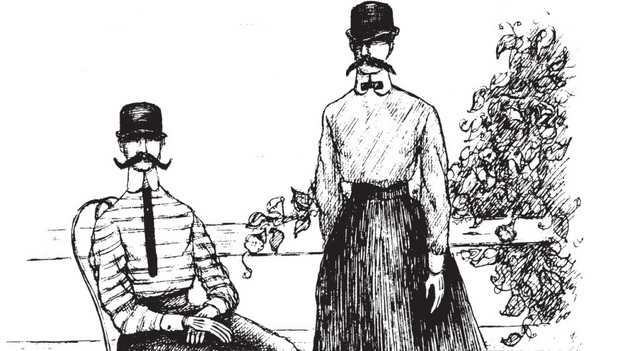
Theroux also talks about his peculiar friend with Tom Spurgeon at The Comics Reporter:
Comments closedI was telling someone the other day, there a division in the 20s and post WWI era, especially growing up in England. I think Gorey inherited this. There were the athletes, the muscular types — on one side of the tennis court, as it were. Then there were these kind of fey, bright young things on the other side of the tennis court. There has always been a kind of mocking, derisive look that they took regarding each other. I think Gorey grew out of that kind of gay interest, that fascination with ’20s movies, ’20s styles; there’s a tradition, I think. He was unhappy in the military and when he was at Harvard he was always in an artsy world. He went to the ballet every night in New York. He was almost a caricature of that Ronald Firbank type of character. He was very fey. He didn’t hide any of that.

The Hare with Amber Eyes: A Hidden Inheritance, Edmund de Waal’s memoir about his extraordinary Jewish family and an inherited collection of ornamental Japanese carvings called netsuke, was on many of last year’s “best-of” lists and is high on my current ‘to-read’ list. The author talks about the book with Eleanor Wachtel on CBC Radio’s Writers & Company:
CBC Radio Writer’s & Co: Edmund de Waal Mp3
Edmund de Waal, who is also a successful ceramicist, is also profiled in The Guardian:
Comments closedDe Waal and his netsuke have been much discussed over the past seven or eight months, but even now he is “completely taken aback” by the success of a book which is an “odd matrix of personal obsessions”. (We talk in the upstairs room of his south London studio – downstairs are three kilns, his wheel and a bag of clay, ready for him to get to work in the afternoon.) Yet that it is so personal and springs from these obsessions (Japan, objects, memory), drawing on his expertise as a potter, is surely a clue to its enormous appeal. How things are made and handled, he writes, and what happens to them “has been central to my life for more than 30 years”.

An interesting interview with John B. Thompson, author of Merchants of Culture: The Publishing Business in the Twenty-First Century, at Beyond the Book:
[R]eaders are going to be faced with a growing proliferation of possibilities in terms of the ways that they read and consume the written word, and people will make different choices about that. I think what we will see is some readers will migrate effortlessly into an electronic environment and will welcome the emergence of a variety of different ways to read texts online or in dedicated e-book readers or on iPads or other forms of device that will enable them to read in different ways and different contexts… Others will find it less attractive and will continue to value some aspects of the printed book that are important to them, because for many readers, books are not just reading devices. Books are cultural artifacts. They are social objects. They are indeed forms of art, which they like to own and possess and to put on a shelf and display and to share with others and to return to time and again and read on various occasions in the future. And they will continue to cherish that physical objective character of the printed book. And so, some will not choose to read in an online or an electronic form, because for them, the book matters as an object.
Beyond the Book John B. Thompson Mp3
(via MobyLives)
2 Comments