Skip to content

Tag: robert rauschenberg

Robert Rauschenberg and the Subversive Language of Junk

Rauschenberg’s ‘muse wall’, a collection of objects and images that inspired him, in his print shop, Captiva, Florida, around 1979. Photograph: Emil Fray/Robert Rauschenberg Foundation

With a major Robert Rauschenberg retrospective opening at Tate Modern in December, Alex Needham, writing for The Guardian, visits the late artist’s island home of Captiva, Florida:

Rauschenberg started visiting in 1962, before moving to Captiva nine years later, describing it as “the foundation of my life and my work… the source and reserve of my energies”. His work by then had become ambitious and complicated; Captiva forced a return to simplicity, and the first things he produced were a selection of wall sculptures made from battered cardboard boxes.

For the world beyond Captiva’s white sands, however, a reacquaintance with Robert Rauschenberg is long overdue. In Britain, there has been no major retrospective of his work since 1981, while the last big US survey, at the Guggenheim in New York, took place in 1997. That will change next month, when Tate Modern opens a London retrospective; it will then move to Moma in New York next May, and after that to the San Francisco Museum of Modern Art.

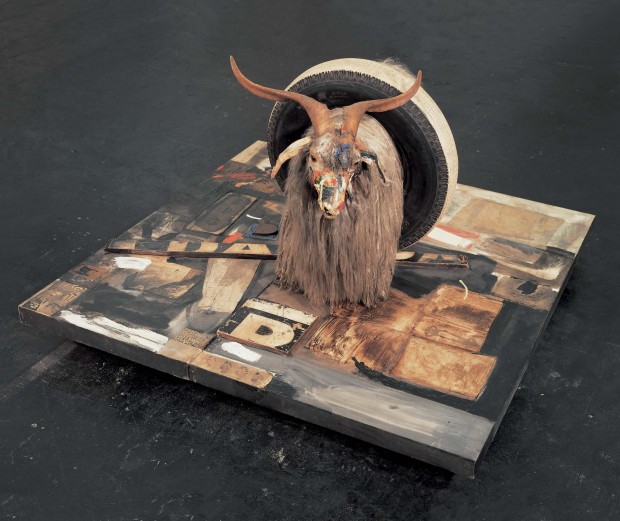
Rauschenberg left a bold and indelible mark on the 20th century. His combines, which integrated the flotsam and trash of everyday life, including the artist’s own duvet in Bed (1955), were neither painting nor sculpture, and proved that anything could be the material of art. At Tate Modern, pride of place will be given to Monogram 1955–59, a horizontal canvas on which perches a stuffed goat with a tyre around its midriff; the work thrilled and scandalised when it was first shown at Castelli’s gallery in New York, and rapidly became synonymous with the artist’s iconoclasm. Since then, his relevance has only increased, says Leah Dickerman, co-curator of the new retrospective: “When you open a gallery and see the art that’s made out of the stuff of the real world, that’s coming off the walls, that’s interdisciplinary in its approach, all that is the legacy of Rauschenberg.”


Detail from Rauschenberg’s Mirthday Man (1997)

Also at writing for The Guardian, Olivia Laing, author of The Lonely City and The Trip to Echo Spring, looks back over Rauschenberg’s career:    

Making the combines, Rauschenberg felt he was cracking “the secret language of junk”. They could be composed of anything: a goat corseted by a tire; a stuffed bald eagle. One of the very first, Untitled (Man with White Shoes), contained – deep breath – fabric, newspaper, a photograph of Jasper Johns, a handwritten letter from Rauschenberg’s son, a drawing by Twombly, glass, mirror, tin, cork, a pair of the artist’s socks and painted leather shoes, dried grass and a taxidermied Plymouth Rock hen.

All the same, there’s a limit to how much world you can cram into a sculpture, and as Rauschenberg’s success grew he became increasingly fascinated by replication. Back in 1952, he’d experimented with transfer drawing, and in 1958 he embarked on a grand project of illustrating Dante’s Inferno using lighter fluid to transfer images on to paper. In 1962, Andy Warhol introduced him to a far more sophisticated technique: the wizardry of using photographic images on silkscreen canvases.

Now he could reuse and resize his own photos and those he snipped from newspapers and magazines, giving him an unprecedented power of composition. Anything could be incorporated: John F Kennedy; a water tower; Bonnie and Clyde. As he gleefully observed of the silkscreen paintings: “It’s as much like Christmas to me as using objects I pick up on the street.” He was giddy for them, until in 1964 he was awarded the Golden Lion at the Venice Biennale. Terrified of stasis, the next day he called his New York studio and asked his assistant to burn all the screens.

See also: Hal Foster on Rauschenberg retrospective for the London Review of Books,  

Comments closed
Robert Hughes on Robert Rauschenberg

9781400044450

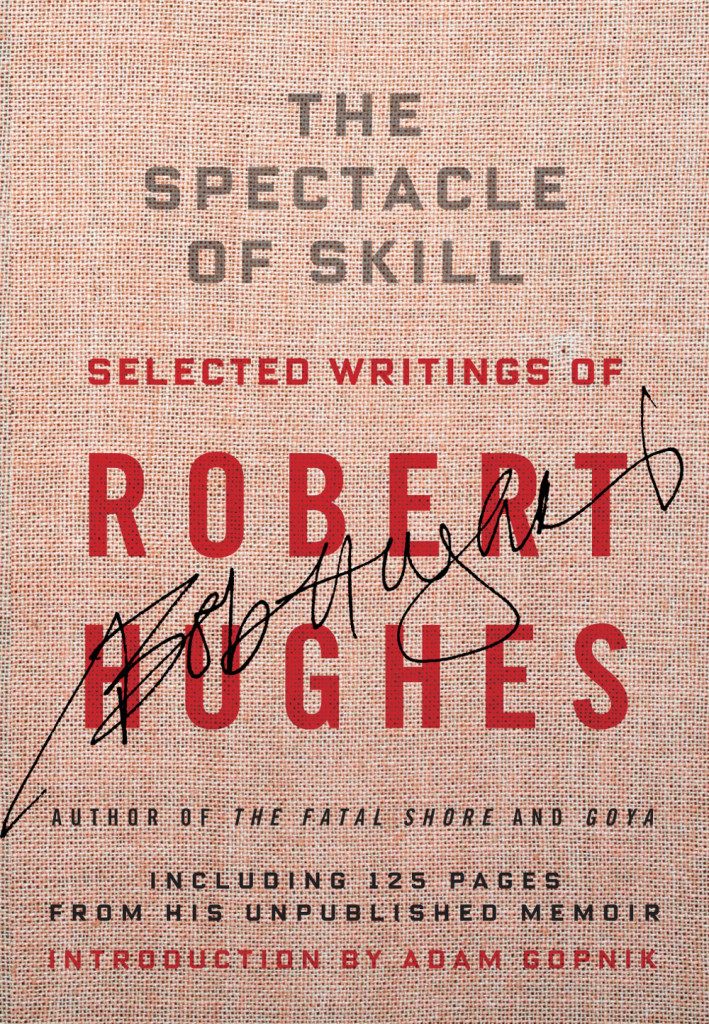
The New York Review Books has an excerpt from the late Robert Hughes’s unfinished memoir — to be published for the first time this month by Knopf in The Spectacle of Skill: Selected Writings of Robert Hughes — on artist Robert Rauschenberg:

Rauschenberg’s references to other media aren’t just tricks. They’re an integral part of the way he connects the language of his images to that of a wider world. Collagists had always done this, ever since the invention of collage. Braque and Picasso brought newspaper clippings and headlines into their images, though these had to be scaled to the actual size of the printed page—you couldn’t effectively do a cubist collage six feet high, it would need too many elements.

The same was true of Kurt Schwitters, with his bus tickets and cigarette wrappers and bits of wood or rusty iron. But around 1962, Rauschenberg began to use not things but the images of things. He gathered photos and enlarged them into silk screens, so that they could be printed directly on the canvas. This had two main effects. First, it enormously increased his image bank, because just about everything in the world, from mountains to beetles, from spermatozoa to Thor-Agena rockets, has been photographed. And second, by reusing silk-screened images from one painting to the next, it let him use repetition and counterpoint across a series of works in a way that wasn’t possible, or not easily possible, if he had been using things themselves. In doing this, he was adapting to the great central fact of American communication, its takeover by the imagery of television.

Comments closed

The Endless Combinations of Robert Rauschenberg

Monogram, Robert Rauschenberg (1955–59)

At the New York Times, Dan Chiasson visits the archive of the late Robert Rauschenberg, currently housed in a high-security warehouse in Westchester, N.Y.. Unsurprisingly, perhaps, it looks “a little like a cross between Charles Foster Kane’s Xanadu and a suburban Lowe’s”:

A source material, for Rauschenberg, could have been almost anything. Among the most prolific and consistently surprising American artists, he worked for over 50 years in a variety of media from feathers, stuffed goats, socks and neckties to cardboard, grass and scrap metal, in genres including choreography, costume design, photography, printmaking and painting. He is most famous for the “combine,” a form he more or less invented that merged three-dimensional collages with sculpture, sometimes with the batty ingenuity of a Rube Goldberg. Few works capture so arrestingly the process that brought them into being: In a finished Rauschenberg, you see a goat, a tire, a tennis ball, but more than that, you see the insights that brought them together. Each component keeps its integrity within a composition in which everything contributes to a profound effect of overall beauty. Indeed, few artists of his era so unabashedly strove for beauty, even majesty: The logic of his work, beginning with cast-offs and flotsam, demanded it. It was the dare he put to himself in everything he made.

Comments closed

Midweek Miscellany

Tell Me a Story From Before I Can Remember — A silkscreen poster of an ideal bookshelf of 100 books designed by Athens-based design studio KEIK Bureau.

Going Back to Bed — Jonathan Jones on the art of Robert Rauschenberg, for The Guardian:

Bed belongs to what is arguably the greatest series of works of art ever made in America. It is said to have been Johns who came up with the word “combines” to describe the works Rauschenberg started to assemble in 1954, putting together found photographs, newspaper clippings, fabrics, furniture, tyres and stuffed animals in intense configuations, all soaked and veiled in abstract expressionist paint. Thinking about them, I find myself struggling to find any match for what Rauschenberg achieved, not just in visual art, but in other arts, such as fiction. For what he created in these complex, tantalising, epic works was that elusive cultural totem, the “great American novel”.

Airstrip 1 — David Aaronovitch on George Orwell’s vision of a totalitarian future, for the BBC Magazine:

I was brought up in a house full of books, none of them by George Orwell.

Simone de Beauvoir was there, as was Sartre and Aldous Huxley and even Lenin. The last is actually a clue as to the absence of the first.

My parents were Communists. To them Orwell was on the other side of politics – someone whose principal writings were hostile to them and what they wanted to achieve….

Comments closed