Skip to content

Tag: pj harvey

Something for the Weekend

Issue #56 — Jessica Abel and Matt Madden discuss the latest volume of The Best American Comics at Comic Book Resources:

The problem with superheroes is it’s not a personal taste so much as it just requires so much insider knowledge to read these things. They don’t stand on their own. There have been about three superhero comics, maybe two, in the past five years that stand on their own. That you can just read and not have to know what happened in issue #56 and ever since. It’s a real problem, I think, and it’s a problem for the industry. How do you get into this stuff if you’re not into it already?

The Highs and Lows — Steven Heller, author of bazillion books on design, profiled in the Village Voice:

“The worst design writer is one who doesn’t tell a story,” Heller tells his students. “Facts are nice, but it’d be better to have the facts telling you some tale of highs, lows, and woes.”

Remaining Solvent — Bert Archer interviews Brooke Gladstone, author of The Influencing Machine, for the Toronto Standard:

“I see new structures already emerging, we are in the midst of a big, big change; it’s so obvious it’s pathetic to even say. We have to form new business models, modulate the ones that are already there; we need to acknowledge the role of the news consumer in the creation of news now, and acknowledge… that the precepts and principles that dominated during the time of television and mass media are beginning to disintegrate and fall back to the precepts and principles that guided journalism back when it was not a mass medium, back when you didn’t need to amass audiences at unprecedented size in order to remain solvent.”

Antisocial Behaviour — Gary Shteyngart on his novel Super Sad True Love Story and the effects of social media:

I know professors who can’t read an entire book–professors of English literature, mind you. So everyone’s attention span has been shot. We’re no longer used to processing long strings of information. When a book is no longer a book but yet another text file, it’s very hard to say, “OK, I’m gonna devote myself to the 300 pages of text on my screen” when I have all this other stuff that I need to do.

That’s why channels like HBO and Showtime have taken over to a big extent. The kind of stuff that used to appear in novel form now appears in “The Wire” or “Breaking Bad.” They deliver the narrative thrust that we need. They teach us about different worlds and different ways of living. But at the same time, they don’t require textual immersion. You just passively sit there and let these things happen on the screen.

And finally…

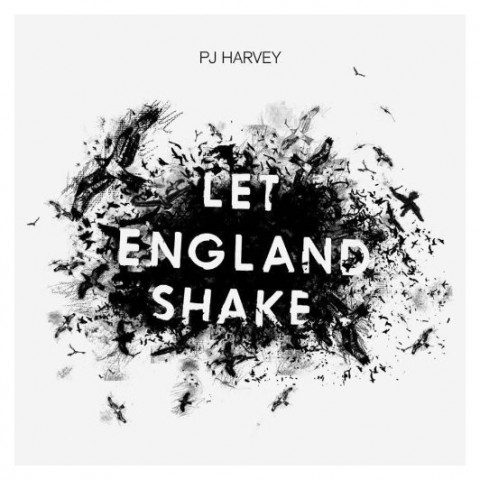
PJ Harvey on writing her award-winning album Let England Shake at GQ Magazine:

As I was doing my research to write this record I realized quite quickly I needed to gather a lot of historical information in order to understand more about our current-day wars, in Afghanistan and Iraq, for example. So I started going through my history books and became so interested in the Gallipoli campaign. It really resonated in me. I felt like I could relate it in a way to some of our contemporary wars and I learned a lot by looking at it, but also just the sheer scale of the mismanagement of that campaign and the scale of the loss of life affected me very deeply. And I really wanted to write about it.

I have played Let England Shake a lot this fall.

Comments closed
Midweek Miscellany

Designer Catherine Casalino discusses her cover design for Darren Shan’s Procession of the Dead at Faceout Books.

50 / 50 — An interesting Design Observer piece by Ernest Beck on the controversy around AIGA’s 50 Books/50 Covers and the changing roles of book designers:

“The design aspect hasn’t changed, but it will,” notes [Chris] Sergio, who like other book designers believes that books and covers will endure in both print and electronic versions. “Digital versus print is a zero-sum argument,” he says. “These roads are not mutually exclusive. If anything, we want to see more competition and more critical exploration [of book design]. That’s why it would have been a shame to blend it all down into one big thing.”

Paula Scher, a partner at Pentagram Design, agrees that book design — in whatever form — is important because people still relate to visual imagery. “It’s the emotional connection,” she says. “People still remember record covers although nobody has records anymore.” Book jackets matter, whether they are on a piece of paper or in an electronic version, she continues “because when none of it matters because it’s digital or nobody does it or it doesn’t save the planet, then we murder our own craft and give excuses to be mediocre and lower standards bit by bit.”

Indelible Replicas — Author Philip Ball (Unnatural: The Heretical Idea of Making People) reviews The Information by James Gleick for The Observer:

Robert Burton, the Oxford anatomist of melancholy, confessed in 1621 that he was drowning in books, pamphlets, news and opinions. All the twittering and tweeting today, the blogs and wikis and apparent determination to archive even the most ephemeral and trivial thought has, as James Gleick observes in this magisterial survey, something of the Borgesian about it. Nothing is forgotten; the world imprints itself on the informatosphere at a scale approaching 1:1, each moment of reality creating an indelible replica.

Also in The Observer

P. J. Harvey on writing and her new album Let England Shake (via A Piece of Monologue):

“I certainly feel like I’m getting somewhere that I wanted to get to as a writer of words. I wanted to get better, I wanted to be more coherent, I wanted there to be a greater strength and depth emotionally, and all these things require work – to hone something, to get rid of any superfluous language. I’m inspired by the other great writers I go back to and read again and again, and think how did they do that?”

Such as? She indicates a volume of Harold Pinter’s poetry that she has brought with her. “Pinter leaves me speechless. Just unbelievable. A poem like ‘American Football’ or ‘The Disappeared’. TS Eliot of course. Ted Hughes. WB Yeats. James Joyce.” She leans forward, freshly excited. “Just that feeling of reading something profound and having your breath quite literally taken away by the end of a piece. I’m reading John Burnside’s poems at the moment. Do you know his work? I’m getting that feeling – just reaching the end of every poem, going ‘Oh my God!'” She clutches her chest and laughs. “And all of these writers offer me a greater understanding of what it is to be alive, and that is such an incredible thing art can do for other people. It made me want to try and get close to this strange, mysterious thing that people can do with words.”

And finally…

The Local Grammar Nazi — Robert Lane Greene, author of You Are What You Speak, on the fluidity of language:

It’s certainly easier to know one set of rigid rules than to develop a fingertip-feel for the nuances of syntax, word choice and mechanics. This is why the book “Elements of Style” is such a hit. William Strunk and E.B. White’s canonised system for language use is short and sharply worded. Read, memorise and you need never think again… Readers are taught any number of things, such as when to use “that” instead of “which” and how one should never begin a sentence with “However, …”. But such guidelines should be understood as the authors’ preferences, not grammatical commandments.

Writing in English offers far more room for manoeuvre than some may realise… A lot of people don’t like this fluidity. Life is tricky in a world without rules. Fortunately, language does have rules, but they are more like bedrock principles than a detailed set of by-laws covering every do and don’t. A good usage dictionary should explain the principles, not simply command.

Comments closed