Skip to content

Tag: moebius

Something for the Weekend

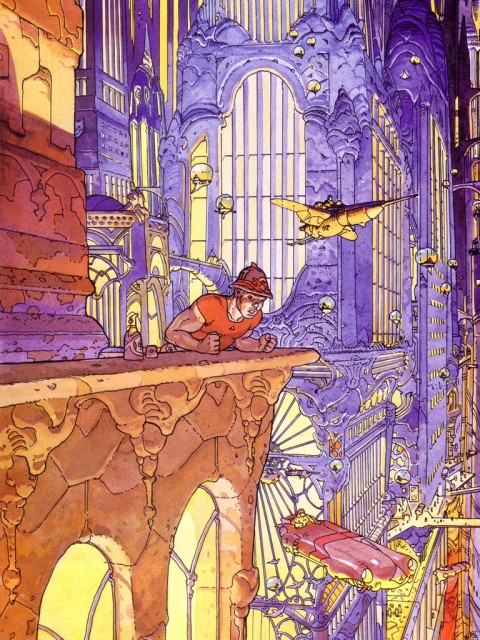
Tim Maughan on the influence of  the Jean Giraud on science fiction for Tor.com:

[The] combination of neon-lit noir streets, cramped towering city blocks, airborne traffic jams and scruffy characters seems almost a cliche today. But this was the first time anything like this had been drawn; and the first time science fiction had embraced the visual chaos of realistic urban environments. And the groundbreaking work is not just there in the architecture and mechanical designs; it’s apparent in the fashions and clothes of the city’s inhabitants. Although fantastic, exaggerated and other-worldy the city of The Long Tomorrow comes alive from the page because it feels so real, so layered and built — it is the urban paradise and nightmare of every industrial city from Tokyo to London.

The Catharsis of Exhaustion — Tim Parks on when to finish a book for the NYRB:

Other writers deploy what I would call a catharsis of exhaustion: their books present themselves as rich and extremely taxing experiences that simply come to an end at some point where writer, reader and indeed characters, all feel they’ve had enough… [These] writers it seems to me, by suggesting that beyond a certain point a book might end anywhere, legitimize the notion that the reader may choose for him or herself, without detracting anything from the experience, where to bow out.

Detachment — Edward St. Aubyn, Patrick Melrose Novels and At Last, profiled in the New York Times:

 “[There] is something morally condescending about forgiveness… Detachment is what interests me, seeing how people couldn’t have been any other way, how they were the product of forces that they had no control over… I was in the downstream of my father’s unhappiness, but it must have been hell to be him.”

And finally…

The Beat Hotel — A new documentary about the cheap no-name hotel at 9 rue Git le Coeur in Paris that harboured the likes of Allen Ginsberg and William Burroughs:

1 Comment
Midweek Miscellany

Obituary for artist Jean Giraud, AKA Moebius, in The Guardian:

Giraud… had an impact on the visual arts that went beyond comics. He was seen as a figurehead linking bandes dessinées with modernism and nouveau réalisme. As the co-creator of Métal Hurlant magazine, he took comics to an older, more literate audience. In cinema, his fans ranged from Federico Fellini to Hayao Miyazaki and his style influenced dozens of others, including Ridley Scott, George Lucas, James Cameron and Luc Besson.

Tom Spurgeon also has an in-depth obituary at The Comics Reporter:

Giraud would… describe the revolution driven by his work and others as one of creative choice rather than content, that the feeling of the artist inhabiting the work was more important than the kind of work being done. He drew a connection to the undergrounds and cartoonists like Robert Crumb, although he felt that the work of he and his peers existed in an entirely different cultural context.

See also: The comics industry remembers Moebius at Robot 6.

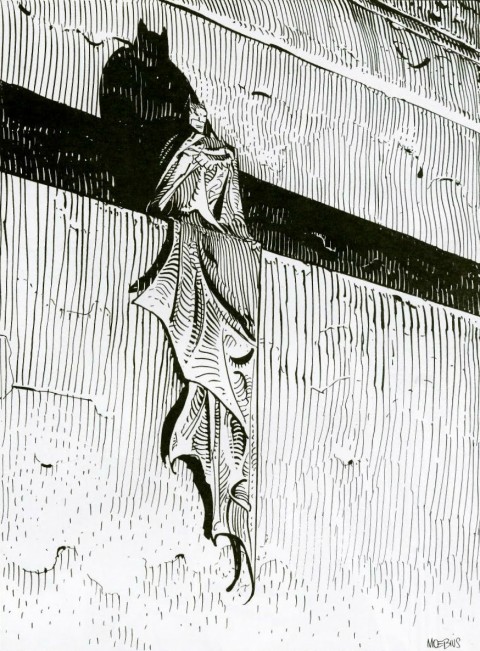
(I remember being very disappointed when I discovered that the drawing above was a standalone piece, and not a panel from a complete Batman story illustrated by Moebius. Heartbreak.)

Material Conversations — An interview with Jonathan Ive, Apple’s Senior Vice President of Industrial Design, in The Evening Standard:

What I love about the creative process, and this may sound naive, but it is this idea that one day there is no idea, and no solution, but then the next day there is an idea. I find that incredibly exciting and conceptually actually remarkable. The nature of having ideas and creativity is incredibly inspiring. There is an idea which is solitary, fragile and tentative and doesn’t have form. What we’ve found here is that it then becomes a conversation, although remains very fragile. When you see the most dramatic shift is when you transition from an abstract idea to a slightly more material conversation. But when you made a 3D model, however crude, you bring form to a nebulous idea, and everything changes – the entire process shifts. It galvanises and brings focus from a broad group of people. It’s a remarkable process.

And finally…

Boredom — Geoff Dyer, author Zona: A Book About a Film About a Journey to a Room, in conversation with Ethan Nosowsky at The Believer:

Boredom is often a side effect of something else. The apparent boredom inflicted by Stalker is actually the friction between the pace of the film and one’s expectations of how a film should proceed, so you just need to give yourself over to it. But then I think some so-called art films are irredeemably and inherently boring. As soon as I say that, though, I realize that the most boring films are the big, moronic action-blockbusters. They really bore the crap out of me. There’s an essential relationship between boring art films and moronic blockbusters because, as Ernst Fischer pointed out, any art form that glories in being understood only by a few—that worships at the altar of its own tedium, as it were—opens the floodgates for trash for the masses. At a certain point, as filmmakers got serious, they willingly took on a slowness that could easily become boring. But there was a long period before that when boredom was just inconceivable, not part of the equation.

Comments closed