Skip to content

Tag: lev grossman

Something for the Weekend

Commercial Indifference — Geoff Dyer’s Zona reviewed at the LA Review of Books:

[Dyer] followed a book of eccentric travel writing with a book on photography, and then in 2009 served up a couple of loosely-linked novellas under the, let’s face it, terrible title of Jeff In Venice, Death in Varanasi. Add in Dyer’s pre-2000 offerings on jazz, D.H. Lawrence, and World War I, along with several novels, and you have an oeuvre that resembles a messy and ever-expanding Venn diagram of the author’s obsessions. Even so, a 200-page book about a Russian film from 1979 takes commercial indifference to heroic lengths.

(And much as I love you and your recent redesign LARB, could we get simple RSS feed please?)

The Great Unwashed — Julia Kingsford, writing at The Bookseller, on the cultural snobbery and clichés surrounding Fifty Shades of Grey  (h/t Don Linn):

Surely they can’t be ‘real’ readers whose papery passions have traditionally been our bread and butter and who shop in ‘real’ bookshops? No, these must be a different sort of reader, new and not as good, ‘silly’ and to be only temporarily humoured and nervously served before we gladly see them off as they return to whatever form of entertainment they normally enjoy. Far from intellectual snobbery about readers being the preserve of the book trade, it runs rife through everyday media and culture, constantly perpetuating the view that books are for the few.

Medium-Rare — Author Lev Grossman (The Magician King) on almost being a rare book collector, at Time:

My specialty as a collector is books that almost have value. When I love a book, I don’t buy the first edition, because those have become incredibly expensive. But I might buy a beat-up copy of the second edition, third printing, which looks almost exactly the same as the first edition except that a couple of typos have been fixed. (In the rare book trade the little details that definitively identify a first edition are called “points.” My books are not strong on points.) It’s not glamorous, but it’s still satisfying, and it’s a hell of a lot cheaper.

And finally…

“New” — An archive interview with art director and pioneer of modern advertising Helmut Krone. There is so much good stuff in this… (via Coudal, naturally):

“New” is when you’ve never seen before what you’ve just put on a piece of paper. You haven’t seen it before and nobody else in the world has ever seen that thing that you’ve just put down on a piece of paper. And when a thing is new all you know about it is that it is brand new. It’s not related to anything that you’ve seen before in your life. And it’s very hard to judge the value of it. You distrust it, and everybody distrusts it. And very often it’s somebody else who has to tell you that that thing has merit, because you have no frame of reference, and you can’t relate it to anything that you or anybody else has ever done before.

(The going rate for Helmut Krone: The Book appears to be upwards of $80 on Abebooks. Time for a reprint?)

Comments closed

Something for the Weekend

Innovation Starvation— SF author Neal Stephenson at World Policy Journal on why the big stuff doesn’t get done:

SF has changed… from the 1950s (the era of the development of nuclear power, jet airplanes, the space race, and the computer) to now. Speaking broadly, the techno-optimism of the Golden Age of SF has given way to fiction written in a generally darker, more skeptical and ambiguous tone. I myself have tended to write a lot about hackers—trickster archetypes who exploit the arcane capabilities of complex systems devised by faceless others.

Believing we have all the technology we’ll ever need, we seek to draw attention to its destructive side effects. This seems foolish now that we find ourselves saddled with technologies like Japan’s ramshackle 1960’s-vintage reactors at Fukushima when we have the possibility of clean nuclear fusion on the horizon. The imperative to develop new technologies and implement them on a heroic scale no longer seems like the childish preoccupation of a few nerds with slide rules. It’s the only way for the human race to escape from its current predicaments. Too bad we’ve forgotten how to do it.

See also:  Stephenson’s new book REAMDE reviewed by The A.V. Club and the NY Times.

Stealing from Dr. Strange — Lev Grossman, author of The Magicians and The Magician King, talks to Graphic Novel Reporter about comics:

Watchmen (and, just as much, Miracleman) changed everything for me. [Alan] Moore attacked and undermined everything that was sacred about the superhero story, and in the process he wrote the greatest superhero story that had ever been written. I never forgot that. A lot of those lessons show up in The Magicians: When you question the basic assumptions of a genre, you make that genre stronger, not weaker.

Also, I steal a lot from Dr. Strange.

And on the subject of comics… Ruth Franklin reviews MetaMaus by Art Spiegelman for The New Republic:

This writer is not Elie Wiesel or Primo Levi, though his work, like theirs, is based in testimony. He is not Piotr Rawicz or H.G. Adler, though he shares their interest in viewing real events through a filter of surrealism. He is not Thomas Keneally, though his work has a quality of the “nonfiction novel” about it; nor is he W.G. Sebald, though his books, like Sebald’s, have been described as a mix of fiction, documentary, and memoir. He is Art Spiegelman, and he has done more than any other writer of the last few decades to change our understanding of the way stories about the Holocaust can be written.

Edges — Nicholas Carr, author of The Shallows, on what remains of books:

One of the essential characteristics of the printed book, as of the scribal codex that preceded it, is its edges. Those edges, as John Updike pointed out not long before he died, manifest themselves in the physical form of bound books – “some are rough-cut, some are smooth-cut, and a few, at least at my extravagant publishing house, are even top-stained” — but they are also there aesthetically and even metaphysically, giving each book integrity as a work in itself. That doesn’t mean that a book exists in isolation — its words, as written and as read, form rich connections with other books as well as with the worlds of nature and of men — but rather that a book offers a self-contained experience. The sense of self-containment is what makes a good book so satisfying to its readers, and the requirement of self-containment is what spurs the writer to the highest levels of literary achievement. The book must feel complete between its edges.

And finally…

In The Wall Street JournalLee Marshall looks for Fellini’s Rome:

Sometimes Fellini’s Rome and Felliniesque Rome live in close proximity. The apartment that Federico and Giulietta shared (Via Margutta, 110) is on a small, charming street where Truman Capote once lived and Puccini composed. There’s not much to see except a plaque on the building with caricatures of the pair and a commemorative poem in Roman dialect. But notice the number on the door of the palazzo: above the 110, it says “Già 113″—formerly 113—a very Felliniesque address.

Comments closed

Midweek Miscellany

A profile of calligrapher DeAnn Singh at The LA Times:

When the producers of “Mad Men” needed a note in cursive and a signature from Don Draper, they turned to Singh. “Something masculine and from the 1950s” was the request, though they eventually decided that the missive be typed…

Ask her about computers, and she’ll tell the story of Steve Jobs.

Before the founding of Apple and the development of the Macintosh, Jobs dropped out of Reed College and studied calligraphy with artist Lloyd Reynolds. If he hadn’t taken that class, he has said, personal computers might not have come with a variety of fonts.

Fantasy Modernism — Lev Grossman talks to the A.V. Club about The Magician King, the sequel to his 2009 novel The Magicians:

I have this theory about modernism and fantasy, which I’ll do in 30 seconds.

They came into being at the same time, which is very interesting. They were both reactions to the disasters of World War I and the electrification of cities, and urbanization, and the rise of the automobile, the end of that twilight world of the Victorians. They both are reactions to that in different ways. Modernism went very inside and delved into the interior lives of people. Fantasy externalized all that in these fantastical, magical, metaphorical landscapes. I thought, “Well, what if you did both the inside and the outside at once?” I tried to combine those foci of fantasy and modernism into one kind of writing. It sounds like I’m writing a dissertation on my own work, but, you know, you end up thinking about what you’re doing. That’s the kind of thing I thought.

See also: Alexander Chee reviews the book for NPR.

Prussian Pedantry — Susie Harries’ new biography of scholar Nikolaus Pevsner, best known for his 46-volume series The Buildings of England, reviewed by George Walden for The Observer:

For us at least the conflict of national intellectual styles he represented was hugely beneficial. The irony of a “Prussian pedant” lecturing the English on Englishness, for which he was mocked, resolves itself in the fact that, together with Gombrich in art history and Weidenfeld in publishing, Pevsner was one of a golden generation of German/Austrian Jewish refugees who did much to give their adopted country the bottom it prided itself on already possessing.

And for those of you not interested in a county-by-county guide to the wonders of English architecture (what’s wrong with you?), Pevsner also wrote the seminal Pioneers of Modern Design: From William Morris to Walter Gropius. First published in 1936, a revised and expanded edition will be available (in the UK at least) in September.

And finally…

Everyone is an AuteurGuardian correspondent Fiachra Gibbons meets Jean-Luc Godard:

“I am not an auteur, well, not now anyway,” he says as casually, as if it was like giving up smoking. “We once believed we were auteurs but we weren’t. We had no idea, really. Film is over. It’s sad nobody is really exploring it. But what to do? And anyway, with mobile phones and everything, everyone is now an auteur.”

Oh Jean-Luc…

Comments closed

Midweek Miscellany

Comic Unease — Cartoonist Emily Carroll talks about comics, fairy tales, dreams, and her story His Face All Red with The Comics Journal:

I think a lot of fairy tales have that sort of unease built into them, just because they introduce so many elements that they never explain, and use fairy tale logic—the kind that isn’t really logic at all, but has that matter-of-fact feel to it anyway—and the reader just has to roll with it.

Dark Matter — Author Lev Grossman on fan fiction for Time Magazine:

Fan fiction is what literature might look like if it were reinvented from scratch after a nuclear apocalypse by a band of brilliant pop-culture junkies trapped in a sealed bunker. They don’t do it for money. That’s not what it’s about. The writers write it and put it up online just for the satisfaction. They’re fans, but they’re not silent, couchbound consumers of media. The culture talks to them, and they talk back to the culture in its own language. Right now fan fiction is still the cultural equivalent of dark matter: it’s largely invisible to the mainstream, but at the same time, it’s unbelievably massive.

Grossman’s new novel The Magician King (the sequel to his 2009 novel The Magicians) is published next month.

Dysfunctional Spies — Author John Le Carré reflects on his time in MI6:

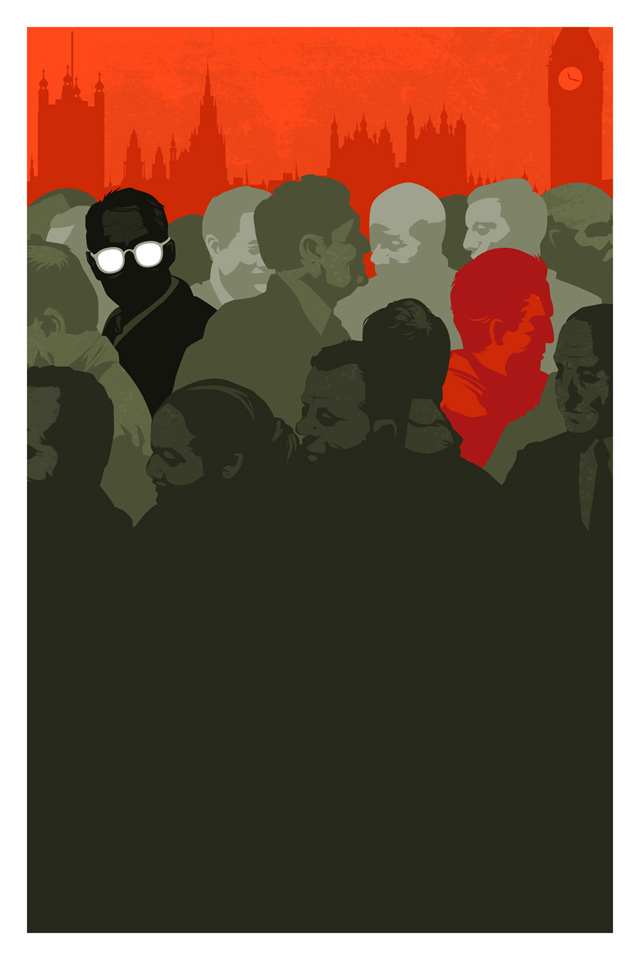
The creation of George Smiley, the retired spy recalled to hunt for… a high-ranking mole in Tinker, Tailor, was extremely personal. I borrowed elements of people I admired and invested them in this mythical character. I’m such a fluent, specious person now, but I was an extremely awkward fellow in those days. I also gave Smiley my social ineptitude, my lack of self-respect and my fumblings in love.

Because I came from a dysfunctional background, I made home the most dangerous place for Smiley. Home is where he lets himself in cautiously. Home is where he sees the shadow of his adulterous wife in the window and wonders who she’s with.

Pictured above is Matt Taylor’s incredible illustration for a new Penguin US edition of Le Carré’s novel Tinker, Tailor, Soldier, Spy — more of that wonderful stuff to come — and a new film adaptation of the book, starring Gary Oldman as Smiley, is being released later this year:

Comments closed

Grossman on Franzen Redux

Literary editor Lev Grossman (author of The Magicians) discusses why Time put Jonathan Franzen on the front cover the magazine of with Ramona Koval on ABC Radio National’s The Book Show:

ABC RADIO NATIONAL THE BOOK SHOW: LEV GROSSMAN

Comments closed

Midweek Miscellany

Chris Ware’s cover for the latest issue of The New Yorker (via The Ephemerist).

Pop Will Eat Itself — Author Lev Grossman (The Magicians) on automated recommendations:

[Recommendation engines] introduce us to new things, which is good, but those new things tend to be a lot like the old things, and they tend to be drawn from the shallow pool of things other people have already liked. As a result, they create a blockbuster culture in which the same few runaway hits get recommended over and over again. It’s the backlash against the “long tail,” the idea that shopping online is all about near infinite selection and cultural diversity. It has a bad habit of eating its own tail and leaving you back where you started.

The Dark Underside of American LifeThe Observer‘s film critic Philip French on the late Jim Thompson and Michael Winterbottom‘s film adaptation of The Killer Inside Me:

Thompson was a man of the left, a lifelong alcoholic and became closely acquainted with the dark underside of American life, the lonely crowd where petty criminals, low-level cops, conmen and prostitutes rub shoulders… One of Thompson’s critics has called him without disparagement “a dime novel Dostoevsky”…

And finally… Popville, a super stylish pop-up book by Anouck Boisrobert and Louis Rigaud, published by Macmillan (thanks Sio!):

5 Comments