Skip to content

Tag: kafka

The Many Ways a Book Cover is Rejected

Is That Kafka design Erik Carter

In an excellent post for The Literary Hub, designer Erik Carter writes about designing the cover of Reiner Stach’s Is That Kafka? 99 Finds for New Directions, and the process of getting a book cover approved:

The actual process of designing a book jacket is more than just reading the book and making a beautiful image with your favorite font and slapping it on the front. A good cover should represent the spirit of the book and celebrate what makes that book unique. So then why do so many covers fall for the same visual clichés as so many other covers? Go on down to your local online book dealer and you’ll see bargain bin stock photos adorned with tiny endorsements about how this book is so, so much better than other one you’re about to click on. In order to get a book cover approved you have to get the sign off from the art director that you’re working for, the marketing department, the author, the editors, sometimes even the author’s spouse, their milkman, or their next door neighbor. It’s a nimble game of politics that you have to play to get the vision that you have for a cover into the bookstore. And it’s a game where design is often the loser. The publisher wants the book to sell, the designer wants the book to look good, and the author wants the cover to match their vision of what the cover of their book should be. And almost always, these three are at odds. There is a lack of definition for “what looks good” and a shaky science as to “what will sell” and authors are so close to their books it can be difficult to find out what it is that they actually want. The language of aesthetics and the aesthetics of language need to trust each other. It’s important for designers to be more acclimated with what it is that a publisher is looking for as to what will sell. Compromising that business by stretching your typefaces to the point of unreadability may not do you any favors. Ultimately it’s the author’s book, and they know it far better than you do, so really it’s their opinion that matters the most, even if they are not familiar with the fundamentals of good design.
Comments closed

Being Mr. K

family

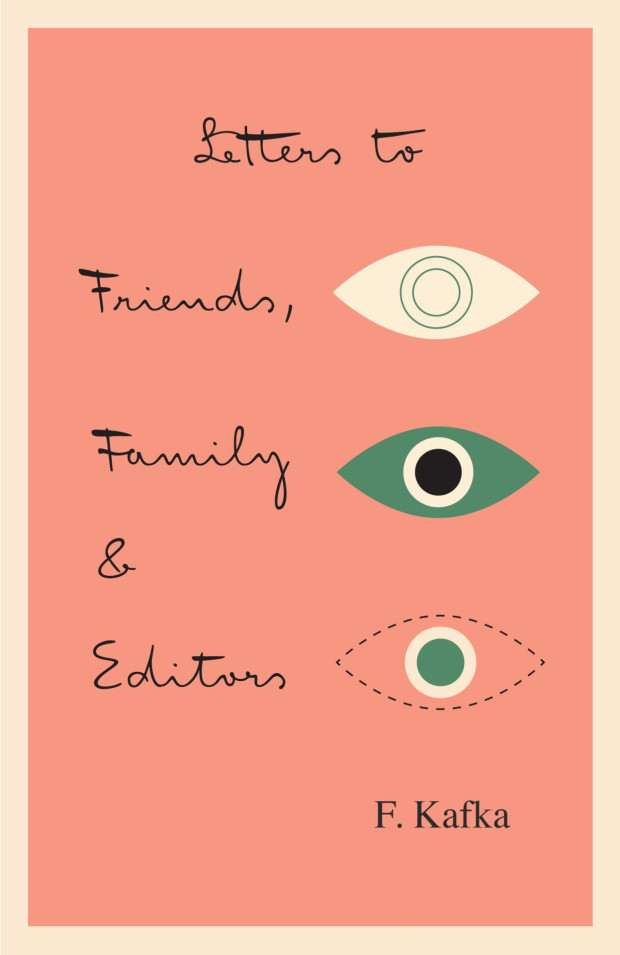
In latest Creative Characters newsletter from MyFonts, designer Julia Sysmäläinen talks about designing FF Mister K, the typeface based on Franz Kafka’s handwriting used by Peter Mendelsund for his redesign of Schocken’s Kafka covers:

Originality, authenticity, and honesty are crucial qualities to me. I think Mr. K has all of that, just like Franz Kafka’s manuscripts do. While I was working on it, I realized that while Mister K is a font, it is also the visualization of a personality. The font is not pretty, or beautiful in the classic sense — and it doesn’t want to be.

It’s a bit like Kafka’s work. There is no beauty in it as such, but rather a confrontation with reality that goes so far as to be repellent. There are all kinds of attributes — stupidity, cunning, weakness, strength, bitterness, humor, lightness, etc. The authenticity of this confrontation is visually reflected in the manuscripts — and also in Mister K Regular, the style in the font family that is most similar to the original Kafka manuscripts.

Whoever wishes to use the typeface must be willing to embrace this ambiguity. Mister K is not particularly suitable for lending a consumer-friendly smoothness to some brand; but there are corporate identities to which it fits very well. I was pleased to see it used by the Norwegian band Flunk, for Stokke highchairs, and for wellness products by Dresdner Essenz; and, of all things, in the logo of an upmarket design hotel in Berlin, Das Stue. What I found even more astounding was its appearance at the international insurance company Watson Towers (an ironic coincidence, as Kafka himself was an employee at an insurance company). But somehow it made sense: “The organic, hand-drawn nature of the logo and graphic system creates a personal and distinctive look amidst the impersonal, corporate, language of its competitors…” — that’s how Interbrand, the design agency, described the project. In its semi-perfection the typeface simply oozes a kind of honesty. That’s its strength, and brings it closer to a lot of people.

Comments closed

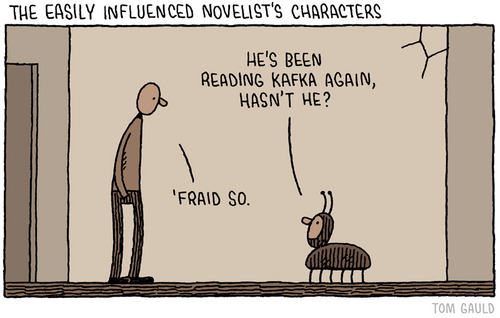
Easily Influenced

easily-influencedI’ve posted Tom Gauld‘s cartoons for The Guardian pretty regularly here for the past few years (and you can read my 2011 Q & A with him here), but he’s really been on great form of late. If you still haven’t checked out his collection of cartoons, You’re All Just Jealous of My Jetpack, I highly recommend you do.

Comments closed

St Franz of Prague


At the Financial Times, Ian Thomson, author of Primo Levi: A Life, reviews three new books about Franz Kafka:

In 1982, the Italian writer and Nazi concentration camp survivor Primo Levi embarked on a translation of Franz Kafka’s The Trial. At first he was enthusiastic, hoping to improve the German he had learnt so imperfectly at Auschwitz. Instead, Kafka involved him more terribly than he could have imagined. Levi found only bleakness in the hero Josef K, who is arrested and executed for a crime he probably did not commit.

The more Levi became immersed in Kafka, the more he began to see his own life mirrored in that of “St Franz of Prague”, as he called the Czech writer. Born in Prague in 1883 into a German-speaking Jewish family, Kafka lived a life of quite exemplary tedium as an insurance clerk, rarely travelling beyond his home or that of his parents. Levi saw similar constrictions in his own life as an assimilated Jew in bourgeois Turin. Moreover, Kafka’s three sisters had all perished in the Nazi gas chambers – victims of the grotesque bureaucracy foretold by their brother two decades earlier in The Trial. Kafka must have had a seer-like sensibility, Levi thought, to have looked so accurately into the future.

Pictured above: David Zane Mairowitz’s graphic novel adaptation of The Castle illustrated by Jaromír99, published by SelfMadeHero.

Comments closed

Franz Kafka – 130th Birthday

Now this is truly wonderful: Designer Pablo Delcán has created an animation to celebrate Kafka’s 130th birthday based on Peter Mendelsund’s cover designs for Schocken Books:

Schocken have just re-released five of Franz Kafka’s letters as eBooks with new covers by Peter, and, if that wasn’t enough, Peter has written a short post about Kafka and Russian composer Dmitri Shostakovich — whose music accompanies the video — on his blog Jacket Mechanical.

Comments closed

Something for the Weekend

Luc Sante, author of Low Life: Lures and Snares of Old New York, has posted an amazing selection of vintage French photographic noir book covers at John Gall’s blog Spine Out.

On the Defensive — Sam Lipsyte, author of The Ask, on teaching creative writing in The Financial Times:

When you teach creative writing, you are already on the defensive. People love to poke you in the chest and cry, “But you can’t teach writing!” This is precisely what I think about automobile driving but I let them rant while I rub the sore part where they poked me. I don’t know why people get so worked up about this subject. Nobody has asked them to teach creative writing or even to learn it. Apprenticeship, the sharing of history and technique, has always been a central feature of art-making. Yet people cling to a romantic idea of the self-made genius toiling away in a garret or napping undisturbed in a sleep module.

Books on Wheels — A really lovely article about bookmobiles from the Smithsonian Magazine:

Bookmobiles, the man said, had been a fundamental inspiration while growing up in rural Mississippi in the mid-1960s. The public library had been closed to blacks—but the bookmobile stopped right on his street, a portal into the world of literature.

The gentleman was W. Ralph Eubanks: today an acclaimed author, and Director of Publishing for the Library of Congress… “The librarians did not care that I was barefoot, and wearing a pair of raggedy shorts. All they cared about was that I wanted to read—and to help me find something I would enjoy reading.”

Eubanks’ story is just one example of the pivotal role bookmobiles have played in literary culture, and individual lives, for more than 150 years.

Strides at The Strand — Nancy Bass Wyden, co-owner of The Strand bookstore in New York, interviewed in The Daily Beast:

We have taken strides to grow with our customers and listen to their needs. When customers started requesting New York Times bestsellers, we started carrying new books and featuring them on tables in the front of the store; when customers started talking about the Internet, we got online; when Amazon and B&N.com became “competitors,” we partnered with them.

And finally…

The Trial — Judith Butler in the LRB on the implications of the ongoing and complex legal battle in Tel Aviv over several boxes of Kafka’s original writings:

Had the works been destroyed, perhaps the ghosts would not be fed – though Kafka could not have anticipated how limitlessly parasitic the forces of nationalism and profit would be, even as he knew those spectral forces were waiting.

Comments closed

Peter Mendelsund and the Art of Metamorphosis

I posted about Peter Mendelsund’s reinterpretations of Kafka for Schocken Books rather breathlessly earlier this week, and I wanted to revisit them now I’ve had some time for greater reflection.

The covers are exceptional designs and surprising reinterpretations of Kafka. What particularly interested me, however, is that they are also a surprising direction for Mendelsund to go in.

As Peter himself notes in his original post, the natural impulse when designing Kafka is to draw on the avant-garde art movements of the early 20th Century. These movements — which smashed together fine art, design, typography, photography, montage, and film — burgeoned in Central and Eastern Europe in aftermath of the Russian Revolution and the First World War, a period when Kafka himself was writing (he died in Vienna in 1924).

Unsurprisingly, recent reinterpretations of Kafka (at least the ones that have eschewed the non-design of an author photograph) have incorporated elements taken from Surrealist photography, modernist posters, and silent film.

The influence of the avant-garde is often apparent in Mendelsund’s work. Covers such as The Idiot, Crime and Punishment and The Double and The Gambler by Fydor Dostoevsky, House of Meetings by Martin Amis, and K. by Roberto Calasso all incorporate elements of Suprematism, Constructivism, DADA and other stark European art movements of the early 20th Century. The new covers, however, which focus on the humour in Kafka’s writing, move in a new direction and incorporate elements from the optimistic age of American mid-century modern design.

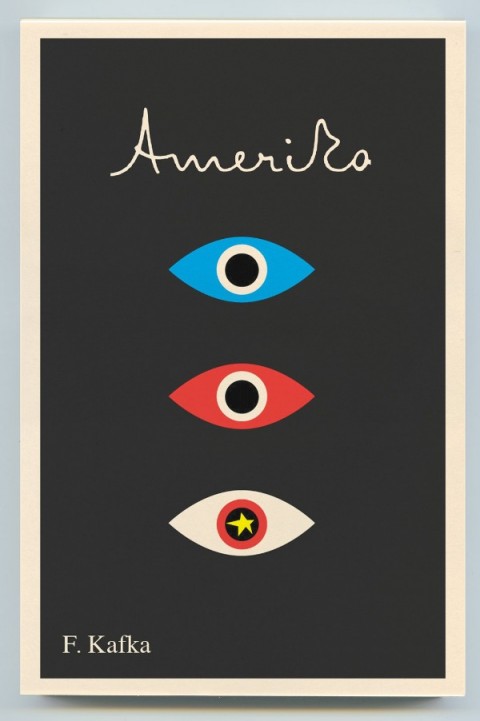
Mendelsund’s use simple geometric shapes, flat colour backgrounds, and stripe patterns are typical of work by Paul Rand and Alvin Lustig.

Hand-written lettering of the type we see in Mendelsund’s Kafkas is used to great effect in Lustig’s design for Kafka’s Amerika and is characteristic of several of Rand’s book covers.

As others have noted, the eye motif used by Mendelsund is also similar to Rand’s iconic IBM poster (and his unused logo for the AIGA). But in this instance at least, Rand is clearly not the only influence. His contemporary Rudolph de Harak used the same motif in his cover design for T.E. Lawrence By His Friends published by McGraw-Hill in 1963.

There are echoes too of an exhibition poster by American expatriate designer E. McKnight Kauffer who designed the cover for the Random House edition of James Joyce’s Ulysses published in 1949 (and who was reputedly an influence on Lustig), and a George Salter cover for a Robert Bloch novel, The Scarf, published by The Dial Press in 1947.

The eye motif also recalls Bill Golden’s CBS logo designed in 1951 (repeated in the British Associated Televison ATC logo), which was itself inspired by a Shaker ‘All Seeing Eye’ symbol Golden had seen. And it is perhaps no coincidence that Mendelsund’s design for The Castle (and McKnight Kauffer’s poster) is reminiscent of the masonic Eye of Providence (also known as the “all-seeing eye of God”) familiar from the US one dollar bill.

Of course, not all of these elements and influences are new to Mendelsund’s work (see his designs for The Millennium Trilogy boxed set), and the new covers draw on some of his more familiar inspirations such as Jean Arp, a founding member of the DADA movement (and likely an influence on Lustig), and post-war European design (see Germano Facetti’s design for George Orwell’s 1984 designed in the early 1960’s).

But compare the Kafka covers to Mendelsund’s recent designs for The Snowman by Jo Nesbø  or C by Tom McCarthy, and the difference is striking. To look at these macabre designs for Knopf — which seem to owe more to the cut-and-paste of DADA, the punk aesthetic of Barney Bubbles or, perhaps, the anti-design of David Carson’s Ray Gun —  is like looking at the work of a wholly different designer.

That Mendelsund is capable of reinterpreting and subverting mid-century modern and making it his own not only demonstrates his creative flexibility, but serves to reminds us that one of his greatest strengths as a designer is his ability to surprise and delight us.

8 Comments

Mendelsund vs. Kafka

Amerika | Peter Mendelsund

Peter Mendelsund on his remarkable (and unexpectedly Paul Rand-like) Kafka redesigns for Knopf imprint Schocken:

After all, what is it that makes Kafka, Kafka? The economy; the dark humor; the teasing inscrutability; the brilliance of the thought-experiments; the hieratic and esoteric flavor of the constructions; the disorienting cadence of the prose; the impeccable, internal, magical logic that drives the mechanical toy theaters of his work; the much discussed Jewishness (as if this was easy to parse); the “concrete abstractions” (in the words of Zadie Smith)…. I suppose what some find most relevant and compelling in Kafka is his ability to inspire in them that paradoxical feeling that great literature always aspires to arouse in readers—the feeling of the universality of their own alienation. Kafka is the ne plus ultra of alienation– alienation being arguably the defining emotional condition of the 20th century.

There is more at Peter’s blog JACKET MECHANICAL.

4 Comments